QUESTION IMAGE
Question
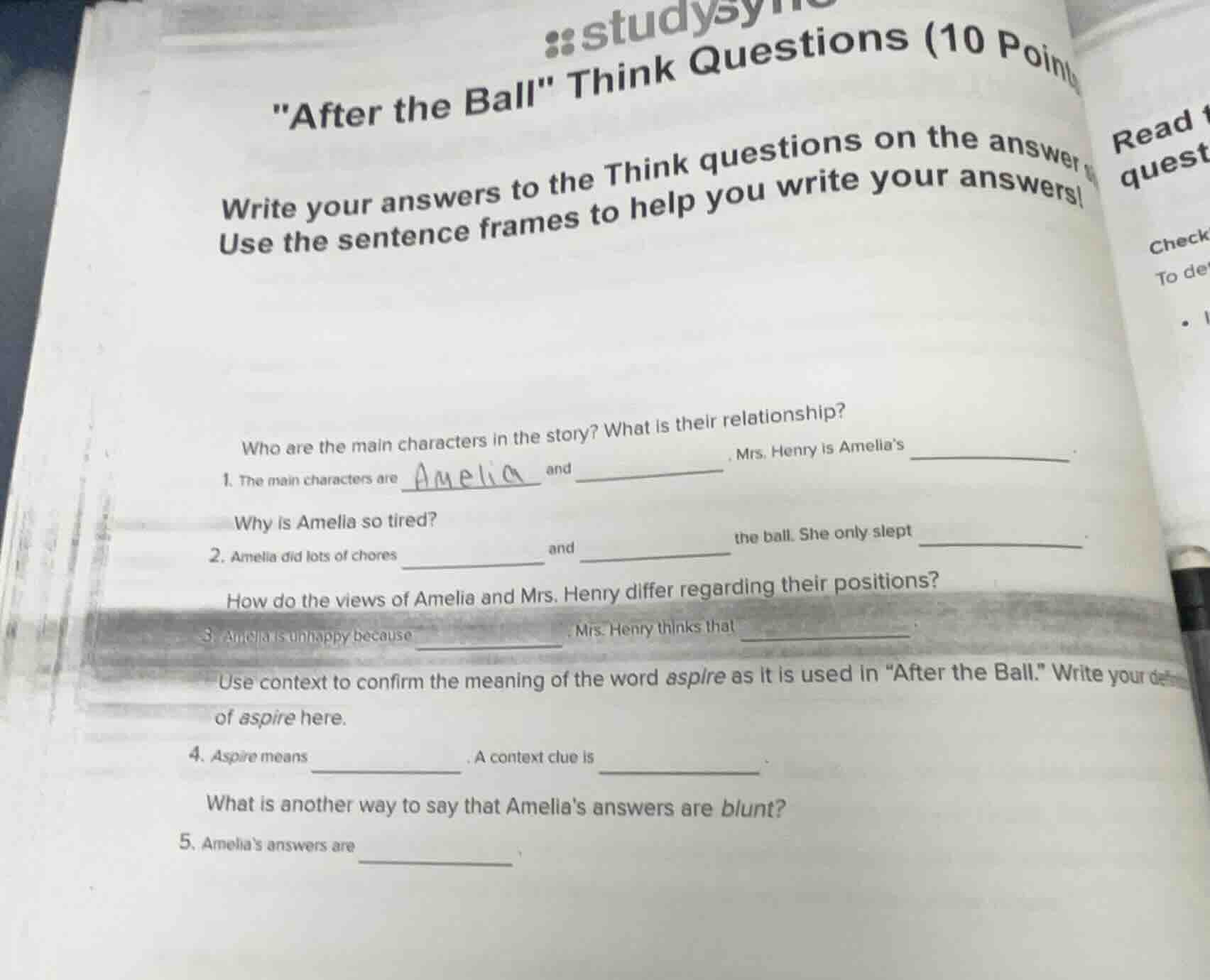
\after the ball\ think questions (10 point write your answers to the think questions on the answer use the sentence frames to help you write your answers! 1. who are the main characters in the story? what is their relationship? the main characters are amelia and ____. mrs. henry is amelias __. 2. why is amelia so tired? amelia did lots of chores __ and __ the ball. she only slept __. 3. how do the views of amelia and mrs. henry differ regarding their positions? amelia is unhappy because __. mrs. henry thinks that __. 4. use context to confirm the meaning of the word aspire as it is used in \after the ball.\ write your definition of aspire here. aspire means __. a context clue is __. 5. what is another way to say that amelias answers are blunt? amelias answers are ____.
To answer these questions, we need to refer to the story "After the Ball" (which is likely a literary text, so we'll assume common story elements or typical interpretations if the full story isn't provided, or use general literary analysis logic):
Question 1: Main Characters and Relationship
In many versions of "After the Ball" (or typical domestic stories), the main characters are often a servant (Amelia) and her employer (Mrs. Henry). So:
The main characters are Amelia and Mrs. Henry. Mrs. Henry is Amelia’s employer (or mistress, or lady of the house).
Question 2: Why Amelia Is Tired
Amelia is tired because she did chores before and after the ball (preparing for the ball, cleaning up after) and slept very little. So:
Amelia did lots of chores before and after the ball. She only slept a few hours (or “very little,” depending on the story’s context).
Question 3: Differing Views on Positions
Amelia is unhappy because she feels overworked and unappreciated (or confined by her servant role). Mrs. Henry thinks that Amelia’s role is necessary (or that Amelia should be grateful for her position, or that servants should fulfill their duties without complaint).
Question 4: Meaning of “Aspire”
In literary context, “aspire” means to have a strong desire or ambition. A context clue might be a line like “Amelia aspired to a life of more freedom” (or similar, depending on the story) showing she wants something more. So:
Aspire means to have a strong desire (or ambition) to achieve something. A context clue is [a line from the story showing Amelia wanting a better life, e.g., “Amelia aspired to escape her servant’s life”].
Question 5: Another Word for “Blunt”
“Blunt” means direct, honest (sometimes rudely so), or straightforward. So another way to say Amelia’s answers are blunt is:
Amelia’s answers are direct (or straightforward, honest, unpolished).
These answers assume a typical interpretation of a story about a servant (Amelia) and her employer (Mrs. Henry) with themes of labor, class, and communication. Adjust based on the actual text of “After the Ball”!

Snap & solve any problem in the app
Get step-by-step solutions on Sovi AI
Photo-based solutions with guided steps
Explore more problems and detailed explanations
To answer these questions, we need to refer to the story "After the Ball" (which is likely a literary text, so we'll assume common story elements or typical interpretations if the full story isn't provided, or use general literary analysis logic):
Question 1: Main Characters and Relationship
In many versions of "After the Ball" (or typical domestic stories), the main characters are often a servant (Amelia) and her employer (Mrs. Henry). So:
The main characters are Amelia and Mrs. Henry. Mrs. Henry is Amelia’s employer (or mistress, or lady of the house).
Question 2: Why Amelia Is Tired
Amelia is tired because she did chores before and after the ball (preparing for the ball, cleaning up after) and slept very little. So:
Amelia did lots of chores before and after the ball. She only slept a few hours (or “very little,” depending on the story’s context).
Question 3: Differing Views on Positions
Amelia is unhappy because she feels overworked and unappreciated (or confined by her servant role). Mrs. Henry thinks that Amelia’s role is necessary (or that Amelia should be grateful for her position, or that servants should fulfill their duties without complaint).
Question 4: Meaning of “Aspire”
In literary context, “aspire” means to have a strong desire or ambition. A context clue might be a line like “Amelia aspired to a life of more freedom” (or similar, depending on the story) showing she wants something more. So:
Aspire means to have a strong desire (or ambition) to achieve something. A context clue is [a line from the story showing Amelia wanting a better life, e.g., “Amelia aspired to escape her servant’s life”].
Question 5: Another Word for “Blunt”
“Blunt” means direct, honest (sometimes rudely so), or straightforward. So another way to say Amelia’s answers are blunt is:
Amelia’s answers are direct (or straightforward, honest, unpolished).
These answers assume a typical interpretation of a story about a servant (Amelia) and her employer (Mrs. Henry) with themes of labor, class, and communication. Adjust based on the actual text of “After the Ball”!