QUESTION IMAGE
Question
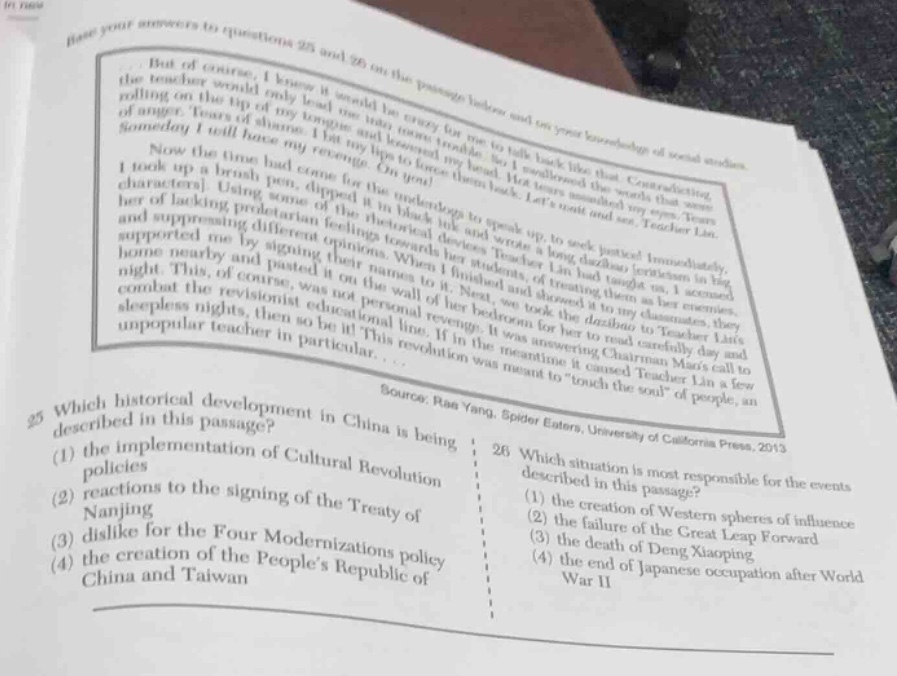
base your answers to questions 25 and 26 on the passage below and on your knowledge of social studies. but of course, i knew it would be crazy for me to talk back like that. contradicting the teacher would only lead me into more trouble, so i swallowed the words that were rolling on the tip of my tongue and forced them back. hot tears welled up, tears of anger, tears of shame. i bit my lip to keep from sobbing. lets not talk and see, teacher lin. someday i will have my revenge. on you! now the time had come for me to speak up, to seek justice! immediately i took up a brush pen, dipped it in black ink and wrote a long, dazzling inscription in big characters! using some of the textbooks devoted to teacher lin, i accused her of lacking proletarian feelings toward her students, of treating them as ta, i scorned and suppressing different opinions. when i finished and showed it to my classmates, they supported me by signing their names to it. next, we took the drafting carefully day and night, nearby and pasted it on the wall of her bedroom. it was for her to read chairman maos call to combat the revisionist educational line. if in the meantime it caused teacher lin a few sleepless nights, then so be it! this revolution was meant to \touch the soul\ of people, an unpopular teacher in particular.... source: rae yang, spider eaters, university of california press, 2013 25 which historical development in china is being described in this passage? (1) the implementation of cultural revolution policies (2) reactions to the signing of the treaty of nanjing (3) dislike for the four modernizations policy (4) the creation of the peoples republic of china and taiwan 26 which situation is most responsible for the events described in this passage? (1) the creation of western spheres of influence (2) the failure of the great leap forward (3) the death of deng xiaoping (4) the end of japanese occupation after world war ii
Question 25
To solve this, we analyze each option:
- Option (1): The passage describes actions against a teacher, which aligns with the Cultural Revolution's focus on criticizing "unpopular" figures and ideological struggles. The Cultural Revolution involved such student - led actions against perceived "enemies" of the revolution, including teachers.
- Option (2): The Treaty of Nanjing was related to the Opium War and foreign influence, and the passage has no elements related to reactions to this treaty.
- Option (3): The Four Modernizations were about economic and technological development, and the passage's content (student actions against a teacher) has nothing to do with disliking this policy.
- Option (4): The creation of the People's Republic of China was about establishing a new government, and the passage's events (student actions against a teacher) are not related to this event.
We analyze each option:
- Option (1): The creation of Western spheres of influence was related to foreign control in China, and the passage's events (student actions against a teacher) are not related to this.
- Option (2): The Great Leap Forward led to economic failure and social unrest, which contributed to the environment where the Cultural Revolution (and the actions described in the passage) took place. The failure of the Great Leap Forward created a situation of discontent and the need for ideological and social upheaval, which is consistent with the actions against the teacher.
- Option (3): Deng Xiaoping's death was much later and not related to the events in the passage (which are related to the Cultural Revolution era).
- Option (4): The end of Japanese occupation was after WWII, and the passage's events are related to the Cultural Revolution, not to the aftermath of Japanese occupation.

Snap & solve any problem in the app
Get step-by-step solutions on Sovi AI
Photo-based solutions with guided steps
Explore more problems and detailed explanations
(1) the implementation of Cultural Revolution