QUESTION IMAGE
Question
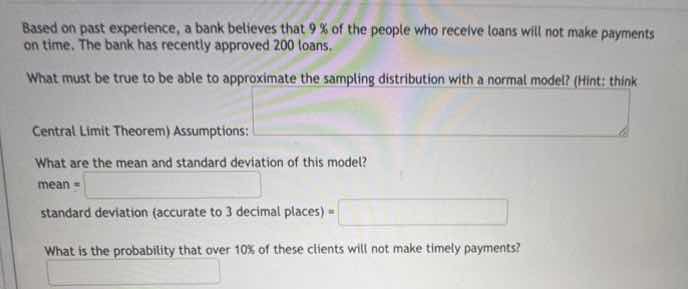
based on past experience, a bank believes that 9 % of the people who receive loans will not make payments on time. the bank has recently approved 200 loans.
what must be true to be able to approximate the sampling distribution with a normal model? (hint: think central limit theorem) assumptions:
what are the mean and standard deviation of this model?
mean =
standard deviation (accurate to 3 decimal places) =
what is the probability that over 10% of these clients will not make timely payments?
Step1: Check normality conditions
We need $np \geq 10$ and $n(1-p) \geq 10$:
$np = 200 \times 0.09 = 18$
$n(1-p) = 200 \times 0.91 = 182$
Both values are ≥10, so normal approximation is valid.
Step2: Calculate the mean
Mean of sampling distribution:
$\mu_{\hat{p}} = p = 0.09$
Step3: Calculate standard deviation
Standard deviation of sampling distribution:
$$\sigma_{\hat{p}} = \sqrt{\frac{p(1-p)}{n}} = \sqrt{\frac{0.09 \times 0.91}{200}}$$
$$= \sqrt{\frac{0.0819}{200}} = \sqrt{0.0004095} \approx 0.020$$
Step4: Find z-score for 10%
Calculate z-score for $\hat{p}=0.10$:
$$z = \frac{\hat{p} - \mu_{\hat{p}}}{\sigma_{\hat{p}}} = \frac{0.10 - 0.09}{0.020} = 0.5$$
Step5: Find probability
We want $P(\hat{p} > 0.10) = P(z > 0.5)$. From z-table, $P(z \leq 0.5) = 0.6915$, so:
$P(z > 0.5) = 1 - 0.6915 = 0.3085$

Snap & solve any problem in the app
Get step-by-step solutions on Sovi AI
Photo-based solutions with guided steps
Explore more problems and detailed explanations
To use a normal model: $np \geq 10$ and $n(1-p) \geq 10$ (both are satisfied here, 18 and 182 respectively)
mean = 0.09
standard deviation (accurate to 3 decimal places) = 0.020
Probability over 10% will not make timely payments: 0.309 (rounded to 3 decimal places)