QUESTION IMAGE
Question
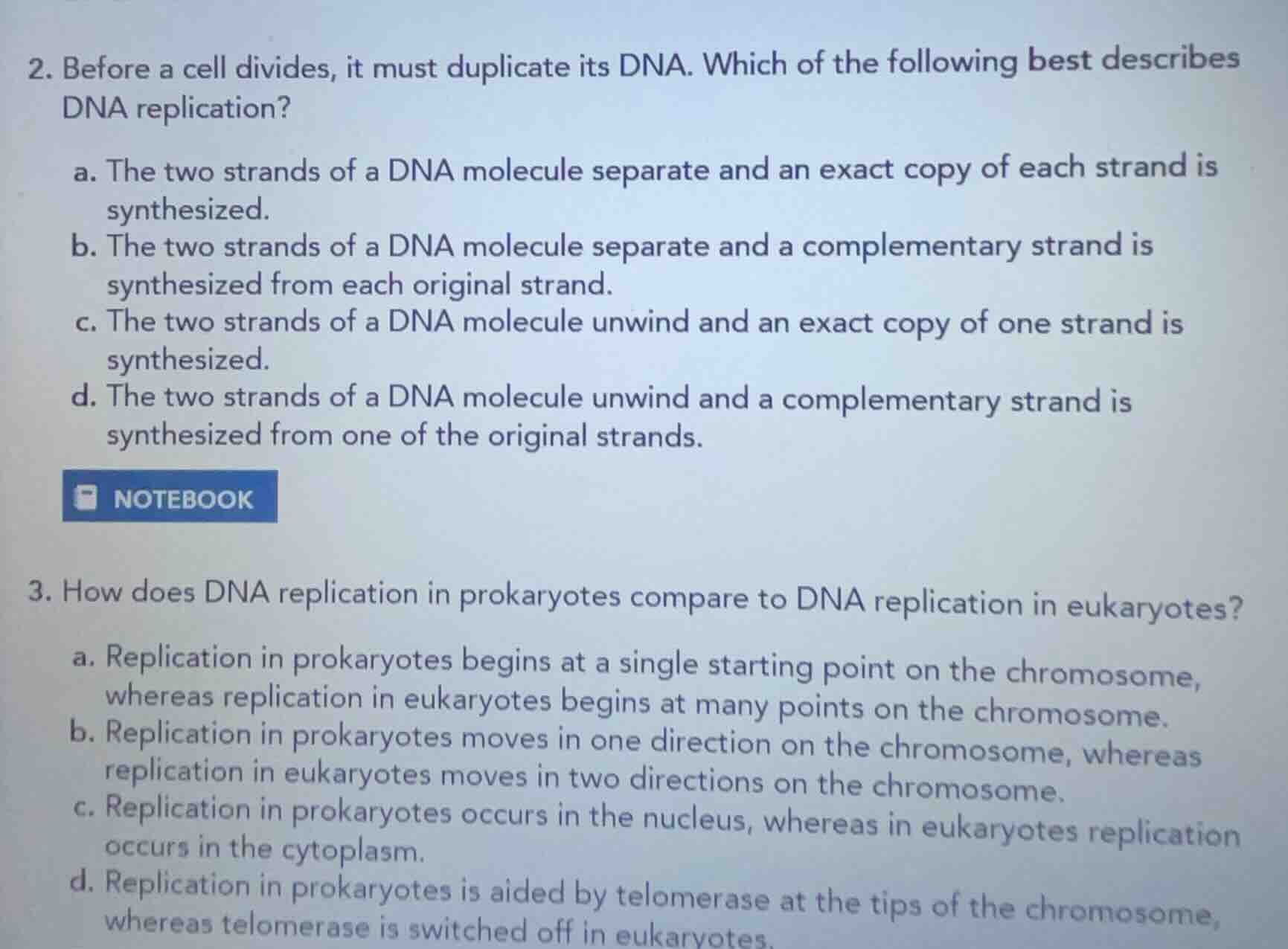
- before a cell divides, it must duplicate its dna. which of the following best describes dna replication?
a. the two strands of a dna molecule separate and an exact copy of each strand is synthesized.
b. the two strands of a dna molecule separate and a complementary strand is synthesized from each original strand.
c. the two strands of a dna molecule unwind and an exact copy of one strand is synthesized.
d. the two strands of a dna molecule unwind and a complementary strand is synthesized from one of the original strands.
- how does dna replication in prokaryotes compare to dna replication in eukaryotes?
a. replication in prokaryotes begins at a single starting point on the chromosome, whereas replication in eukaryotes begins at many points on the chromosome.
b. replication in prokaryotes moves in one direction on the chromosome, whereas replication in eukaryotes moves in two directions on the chromosome.
c. replication in prokaryotes occurs in the nucleus, whereas in eukaryotes replication occurs in the cytoplasm.
d. replication in prokaryotes is aided by telomerase at the tips of the chromosome, whereas telomerase is switched off in eukaryotes.
For Question 2:
DNA replication is semi-conservative. The double helix unwinds, and each original strand acts as a template for a new complementary strand (A-T, G-C base pairing), not an exact copy of the template strand. Both original strands are used as templates.
For Question 3:
Prokaryotes have a single circular chromosome with one origin of replication, while eukaryotes have linear chromosomes with multiple origins to speed up replication. Prokaryotic replication is bidirectional, occurs in the cytoplasm, and lacks telomeres; eukaryotic replication is bidirectional, occurs in the nucleus, and uses telomerase.

Snap & solve any problem in the app
Get step-by-step solutions on Sovi AI
Photo-based solutions with guided steps
Explore more problems and detailed explanations
- b. The two strands of a DNA molecule separate and a complementary strand is synthesized from each original strand.
- a. Replication in prokaryotes begins at a single starting point on the chromosome, whereas replication in eukaryotes begins at many points on the chromosome.