QUESTION IMAGE
Question
benchmark assessment sc.7.l.15.2
fill in the letter of the best choice.
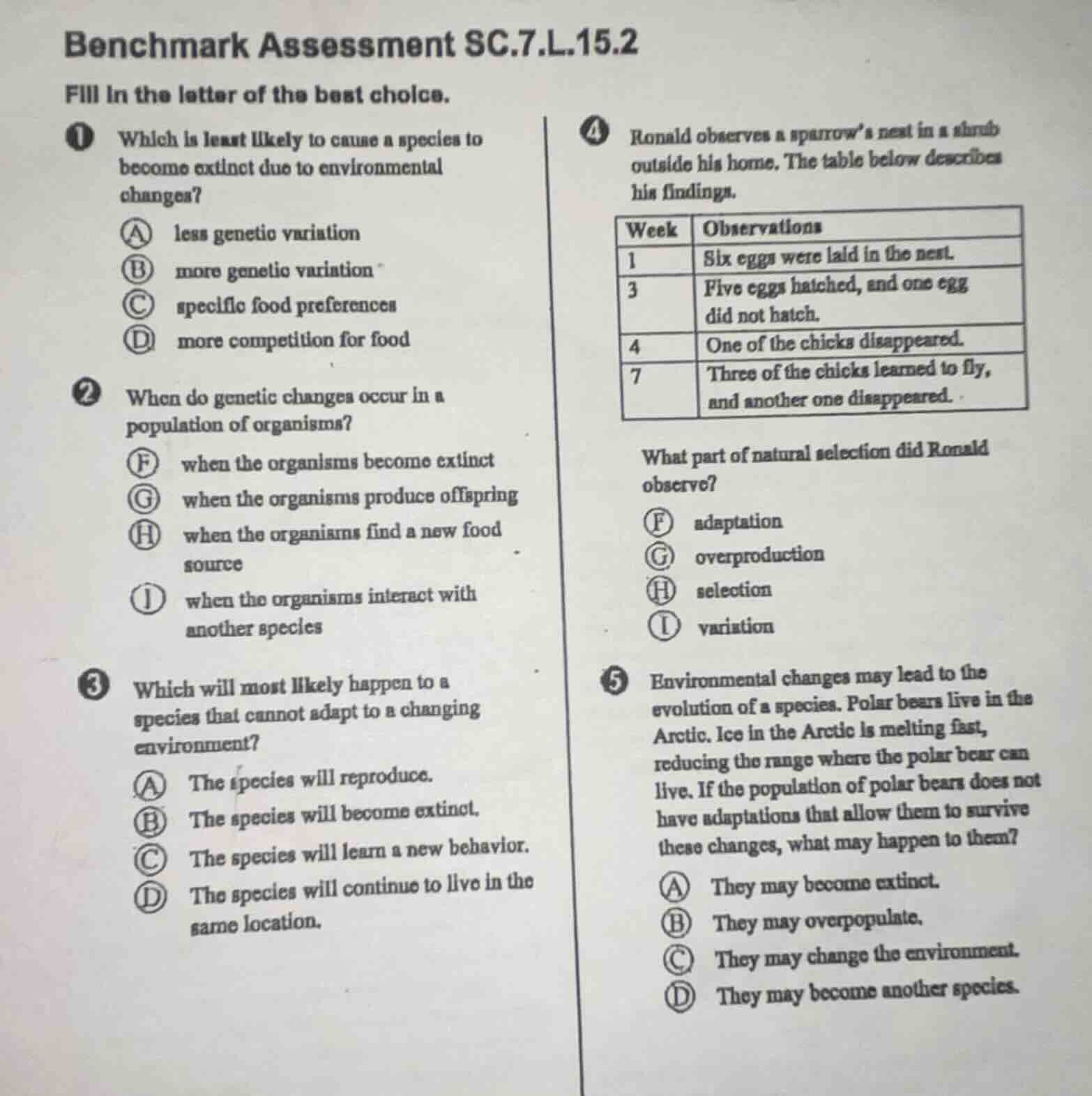
1 which is least likely to cause a species to become extinct due to environmental changes?
a less genetic variation
b more genetic variation
c specific food preferences
d more competition for food
2 when do genetic changes occur in a population of organisms?
f when the organisms become extinct
g when the organisms produce offspring
h when the organisms find a new food source
i when the organisms interact with another species
3 which will most likely happen to a species that cannot adapt to a changing environment?
a the species will reproduce.
b the species will become extinct.
c the species will learn a new behavior.
d the species will continue to live in the same location.
4 ronald observes a sparrow’s nest in a shrub outside his home. the table below describes his findings.
| week | observations |
|---|---|
| 3 | five eggs hatched, and one egg did not hatch. |
| 4 | one of the chicks disappeared. |
| 7 | three of the chicks learned to fly, and another one disappeared. |
what part of natural selection did ronald observe?
f adaptation
g overproduction
h selection
i variation
5 environmental changes may lead to the evolution of a species. polar bears live in the arctic. ice in the arctic is melting fast, reducing the range where the polar bear can live. if the population of polar bears does not have adaptations that allow them to survive these changes, what may happen to them?
a they may become extinct.
b they may overpopulate.
c they may change the environment.
d they may become another species.
Question 1
To determine what's least likely to cause extinction, we analyze each option:
- Option A: Less genetic variation reduces a species' ability to adapt, increasing extinction risk.
- Option B: More genetic variation gives a species more traits to adapt to environmental changes, so it's least likely to cause extinction.
- Option C: Specific food preferences mean if that food is lost, the species is at risk.
- Option D: More competition for food can stress the population and lead to extinction.
Genetic changes (mutations) can occur during reproduction (when organisms produce offspring) as DNA is replicated and passed on.
- Option F: Extinction is the end of a population, not when genetic changes occur.
- Option G: During reproduction (offspring production), mutations can happen in DNA replication, leading to genetic changes in the population.
- Option H: Finding a new food source doesn't directly cause genetic changes.
- Option I: Interacting with another species doesn't directly cause genetic changes in the population's genes.
If a species can't adapt to environmental changes, it won't be able to survive in that environment.
- Option A: A species that can't adapt is unlikely to reproduce successfully as it can't survive.
- Option B: A species unable to adapt will most likely die out (become extinct) as it can't cope with the new environment.
- Option C: Learning a new behavior isn't the same as adapting genetically or physiologically to survive; if it can't adapt, it can't survive to learn new behaviors effectively.
- Option D: If it can't adapt, the environment is no longer suitable, so it can't continue to live in the same location.

Snap & solve any problem in the app
Get step-by-step solutions on Sovi AI
Photo-based solutions with guided steps
Explore more problems and detailed explanations
B. more genetic variation