QUESTION IMAGE
Question
biology
date:
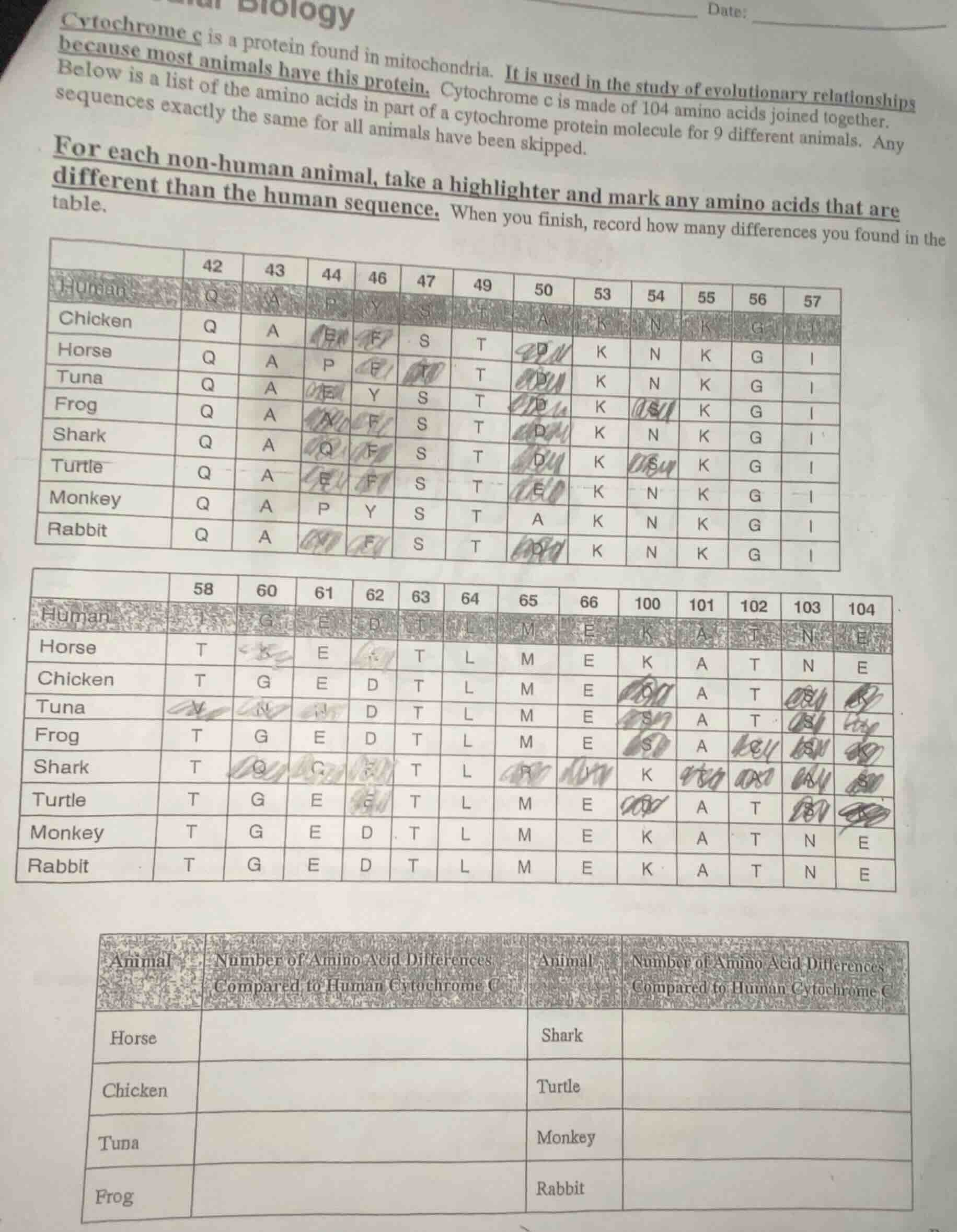
cytochrome c is a protein found in mitochondria. it is used in the study of evolutionary relationships because most animals have this protein. cytochrome c is made of 104 amino acids joined together.
below is a list of the amino acids in part of a cytochrome protein molecule for 9 different animals. any sequences exactly the same for all animals have been skipped.
for each non - human animal, take a highlighter and mark any amino acids that are different than the human sequence. when you finish, record how many differences you found in the table.
(the following are two tables of amino acid sequences for different animals and a table for recording the number of amino acid differences. the first amino acid sequence table has columns 42, 43, 44, 46, 47, 49, 50, 53, 54, 55, 56, 57 and rows for human, chicken, horse, tuna, frog, shark, turtle, monkey, rabbit. the second amino acid sequence table has columns 58, 60, 61, 62, 63, 64, 65, 66, 100, 101, 102, 103, 104 and rows for human, horse, chicken, tuna, frog, shark, turtle, monkey, rabbit. the last table is for recording the number of amino acid differences, with columns \animal\,
umber of amino acid differences compared to human cytochrome c\, \animal\,
umber of amino acid differences compared to human cytochrome c\ and rows for horse, chicken, tuna, frog, shark, turtle, monkey, rabbit.)
To solve for the number of amino acid differences between each non - human animal and human cytochrome c, we compare each amino acid position of the non - human animal with that of the human.
Horse
- Position 46: Human has Y, Horse has F (1 difference)
- Position 50: Human has A, Horse has D (1 difference)
- Position 58: Human has I, Horse has T (1 difference)
- Position 60: Human has G, Horse has K (1 difference)
- Position 62: Human has D, Horse has K (1 difference)
Total differences for Horse: \(1 + 1+1 + 1+1=5\)
Chicken
- Position 44: Human has P, Chicken has E (1 difference)
- Position 46: Human has Y, Chicken has F (1 difference)
- Position 50: Human has A, Chicken has D (1 difference)
- Position 58: Human has I, Chicken has T (1 difference)
- Position 100: Human has K, Chicken has Q (1 difference)
- Position 103: Human has N, Chicken has S (1 difference)
- Position 104: Human has E, Chicken has R (1 difference)
Total differences for Chicken: \(1+1 + 1+1+1+1+1 = 7\)
Tuna
- Position 44: Human has P, Tuna has E (1 difference)
- Position 46: Human has Y, Tuna has Y (0 difference)
- Position 47: Human has S, Tuna has T (1 difference)
- Position 50: Human has A, Tuna has D (1 difference)
- Position 54: Human has N, Tuna has S (1 difference)
- Position 58: Human has I, Tuna has V (1 difference)
- Position 60: Human has G, Tuna has N (1 difference)
- Position 61: Human has E, Tuna has N (1 difference)
- Position 100: Human has K, Tuna has S (1 difference)
- Position 103: Human has N, Tuna has S (1 difference)
- Position 104: Human has E, Tuna has K (1 difference)
Total differences for Tuna: \(1+0 + 1+1+1+1+1+1+1+1+1 = 10\)
Frog
- Position 44: Human has P, Frog has A (1 difference)
- Position 46: Human has Y, Frog has F (1 difference)
- Position 50: Human has A, Frog has D (1 difference)
- Position 54: Human has N, Frog has S (1 difference)
- Position 58: Human has I, Frog has T (1 difference)
- Position 100: Human has K, Frog has S (1 difference)
- Position 102: Human has T, Frog has V (1 difference)
- Position 103: Human has N, Frog has S (1 difference)
- Position 104: Human has E, Frog has K (1 difference)
Total differences for Frog: \(1+1+1 + 1+1+1+1+1+1 = 9\)
Shark
- Position 44: Human has P, Shark has Q (1 difference)
- Position 46: Human has Y, Shark has F (1 difference)
- Position 50: Human has A, Shark has D (1 difference)
- Position 54: Human has N, Shark has S (1 difference)
- Position 58: Human has I, Shark has T (1 difference)
- Position 60: Human has G, Shark has Q (1 difference)
- Position 61: Human has E, Shark has G (1 difference)
- Position 62: Human has D, Shark has E (1 difference)
- Position 65: Human has M, Shark has R (1 difference)
- Position 66: Human has E, Shark has I (1 difference)
- Position 100: Human has K, Shark has K (0 difference)
- Position 101: Human has A, Shark has V (1 difference)
- Position 102: Human has T, Shark has A (1 difference)
- Position 103: Human has N, Shark has A (1 difference)
- Position 104: Human has E, Shark has S (1 difference)
Total differences for Shark: \(1+1+1 + 1+1+1+1+1+1+1+0+1+1+1+1 = 14\)
Turtle
- Position 44: Human has P, Turtle has E (1 difference)
- Position 46: Human has Y, Turtle has F (1 difference)
- Position 50: Human has A, Turtle has E (1 difference)
- Position 54: Human has N, Turtle has S (1 difference)
- Position 58: Human ha…

Snap & solve any problem in the app
Get step-by-step solutions on Sovi AI
Photo-based solutions with guided steps
Explore more problems and detailed explanations
To solve for the number of amino acid differences between each non - human animal and human cytochrome c, we compare each amino acid position of the non - human animal with that of the human.
Horse
- Position 46: Human has Y, Horse has F (1 difference)
- Position 50: Human has A, Horse has D (1 difference)
- Position 58: Human has I, Horse has T (1 difference)
- Position 60: Human has G, Horse has K (1 difference)
- Position 62: Human has D, Horse has K (1 difference)
Total differences for Horse: \(1 + 1+1 + 1+1=5\)
Chicken
- Position 44: Human has P, Chicken has E (1 difference)
- Position 46: Human has Y, Chicken has F (1 difference)
- Position 50: Human has A, Chicken has D (1 difference)
- Position 58: Human has I, Chicken has T (1 difference)
- Position 100: Human has K, Chicken has Q (1 difference)
- Position 103: Human has N, Chicken has S (1 difference)
- Position 104: Human has E, Chicken has R (1 difference)
Total differences for Chicken: \(1+1 + 1+1+1+1+1 = 7\)
Tuna
- Position 44: Human has P, Tuna has E (1 difference)
- Position 46: Human has Y, Tuna has Y (0 difference)
- Position 47: Human has S, Tuna has T (1 difference)
- Position 50: Human has A, Tuna has D (1 difference)
- Position 54: Human has N, Tuna has S (1 difference)
- Position 58: Human has I, Tuna has V (1 difference)
- Position 60: Human has G, Tuna has N (1 difference)
- Position 61: Human has E, Tuna has N (1 difference)
- Position 100: Human has K, Tuna has S (1 difference)
- Position 103: Human has N, Tuna has S (1 difference)
- Position 104: Human has E, Tuna has K (1 difference)
Total differences for Tuna: \(1+0 + 1+1+1+1+1+1+1+1+1 = 10\)
Frog
- Position 44: Human has P, Frog has A (1 difference)
- Position 46: Human has Y, Frog has F (1 difference)
- Position 50: Human has A, Frog has D (1 difference)
- Position 54: Human has N, Frog has S (1 difference)
- Position 58: Human has I, Frog has T (1 difference)
- Position 100: Human has K, Frog has S (1 difference)
- Position 102: Human has T, Frog has V (1 difference)
- Position 103: Human has N, Frog has S (1 difference)
- Position 104: Human has E, Frog has K (1 difference)
Total differences for Frog: \(1+1+1 + 1+1+1+1+1+1 = 9\)
Shark
- Position 44: Human has P, Shark has Q (1 difference)
- Position 46: Human has Y, Shark has F (1 difference)
- Position 50: Human has A, Shark has D (1 difference)
- Position 54: Human has N, Shark has S (1 difference)
- Position 58: Human has I, Shark has T (1 difference)
- Position 60: Human has G, Shark has Q (1 difference)
- Position 61: Human has E, Shark has G (1 difference)
- Position 62: Human has D, Shark has E (1 difference)
- Position 65: Human has M, Shark has R (1 difference)
- Position 66: Human has E, Shark has I (1 difference)
- Position 100: Human has K, Shark has K (0 difference)
- Position 101: Human has A, Shark has V (1 difference)
- Position 102: Human has T, Shark has A (1 difference)
- Position 103: Human has N, Shark has A (1 difference)
- Position 104: Human has E, Shark has S (1 difference)
Total differences for Shark: \(1+1+1 + 1+1+1+1+1+1+1+0+1+1+1+1 = 14\)
Turtle
- Position 44: Human has P, Turtle has E (1 difference)
- Position 46: Human has Y, Turtle has F (1 difference)
- Position 50: Human has A, Turtle has E (1 difference)
- Position 54: Human has N, Turtle has S (1 difference)
- Position 58: Human has I, Turtle has T (1 difference)
- Position 62: Human has D, Turtle has E (1 difference)
- Position 100: Human has K, Turtle has Q (1 difference)
- Position 103: Human has N, Turtle has S (1 difference)
- Position 104: Human has E, Turtle has R (1 difference)
Total differences for Turtle: \(1+1+1 + 1+1+1+1+1+1 = 9\)
Monkey
- Position 46: Human has Y, Monkey has Y (0 difference)
- Position 50: Human has A, Monkey has A (0 difference)
- Position 58: Human has I, Monkey has T (1 difference)
Total differences for Monkey: \(1\)
Rabbit
- Position 44: Human has P, Rabbit has N (1 difference)
- Position 46: Human has Y, Rabbit has F (1 difference)
- Position 50: Human has A, Rabbit has D (1 difference)
- Position 58: Human has I, Rabbit has T (1 difference)
Total differences for Rabbit: \(1+1+1 + 1=4\)
| Animal | Number of Amino Acid Differences Compared to Human Cytochrome C | Animal | Number of Amino Acid Differences Compared to Human Cytochrome C |
|---|---|---|---|
| Chicken | 7 | Turtle | 9 |
| Tuna | 10 | Monkey | 1 |
| Frog | 9 | Rabbit | 4 |
Final Answers (Filling the table)
- Horse: \(\boldsymbol{5}\)
- Chicken: \(\boldsymbol{7}\)
- Tuna: \(\boldsymbol{10}\)
- Frog: \(\boldsymbol{9}\)
- Shark: \(\boldsymbol{14}\)
- Turtle: \(\boldsymbol{9}\)
- Monkey: \(\boldsymbol{1}\)
- Rabbit: \(\boldsymbol{4}\)