QUESTION IMAGE
Question
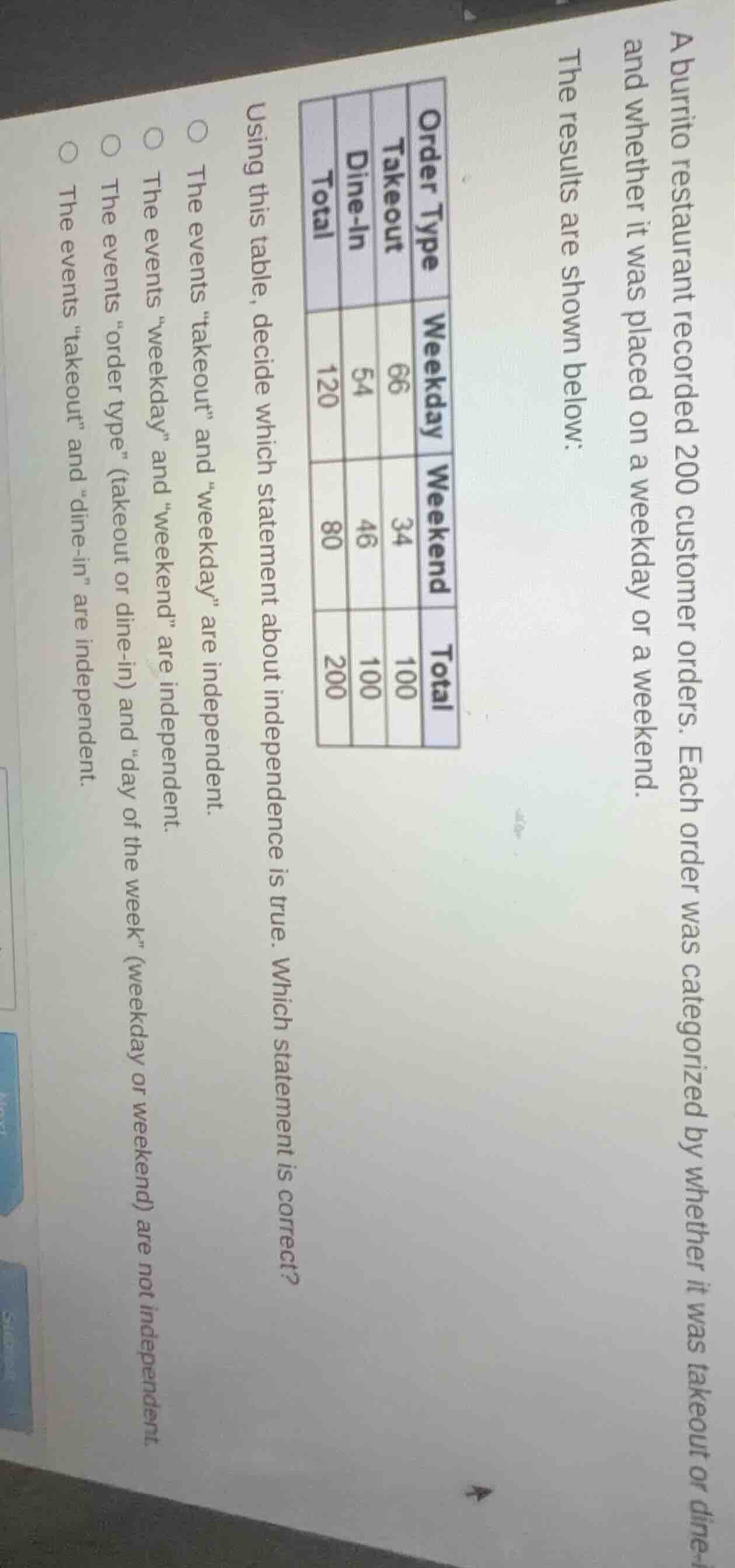
a burrito restaurant recorded 200 customer orders. each order was categorized by whether it was takeout or dine-in and whether it was placed on a weekday or a weekend. the results are shown below: chart with columns order type (takeout, dine-in, total) and rows weekday, weekend, total, with values: weekday - takeout: 66, dine-in: 54, total: 120; weekend - takeout: 34, dine-in: 46, total: 80; total - takeout: 100, dine-in: 100, total: 200 using this table, decide which statement about independence is true. which statement is correct? the events \takeout\ and \weekday\ are independent. the events \weekday\ and \weekend\ are independent. the events \order type\ (takeout or dine-in) and \day of the week\ (weekday or weekend) are not independent. the events \takeout\ and \dine-in\ are independent.
To determine if two events \( A \) and \( B \) are independent, we use the formula \( P(A \cap B) = P(A) \times P(B) \).
Step 1: Define the events and find probabilities
Let's check the events "takeout" (T) and "weekday" (W), "weekday" (W) and "weekend" (We) (but these are mutually exclusive, so not independent), "order type" (T or D) and "day of the week" (W or We), and "takeout" (T) and "dine - in" (D) (mutually exclusive).
First, for events "takeout" (T) and "weekday" (W):
- Total number of orders \( n = 200 \)
- Number of takeout orders \( n(T)=100 \), so \( P(T)=\frac{100}{200} = 0.5 \)
- Number of weekday orders \( n(W)=120 \), so \( P(W)=\frac{120}{200}=0.6 \)
- Number of takeout and weekday orders \( n(T\cap W) = 66 \), so \( P(T\cap W)=\frac{66}{200}=0.33 \)
Now, calculate \( P(T)\times P(W)=0.5\times0.6 = 0.3 \)
Since \( P(T\cap W)=0.33
eq P(T)\times P(W) = 0.3 \), let's check the third option: "order type" (takeout or dine - in) and "day of the week" (weekday or weekend).
Let's take takeout (T) and weekend (We):
- \( P(T) = 0.5 \), \( P(We)=\frac{80}{200} = 0.4 \)
- \( n(T\cap We)=34 \), \( P(T\cap We)=\frac{34}{200}=0.17 \)
- \( P(T)\times P(We)=0.5\times0.4 = 0.2 \), and \( 0.17
eq0.2 \)
For dine - in (D) and weekday (W):
- \( P(D)=\frac{100}{200}=0.5 \), \( P(W) = 0.6 \)
- \( n(D\cap W)=54 \), \( P(D\cap W)=\frac{54}{200}=0.27 \)
- \( P(D)\times P(W)=0.5\times0.6 = 0.3
eq0.27 \)
For dine - in (D) and weekend (We):
- \( P(D) = 0.5 \), \( P(We)=0.4 \)
- \( n(D\cap We)=46 \), \( P(D\cap We)=\frac{46}{200}=0.23 \)
- \( P(D)\times P(We)=0.5\times0.4 = 0.2
eq0.23 \)
Now, let's check the third option: "The events 'order type' (takeout or dine - in) and 'day of the week' (weekday or weekend) are not independent".
Since for both takeout - weekday, takeout - weekend, dine - in - weekday, dine - in - weekend, the product of the marginal probabilities is not equal to the joint probability, the events "order type" (takeout or dine - in) and "day of the week" (weekday or weekend) are not independent.
The events "takeout" and "dine - in" are mutually exclusive (a meal can't be both takeout and dine - in at the same time), so \( P(T\cap D) = 0 \), and \( P(T)\times P(D)=0.5\times0.5 = 0.25
eq0 \), but we are checking the third option.
The events "weekday" and "weekend" are mutually exclusive (a day can't be both weekday and weekend), so \( P(W\cap We)=0 \), and \( P(W)\times P(We)=0.6\times0.4 = 0.24
eq0 \), so they are not independent, but the third option is about "order type" and "day of the week".
The first option: For "takeout" and "weekday", we saw \( P(T\cap W)=0.33 \) and \( P(T)\times P(W)=0.3 \), so they are not independent. Wait, maybe I made a mistake. Let's re - check the third option.
Wait, the third option says "The events 'order type' (takeout or dine - in) and 'day of the week' (weekday or weekend) are not independent". Let's check the conditional probability.
The probability of takeout on weekday: \( P(T|W)=\frac{66}{120}=0.55 \)
The probability of takeout overall: \( P(T)=\frac{100}{200}=0.5 \)
Since \( P(T|W)
eq P(T) \), the events "order type" (takeout is part of order type) and "day of the week" (weekday) are dependent. Similarly, for dine - in on weekend: \( P(D|We)=\frac{46}{80}=0.575 \), and \( P(D)=\frac{100}{200}=0.5 \), so \( P(D|We)
eq P(D) \). So the events "order type" (takeout or dine - in) and "day of the week" (weekday or weekend) are not independent.
The first option: "The events 'takeout' and 'weekday' are independent" is wrong because \( P(T\cap W)=0.33 \) and \( P(T)\tim…

Snap & solve any problem in the app
Get step-by-step solutions on Sovi AI
Photo-based solutions with guided steps
Explore more problems and detailed explanations
The events "order type" (takeout or dine - in) and "day of the week" (weekday or weekend) are not independent. (The option: The events "order type" (takeout or dine - in) and "day of the week" (weekday or weekend) are not independent)