QUESTION IMAGE
Question
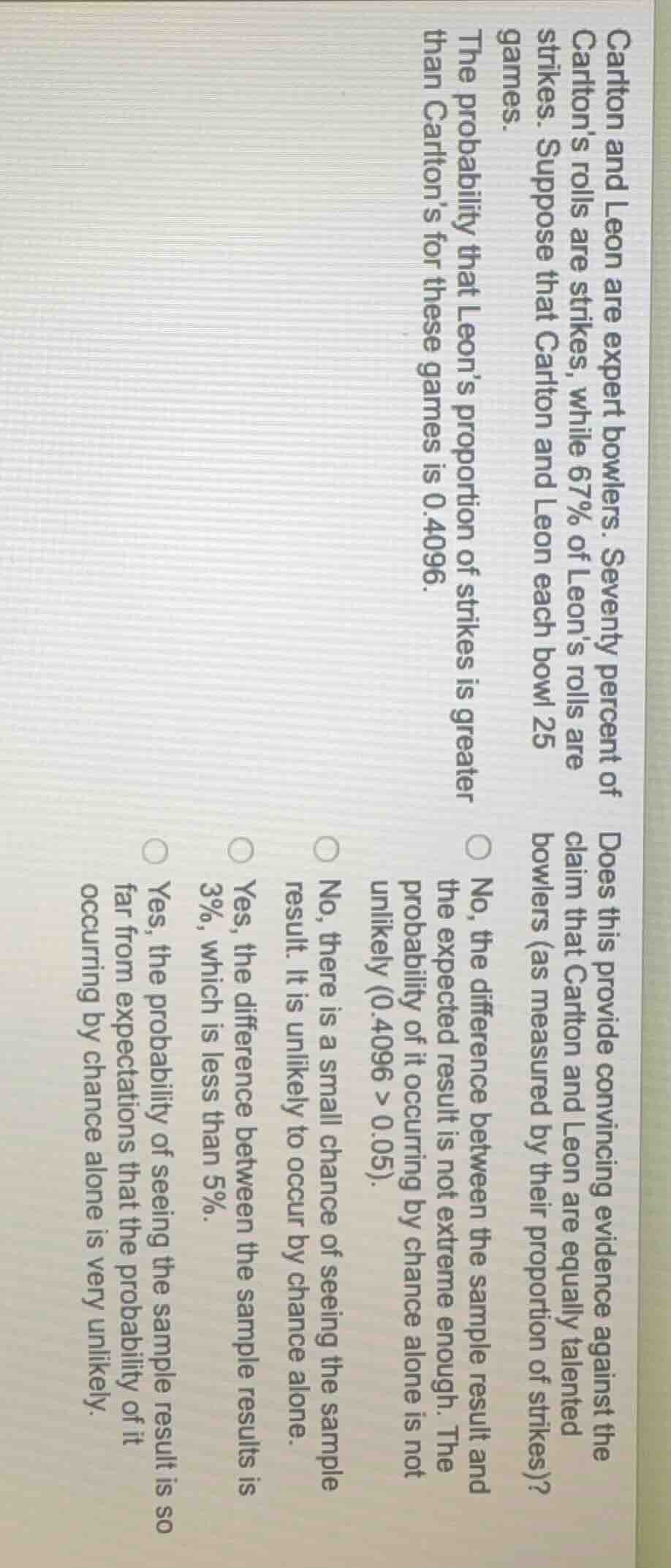
carlton and leon are expert bowlers. seventy percent of carltons rolls are strikes, while 67% of leons rolls are strikes. suppose that carlton and leon each bowl 25 games.
the probability that leons proportion of strikes is greater than carltons for these games is 0.4096.
does this provide convincing evidence against the claim that carlton and leon are equally talented bowlers (as measured by their proportion of strikes)?
○ no, the difference between the sample result and the expected result is not extreme enough. the probability of it occurring by chance alone is not unlikely (0.4096 > 0.05).
○ no, there is a small chance of seeing the sample result. it is unlikely to occur by chance alone.
○ yes, the difference between the sample results is 3%, which is less than 5%.
○ yes, the probability of seeing the sample result is so far from expectations that the probability of it occurring by chance alone is very unlikely.
To evaluate the evidence against the claim that the bowlers are equally talented, we use the given probability of the observed result (Leon's strike proportion being greater than Carlton's) which is 0.4096. In hypothesis testing for such claims, a probability (p-value) greater than 0.05 means the observed result is likely to occur by chance alone, so we do not have convincing evidence against the null claim of equal talent.

Snap & solve any problem in the app
Get step-by-step solutions on Sovi AI
Photo-based solutions with guided steps
Explore more problems and detailed explanations
No, the difference between the sample result and the expected result is not extreme enough. The probability of it occurring by chance alone is not unlikely (0.4096 > 0.05).