QUESTION IMAGE
Question
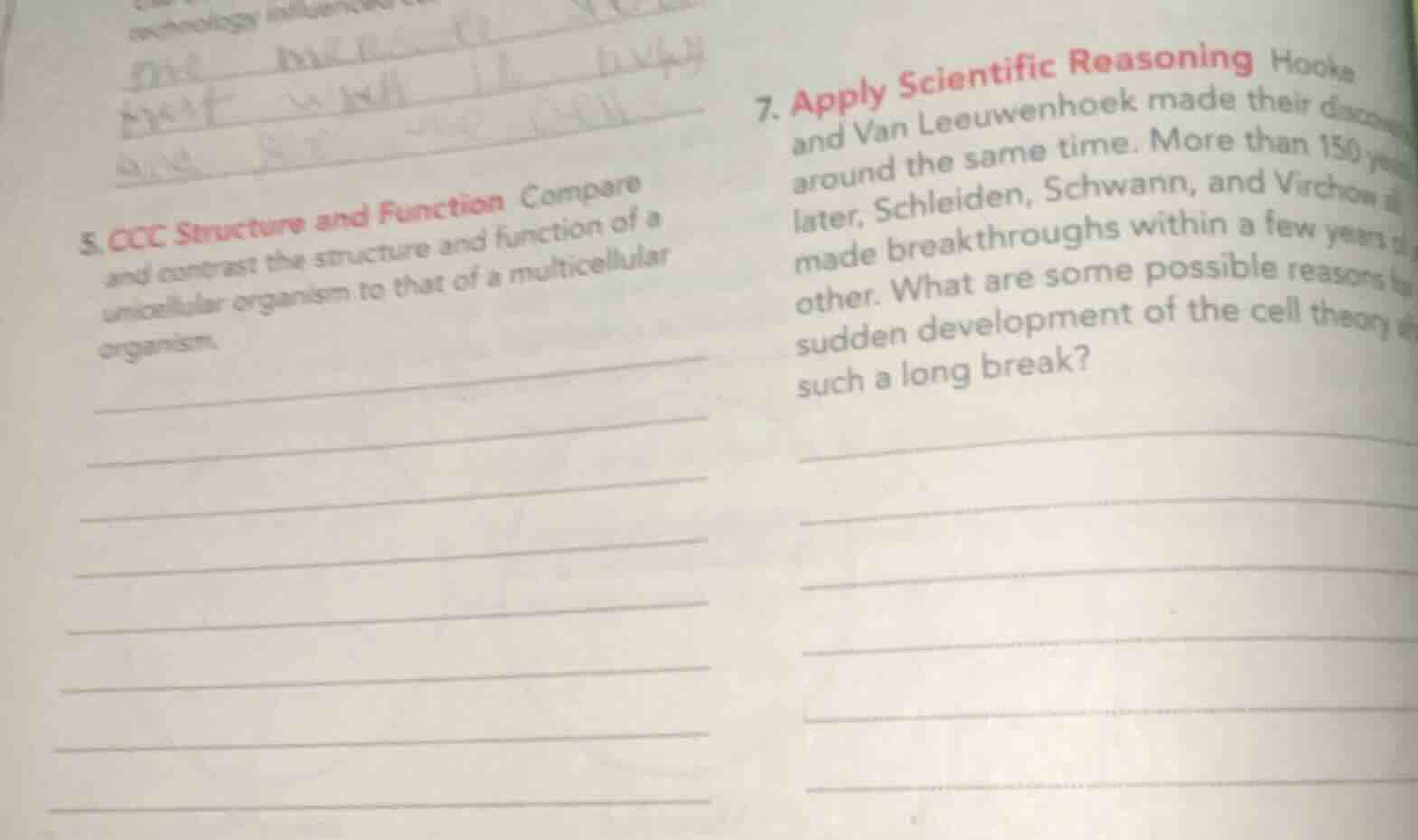
- ccc structure and function compare and contrast the structure and function of a unicellular organism to that of a multicellular organism.
- apply scientific reasoning hooke and van leeuwenhoek made their discoveries around the same time. more than 150 years later, schleiden, schwann, and virchow all made breakthroughs within a few years of each other. what are some possible reasons for the sudden development of the cell theory after such a long break?
Brief Explanations
For Question 5:
- Structure: Unicellular organisms consist of a single cell that carries out all life functions; multicellular organisms have specialized, differentiated cells organized into tissues, organs, and organ systems.
- Function: In unicellular organisms, the single cell handles all tasks like nutrition, reproduction, and excretion. In multicellular organisms, specialized cells perform specific roles (e.g., muscle cells for movement, nerve cells for signaling), with systems working together to sustain the whole organism.
- Similarity: Both rely on cells as the basic unit of life, use DNA for genetic information, and perform core life processes (metabolism, reproduction).
For Question 7:
- Technological Advancements: Microscopes improved significantly after Hooke and van Leeuwenhoek, allowing clearer observation of cell details and internal structures, which was critical for identifying cell commonalities.
- Scientific Community Growth: A larger, more connected scientific community emerged, enabling faster sharing of observations and ideas, which facilitated collaborative breakthroughs.
- Shift in Scientific Focus: Later scientists moved beyond just observing cells to studying their roles in living organisms, leading to the synthesis of the cell theory.

Snap & solve any problem in the app
Get step-by-step solutions on Sovi AI
Photo-based solutions with guided steps
Explore more problems and detailed explanations
Question 5:
- Structure: Unicellular = 1 independent cell; Multicellular = Specialized, organized cells/tissues/organs.
- Function: Unicellular = Single cell does all life tasks; Multicellular = Specialized cells perform specific roles, systems work together.
- Similarity: Both use cells as the basic life unit, have DNA, and perform core life functions.
Question 7:
- Improved microscope technology enabled better cell observation.
- A larger, more connected scientific community allowed faster idea sharing.
- Scientists shifted focus from observing cells to studying their biological roles, enabling the cell theory's development.