QUESTION IMAGE
Question
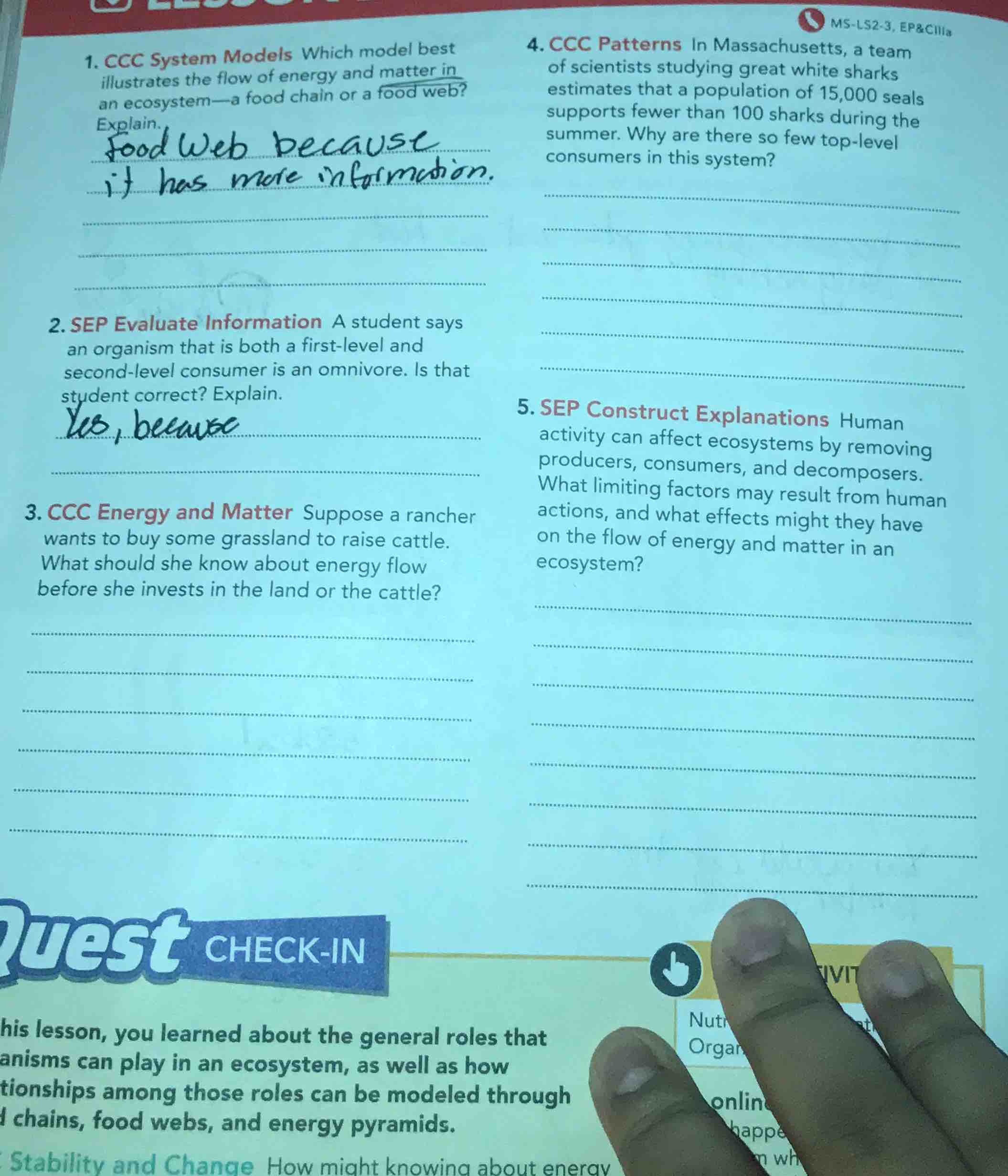
- ccc system models which model best illustrates the flow of energy and matter in an ecosystem—a food chain or a food web? explain.
- sep evaluate information a student says an organism that is both a first - level and second - level consumer is an omnivore. is that student correct? explain.
- ccc energy and matter suppose a rancher wants to buy some grassland to raise cattle. what should she know about energy flow before she invests in the land or the cattle?
- ccc patterns in massachusetts, a team of scientists studying great white sharks estimates that a population of 15,000 seals supports fewer than 100 sharks during the summer. why are there so few top - level consumers in this system?
- sep construct explanations human activity can affect ecosystems by removing producers, consumers, and decomposers. what limiting factors may result from human actions, and what effects might they have on the flow of energy and matter in an ecosystem?
Question 1
A food web is a better model for showing energy and matter flow in an ecosystem. A food chain is a simple linear sequence of who eats whom, while a food web consists of multiple interconnected food chains. Ecosystems have complex feeding relationships, and a food web can represent the multiple prey and predator relationships of different organisms, thus providing a more comprehensive view of how energy and matter move through the various trophic levels and different populations. So it captures the complexity of real - world ecosystems better than a single food chain.
First - level consumers eat producers (plants), and second - level consumers eat first - level consumers. An omnivore is an organism that eats both plants (producers) and animals (which can be first - level consumers). So if an organism is a first - level consumer (eating producers) and a second - level consumer (eating first - level consumers), it is consuming both producers and other consumers, which fits the definition of an omnivore. For example, a bear eats berries (producers, acting as a first - level consumer) and also eats fish (which may be first - level consumers, so the bear acts as a second - level consumer in that relationship).
Energy flow in an ecosystem follows the 10% rule, where only about 10% of the energy from one trophic level is passed on to the next. Producers (grass in the grassland) capture energy from the sun. Primary consumers (cattle, as herbivores) eat the producers, and only a small portion of the energy from the grass is available to the cattle. The rancher should know that the amount of grass (producers) will limit the number of cattle (primary consumers) she can raise, because the energy transfer is inefficient. Also, if she plans to sell the cattle or use them for other purposes, she needs to consider the carrying capacity of the grassland, which is related to the energy flow and the amount of available producers. Additionally, she should be aware of the trophic levels and how energy is lost at each level (through respiration, waste, etc.), so that she can manage the grassland and the cattle population in a sustainable way.

Snap & solve any problem in the app
Get step-by-step solutions on Sovi AI
Photo-based solutions with guided steps
Explore more problems and detailed explanations
A food web best illustrates the flow of energy and matter in an ecosystem. Because a food web shows the complex, interconnected feeding relationships (multiple food chains linked together) in an ecosystem, while a food chain is a simple, linear sequence. This complexity in the food web better represents how energy and matter move through different trophic levels and organisms in a real - world ecosystem.