QUESTION IMAGE
Question
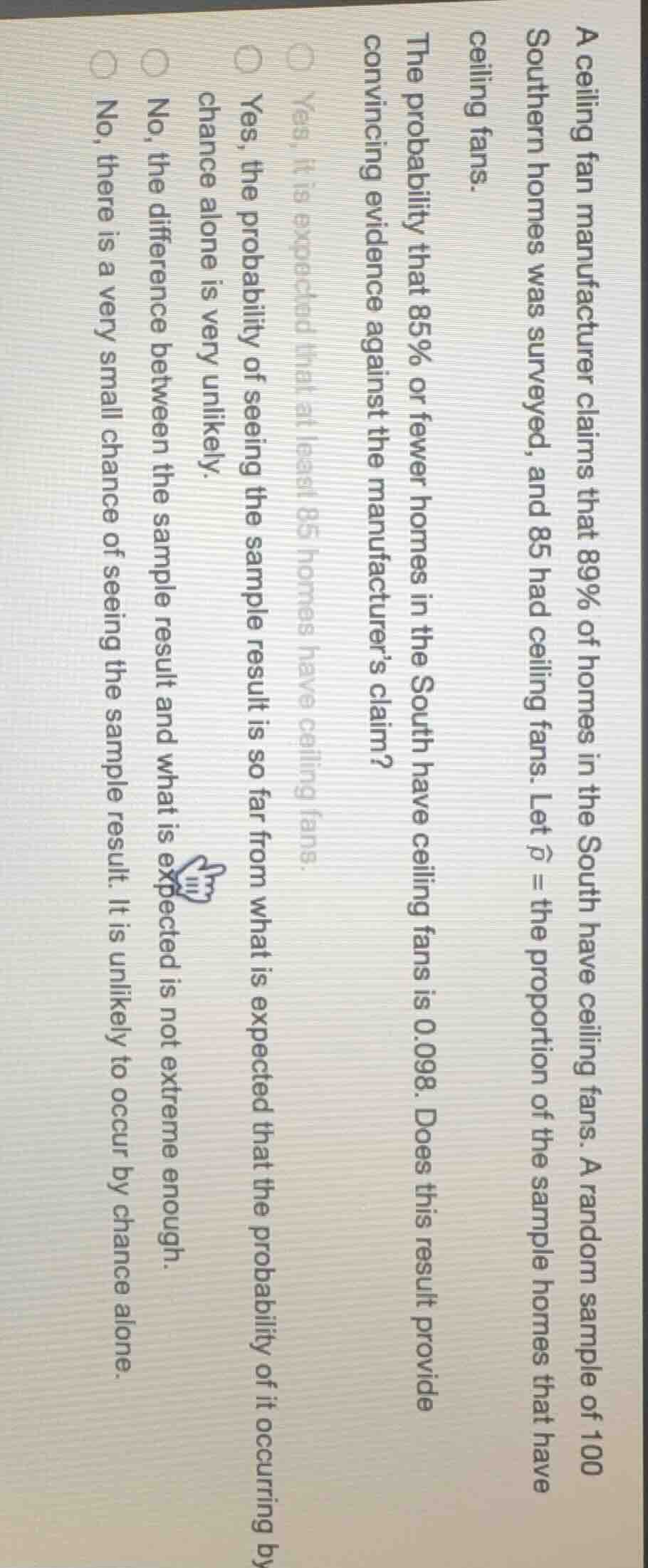
a ceiling fan manufacturer claims that 89% of homes in the south have ceiling fans. a random sample of 100 southern homes was surveyed, and 85 had ceiling fans. let $widehat{p}$ = the proportion of the sample homes that have ceiling fans.
the probability that 85% or fewer homes in the south have ceiling fans is 0.098. does this result provide convincing evidence against the manufacturers claim?
$\bigcirc$ yes, it is expected that at least 85 homes have ceiling fans.
$\bigcirc$ yes, the probability of seeing the sample result is so far from what is expected that the probability of it occurring by chance alone is very unlikely.
$\bigcirc$ no, the difference between the sample result and what is expected is not extreme enough.
$\bigcirc$ no, there is a very small chance of seeing the sample result. it is unlikely to occur by chance alone.
Step1: Interpret the given probability
We are given the probability that 85% or fewer homes in the sample have ceiling fans is $P(\hat{p} \leq 0.85) = 0.098$.
Step2: Evaluate statistical significance
A probability of 0.098 (9.8%) is generally not considered a small enough chance (we typically use a threshold like 5% for statistical significance) to rule out random chance. This means the sample result is not extreme enough to contradict the manufacturer's claim.

Snap & solve any problem in the app
Get step-by-step solutions on Sovi AI
Photo-based solutions with guided steps
Explore more problems and detailed explanations
No, the difference between the sample result and what is expected is not extreme enough.