QUESTION IMAGE
Question
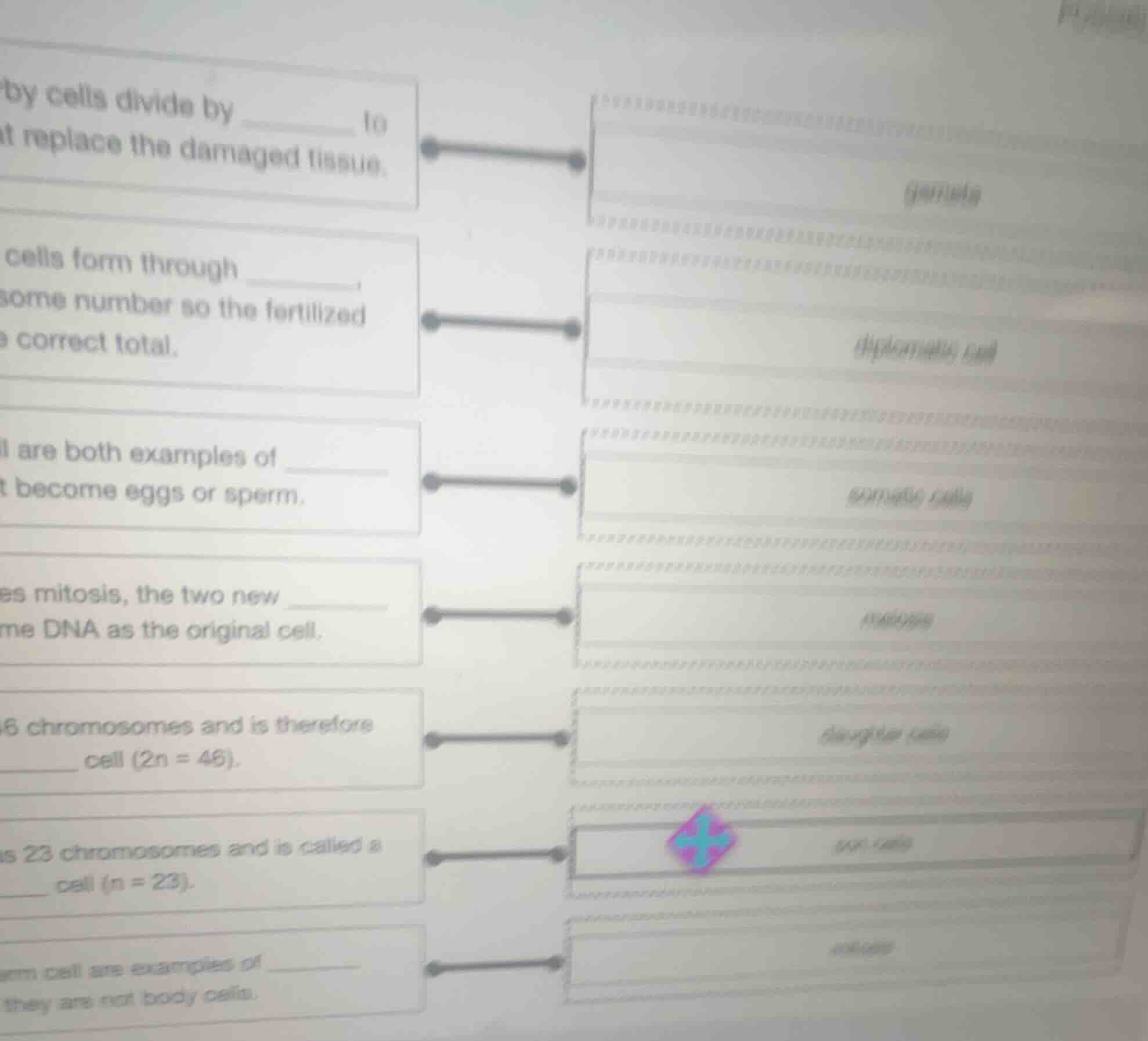
by cells divide by ______ to replace the damaged tissue.
cells form through ______,
some number so the fertilized
e correct total.
are both examples of ______\tbecome eggs or sperm.
es mitosis, the two new ______
me dna as the original cell.
6 chromosomes and is therefore
______ cell (2n = 46).
s 23 chromosomes and is called a
______ cell (n = 23).
erm cell are examples of ______
they are not body cells.
To solve this cell division - related matching problem, we analyze each statement:
1. Body cells divide by ____ to replace the damaged tissue.
Body cells use mitosis for growth, repair (like replacing damaged tissue), and asexual reproduction. So the term here is "mitosis".
2. Sex cells form through ____ to reduce the chromosome number so the fertilized egg has the correct total.
Sex cells (gametes) are formed through meiosis, which reduces the chromosome number by half. So the term here is "meiosis".
3. Skin cells and liver cells are both examples of ____ because they will never become eggs or sperm.
Somatic cells are body cells (like skin and liver cells) that are not involved in producing gametes (eggs or sperm). So the term here is "somatic cells".
4. When a cell undergoes mitosis, the two new ____ have the same DNA as the original cell.
Mitosis results in two daughter cells that are genetically identical to the parent cell. So the term here is "daughter cells".
5. A skin cell has 46 chromosomes and is therefore a ____ cell (\(2n = 46\)).
Somatic cells are diploid (\(2n\)), meaning they have two sets of chromosomes (46 in humans for somatic cells). So the term here is "diploid".
6. A sperm cell has 23 chromosomes and is called a ____ cell (\(n = 23\)).
Gametes (like sperm or egg cells) are haploid (\(n\)), meaning they have half the number of chromosomes of somatic cells. So the term here is "haploid".
7. An egg cell and a sperm cell are examples of ____ because they are not body cells.
Gametes are the sex cells (egg and sperm) that are involved in sexual reproduction and are not body (somatic) cells. So the term here is "gametes".
The correct matches are:
- Body cells divide by $\boldsymbol{\text{mitosis}}$ to replace the damaged tissue.
- Sex cells form through $\boldsymbol{\text{meiosis}}$ to reduce the chromosome number so the fertilized egg has the correct total.
- Skin cells and liver cells are both examples of $\boldsymbol{\text{somatic cells}}$ because they will never become eggs or sperm.
- When a cell undergoes mitosis, the two new $\boldsymbol{\text{daughter cells}}$ have the same DNA as the original cell.
- A skin cell has 46 chromosomes and is therefore a $\boldsymbol{\text{diploid}}$ cell (\(2n = 46\)).
- A sperm cell has 23 chromosomes and is called a $\boldsymbol{\text{haploid}}$ cell (\(n = 23\)).
- An egg cell and a sperm cell are examples of $\boldsymbol{\text{gametes}}$ because they are not body cells.

Snap & solve any problem in the app
Get step-by-step solutions on Sovi AI
Photo-based solutions with guided steps
Explore more problems and detailed explanations
To solve this cell division - related matching problem, we analyze each statement:
1. Body cells divide by ____ to replace the damaged tissue.
Body cells use mitosis for growth, repair (like replacing damaged tissue), and asexual reproduction. So the term here is "mitosis".
2. Sex cells form through ____ to reduce the chromosome number so the fertilized egg has the correct total.
Sex cells (gametes) are formed through meiosis, which reduces the chromosome number by half. So the term here is "meiosis".
3. Skin cells and liver cells are both examples of ____ because they will never become eggs or sperm.
Somatic cells are body cells (like skin and liver cells) that are not involved in producing gametes (eggs or sperm). So the term here is "somatic cells".
4. When a cell undergoes mitosis, the two new ____ have the same DNA as the original cell.
Mitosis results in two daughter cells that are genetically identical to the parent cell. So the term here is "daughter cells".
5. A skin cell has 46 chromosomes and is therefore a ____ cell (\(2n = 46\)).
Somatic cells are diploid (\(2n\)), meaning they have two sets of chromosomes (46 in humans for somatic cells). So the term here is "diploid".
6. A sperm cell has 23 chromosomes and is called a ____ cell (\(n = 23\)).
Gametes (like sperm or egg cells) are haploid (\(n\)), meaning they have half the number of chromosomes of somatic cells. So the term here is "haploid".
7. An egg cell and a sperm cell are examples of ____ because they are not body cells.
Gametes are the sex cells (egg and sperm) that are involved in sexual reproduction and are not body (somatic) cells. So the term here is "gametes".
The correct matches are:
- Body cells divide by $\boldsymbol{\text{mitosis}}$ to replace the damaged tissue.
- Sex cells form through $\boldsymbol{\text{meiosis}}$ to reduce the chromosome number so the fertilized egg has the correct total.
- Skin cells and liver cells are both examples of $\boldsymbol{\text{somatic cells}}$ because they will never become eggs or sperm.
- When a cell undergoes mitosis, the two new $\boldsymbol{\text{daughter cells}}$ have the same DNA as the original cell.
- A skin cell has 46 chromosomes and is therefore a $\boldsymbol{\text{diploid}}$ cell (\(2n = 46\)).
- A sperm cell has 23 chromosomes and is called a $\boldsymbol{\text{haploid}}$ cell (\(n = 23\)).
- An egg cell and a sperm cell are examples of $\boldsymbol{\text{gametes}}$ because they are not body cells.