QUESTION IMAGE
Question
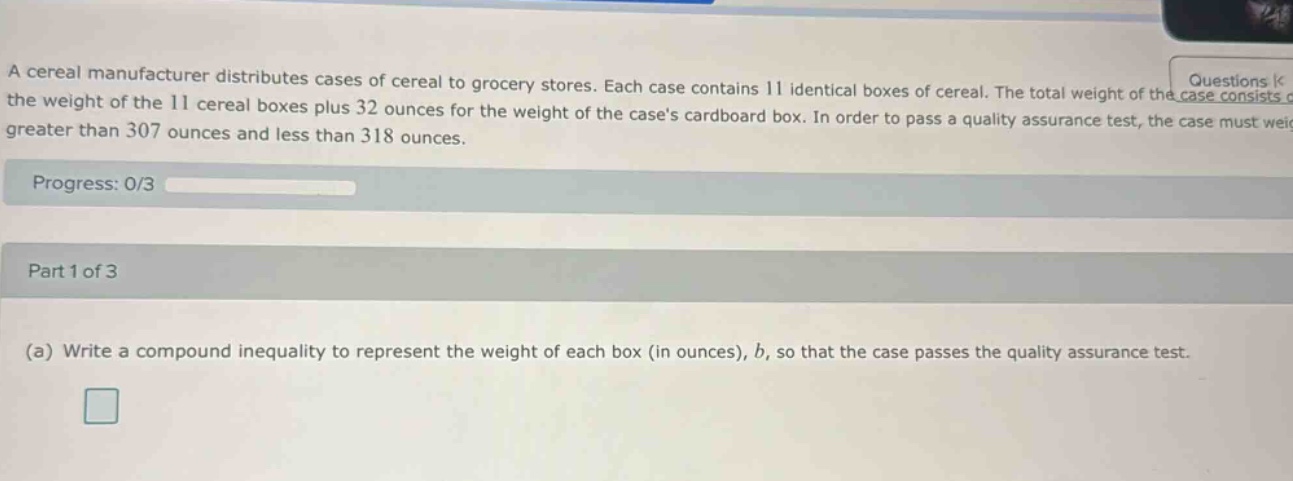
a cereal manufacturer distributes cases of cereal to grocery stores. each case contains 11 identical boxes of cereal. the total weight of the case consists of the weight of the 11 cereal boxes plus 32 ounces for the weight of the cases cardboard box. in order to pass a quality assurance test, the case must weigh greater than 307 ounces and less than 318 ounces. progress: 0/3 part 1 of 3 (a) write a compound inequality to represent the weight of each box (in ounces), b, so that the case passes the quality assurance test.
Step1: Define total weight formula
The total weight of a case is \(11b + 32\), where \(b\) is the weight of one box.
Step2: Set up compound inequality
The case weight must be greater than 307 and less than 318, so:
\(307 < 11b + 32 < 318\)
Step3: Solve for \(b\) (optional for part (a) but shows derivation)
Subtract 32 from all parts:
\(307 - 32 < 11b + 32 - 32 < 318 - 32\)
\(275 < 11b < 286\)
Divide all parts by 11:
\(\frac{275}{11} < \frac{11b}{11} < \frac{286}{11}\)
\(25 < b < 26\) (But for part (a), the compound inequality in terms of \(b\) from the total weight is \(307 < 11b + 32 < 318\))

Snap & solve any problem in the app
Get step-by-step solutions on Sovi AI
Photo-based solutions with guided steps
Explore more problems and detailed explanations
\(307 < 11b + 32 < 318\) (or simplified to \(25 < b < 26\) but the first form is from the total weight setup as required for part (a))