QUESTION IMAGE
Question
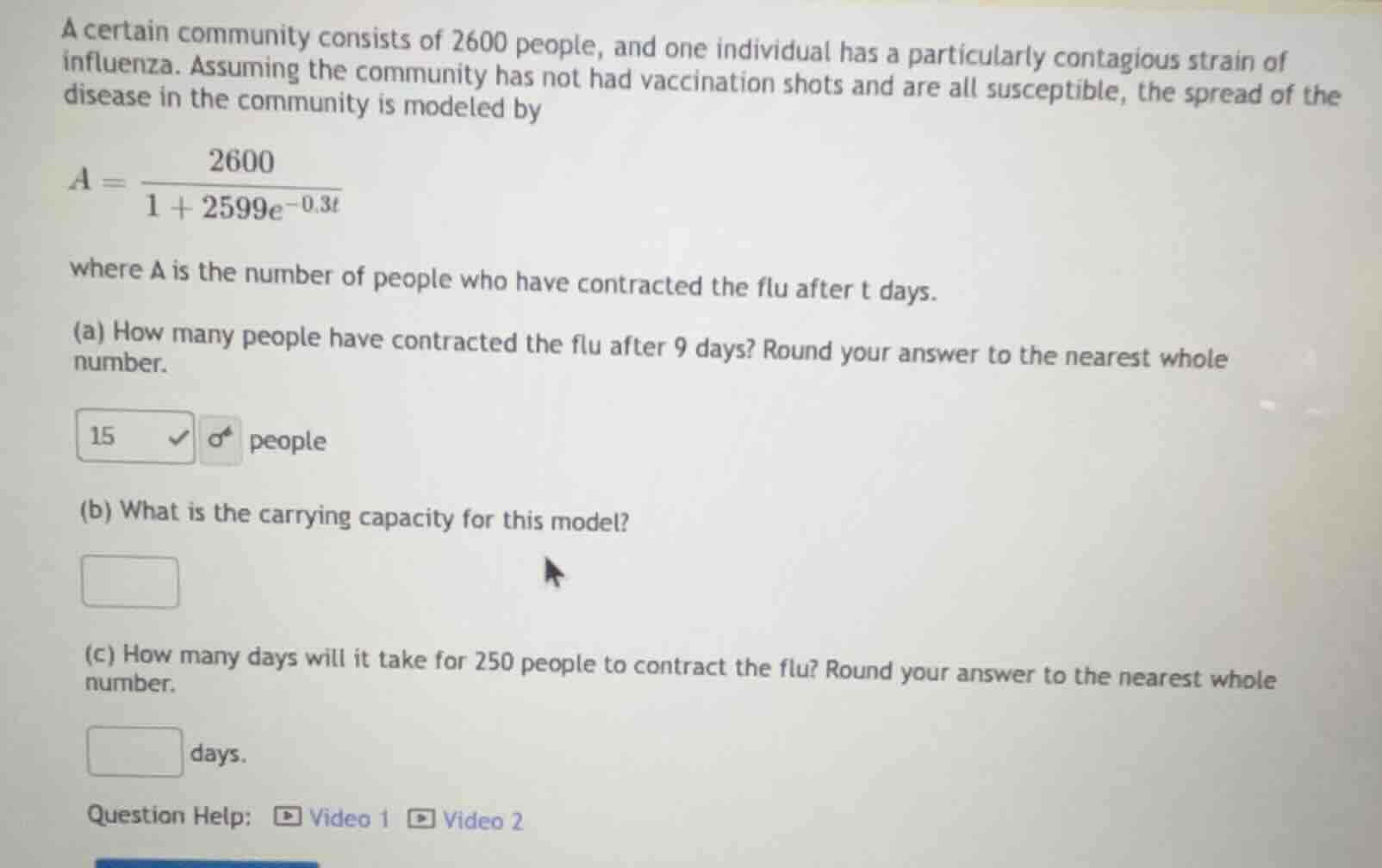
a certain community consists of 2600 people, and one individual has a particularly contagious strain of influenza. assuming the community has not had vaccination shots and are all susceptible, the spread of the disease in the community is modeled by
$a = \frac{2600}{1 + 2599e^{-0.3t}}$
where a is the number of people who have contracted the flu after t days.
(a) how many people have contracted the flu after 9 days? round your answer to the nearest whole number.
15 ✔ people
(b) what is the carrying capacity for this model?
(c) how many days will it take for 250 people to contract the flu? round your answer to the nearest whole number.
days.
question help: video 1 video 2
Step1: Solve part (a): Substitute t=9
Substitute $t=9$ into the given model:
$A = \frac{2600}{1 + 2599e^{-0.3(9)}}$
First calculate the exponent: $-0.3\times9=-2.7$, so $e^{-2.7}\approx0.0672$
Then compute denominator: $1 + 2599\times0.0672\approx1 + 174.65=175.65$
Finally: $A\approx\frac{2600}{175.65}\approx15$
Step2: Solve part (b): Identify carrying capacity
For a logistic model $A=\frac{K}{1+Ce^{-rt}}$, $K$ is the carrying capacity. Compare with the given formula:
$A = \frac{2600}{1 + 2599e^{-0.3t}}$
Here, $K=2600$, which is the maximum number of people that can contract the flu (the total community size).
Step3: Solve part (c): Solve for t when A=250
Set $A=250$ and solve for $t$:
$250 = \frac{2600}{1 + 2599e^{-0.3t}}$
First rearrange to isolate the exponential term:
$1 + 2599e^{-0.3t} = \frac{2600}{250}=10.4$
$2599e^{-0.3t}=10.4-1=9.4$
$e^{-0.3t}=\frac{9.4}{2599}\approx0.00362$
Take natural log of both sides:
$-0.3t=\ln(0.00362)\approx-5.62$
Solve for $t$:
$t=\frac{-5.62}{-0.3}\approx19$

Snap & solve any problem in the app
Get step-by-step solutions on Sovi AI
Photo-based solutions with guided steps
Explore more problems and detailed explanations
(a) 15 people
(b) 2600
(c) 19 days