QUESTION IMAGE
Question
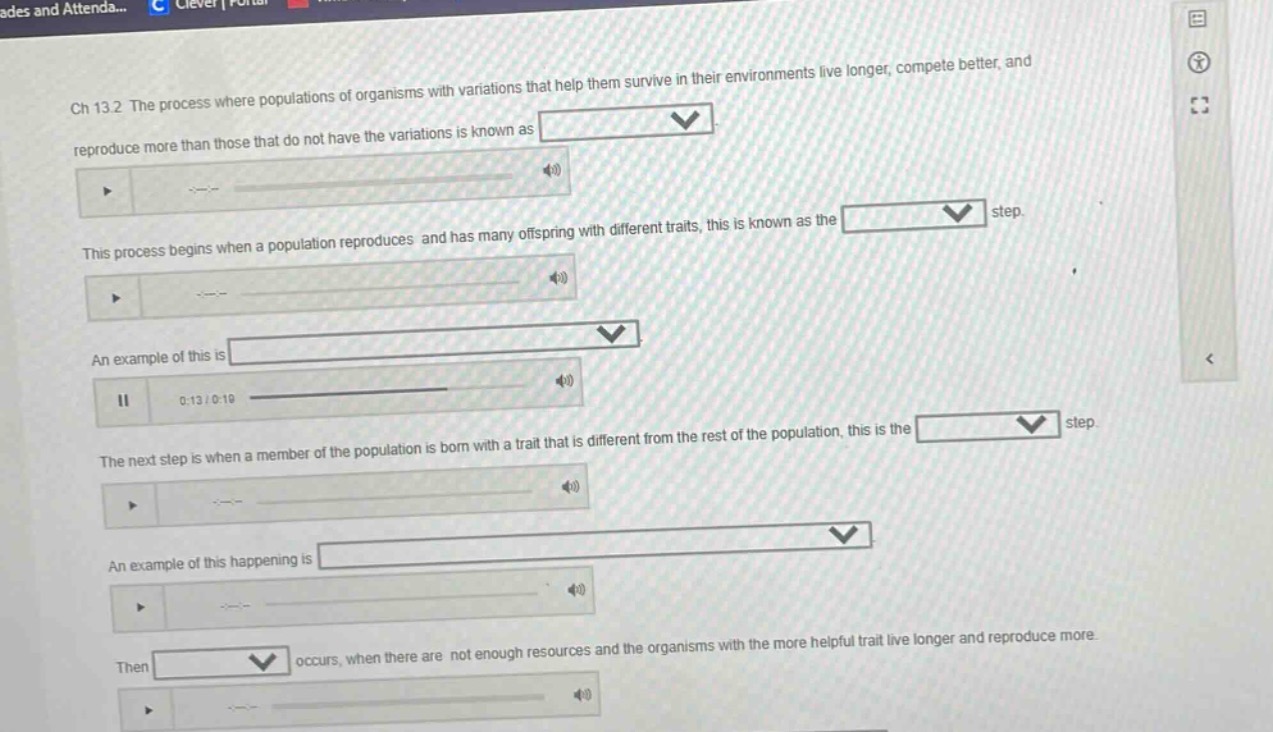
ch 13.2 the process where populations of organisms with variations that help them survive in their environments live longer, compete better, and reproduce more than those that do not have the variations is known as
this process begins when a population reproduces and has many offspring with different traits, this is known as the step.
an example of this is
the next step is when a member of the population is born with a trait that is different from the rest of the population, this is the step.
an example of this happening is
then occurs, when there are not enough resources and the organisms with the more helpful trait live longer and reproduce more.
To solve this problem, we analyze each blank based on the concepts of natural selection and its steps:
First Blank (Process Definition)
The process where organisms with beneficial variations survive, compete, and reproduce more is natural selection. This is the core concept of evolution by natural selection.
Second Blank (First Step of Natural Selection)
The first step of natural selection is when a population reproduces and has many offspring with different traits. This is known as overproduction (or "production of many offspring"). Populations produce more offspring than the environment can support, leading to competition.
Third Blank (Example of Overproduction)
An example of overproduction could be: "A female sea turtle lays hundreds of eggs, but most hatchlings do not survive to adulthood" (or any example where a species produces many offspring, most of which do not survive due to limited resources).
Fourth Blank (Second Step of Natural Selection)
The second step is when a member of the population is born with a trait different from the rest. This is variation (or "genetic variation"). Traits can vary due to mutations, genetic recombination, etc.
Fifth Blank (Example of Variation)
An example of variation could be: "A moth is born with a darker coloration than other moths in its population" (or any example of a heritable trait that differs from the population norm).
Sixth Blank (Third Step of Natural Selection)
The third step is when organisms with more helpful traits live longer and reproduce more due to limited resources. This is competition (or "survival of the fittest," where organisms compete for resources like food, shelter, or mates).
Final Answers (Filling the Blanks):
- The process: $\boldsymbol{\text{natural selection}}$
- First step: $\boldsymbol{\text{overproduction}}$ (example: "A female sea turtle lays hundreds of eggs...")
- Second step: $\boldsymbol{\text{variation}}$ (example: "A moth is born with a darker coloration...")
- Third step: $\boldsymbol{\text{competition}}$ (or "survival of the fittest")
(Note: The exact wording of examples may vary, but the key concepts are overproduction, variation, and competition as steps of natural selection.)

Snap & solve any problem in the app
Get step-by-step solutions on Sovi AI
Photo-based solutions with guided steps
Explore more problems and detailed explanations
To solve this problem, we analyze each blank based on the concepts of natural selection and its steps:
First Blank (Process Definition)
The process where organisms with beneficial variations survive, compete, and reproduce more is natural selection. This is the core concept of evolution by natural selection.
Second Blank (First Step of Natural Selection)
The first step of natural selection is when a population reproduces and has many offspring with different traits. This is known as overproduction (or "production of many offspring"). Populations produce more offspring than the environment can support, leading to competition.
Third Blank (Example of Overproduction)
An example of overproduction could be: "A female sea turtle lays hundreds of eggs, but most hatchlings do not survive to adulthood" (or any example where a species produces many offspring, most of which do not survive due to limited resources).
Fourth Blank (Second Step of Natural Selection)
The second step is when a member of the population is born with a trait different from the rest. This is variation (or "genetic variation"). Traits can vary due to mutations, genetic recombination, etc.
Fifth Blank (Example of Variation)
An example of variation could be: "A moth is born with a darker coloration than other moths in its population" (or any example of a heritable trait that differs from the population norm).
Sixth Blank (Third Step of Natural Selection)
The third step is when organisms with more helpful traits live longer and reproduce more due to limited resources. This is competition (or "survival of the fittest," where organisms compete for resources like food, shelter, or mates).
Final Answers (Filling the Blanks):
- The process: $\boldsymbol{\text{natural selection}}$
- First step: $\boldsymbol{\text{overproduction}}$ (example: "A female sea turtle lays hundreds of eggs...")
- Second step: $\boldsymbol{\text{variation}}$ (example: "A moth is born with a darker coloration...")
- Third step: $\boldsymbol{\text{competition}}$ (or "survival of the fittest")
(Note: The exact wording of examples may vary, but the key concepts are overproduction, variation, and competition as steps of natural selection.)