QUESTION IMAGE
Question
chapter 03 quiz: the biological bases of behavior
total points: --/20
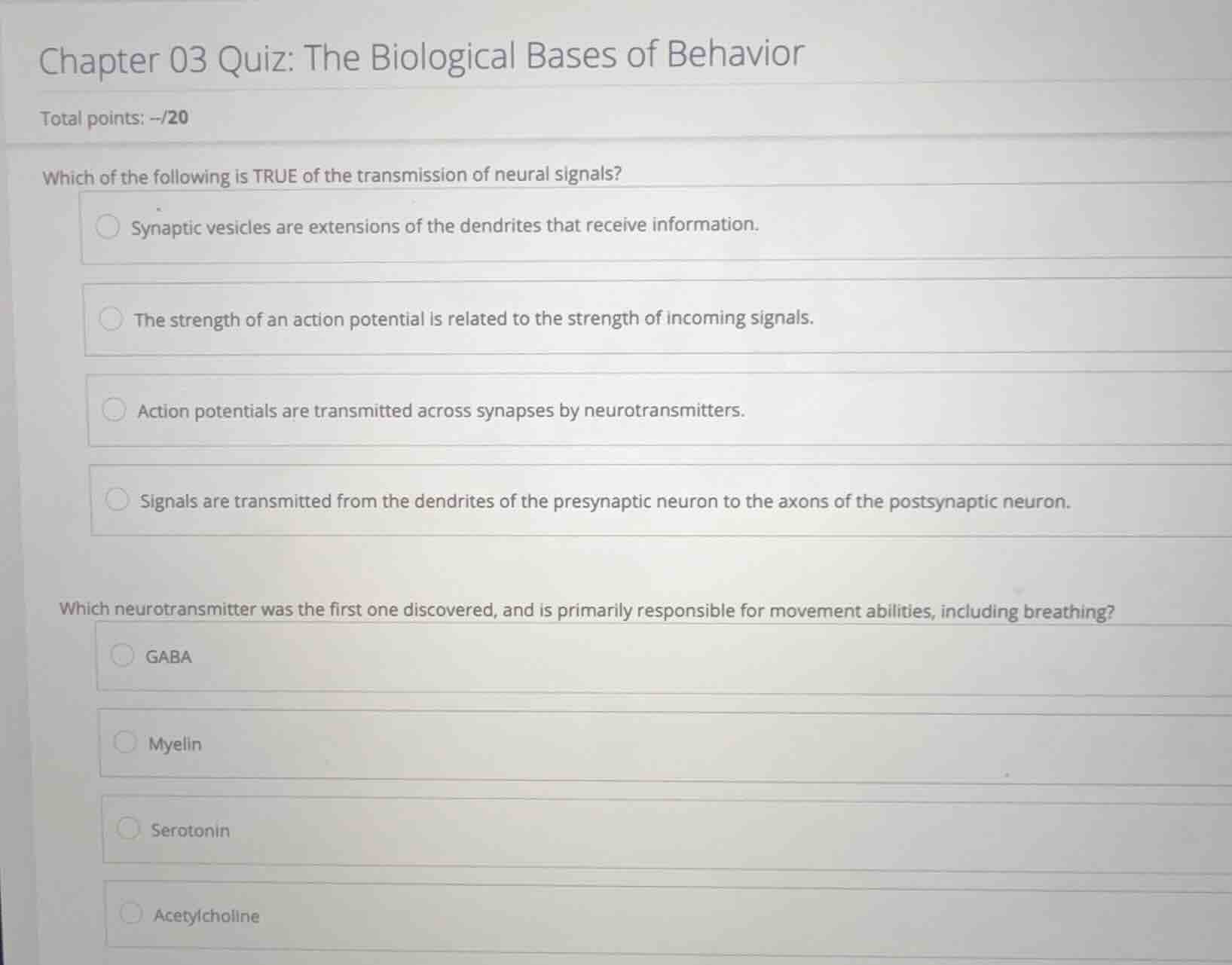
which of the following is true of the transmission of neural signals?
synaptic vesicles are extensions of the dendrites that receive information.
the strength of an action potential is related to the strength of incoming signals.
action potentials are transmitted across synapses by neurotransmitters.
signals are transmitted from the dendrites of the presynaptic neuron to the axons of the postsynaptic neuron.
which neurotransmitter was the first one discovered, and is primarily responsible for movement abilities, including breathing?
gaba
myelin
serotonin
acetylcholine
For the first question:
- Synaptic vesicles are small sacs in axon terminals (not dendrite extensions) that store neurotransmitters, so the first option is false.
- Action potentials follow the "all-or-none" law—their strength is constant, regardless of incoming signal strength, so the second option is false.
- When an action potential reaches a synapse, neurotransmitters are released to carry the signal to the next neuron, making this option true.
- Signals travel from the axon terminal of the presynaptic neuron to the dendrites of the postsynaptic neuron, so the fourth option is false.
For the second question:
- GABA is an inhibitory neurotransmitter, not linked to movement/breathing or the first discovered.
- Myelin is a fatty sheath, not a neurotransmitter.
- Serotonin regulates mood, sleep, etc., not movement/breathing as its primary role.
- Acetylcholine was the first discovered neurotransmitter, and it controls muscle movement, including the muscles involved in breathing.

Snap & solve any problem in the app
Get step-by-step solutions on Sovi AI
Photo-based solutions with guided steps
Explore more problems and detailed explanations
- Action potentials are transmitted across synapses by neurotransmitters.
- Acetylcholine