QUESTION IMAGE
Question
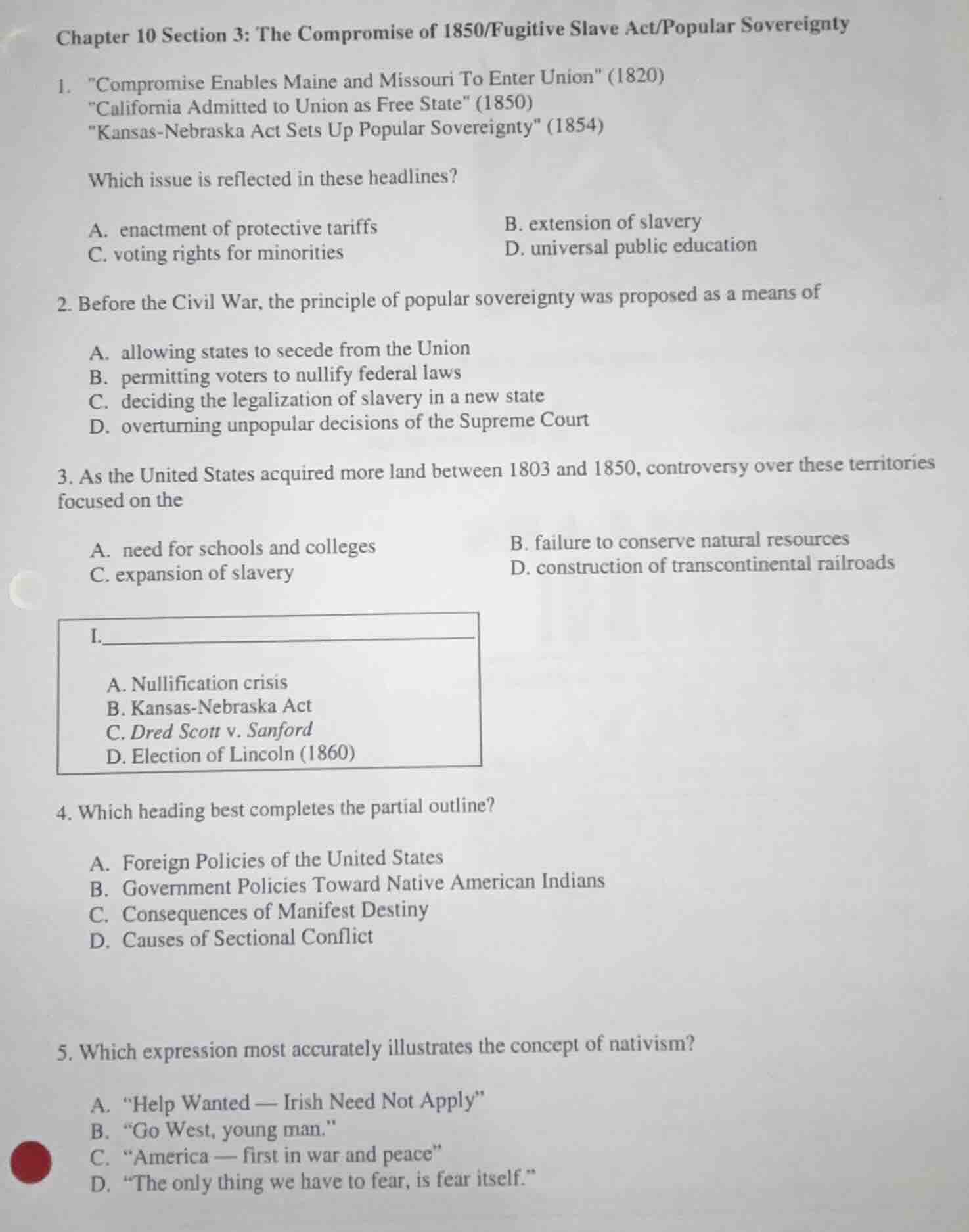
chapter 10 section 3: the compromise of 1850/fugitive slave act/popular sovereignty
- \compromise enables maine and missouri to enter union\ (1820)
\california admitted to union as free state\ (1850)
\kansas-nebraska act sets up popular sovereignty\ (1854)
which issue is reflected in these headlines?
a. enactment of protective tariffs b. extension of slavery
c. voting rights for minorities d. universal public education
- before the civil war, the principle of popular sovereignty was proposed as a means of
a. allowing states to secede from the union
b. permitting voters to nullify federal laws
c. deciding the legalization of slavery in a new state
d. overturning unpopular decisions of the supreme court
- as the united states acquired more land between 1803 and 1850, controversy over these territories focused on the
a. need for schools and colleges b. failure to conserve natural resources
c. expansion of slavery d. construction of transcontinental railroads
i.
a. nullification crisis
b. kansas-nebraska act
c. dred scott v. sanford
d. election of lincoln (1860)
- which heading best completes the partial outline?
a. foreign policies of the united states
b. government policies toward native american indians
c. consequences of manifest destiny
d. causes of sectional conflict
- which expression most accurately illustrates the concept of nativism?
a. \help wanted — irish need not apply\
b. \go west, young man.\
c. \america — first in war and peace\
d. \the only thing we have to fear, is fear itself.\
Question 1
The headlines involve Missouri Compromise (1820), California's admission (1850), and Kansas - Nebraska Act (1854). All these events were related to whether new states would be free or slave states, which is about the extension of slavery. Option A is about tariffs, C about minority voting rights, D about public education, none related.
Popular sovereignty before Civil War was about letting the people of a new territory decide if slavery would be legal there. Option A is secession, B is nullifying federal laws, D is overturning Supreme Court decisions, none match.
Between 1803 - 1850, as US acquired land, the main controversy was about whether slavery would expand into these new territories. Option A is about education, B about natural resources conservation, D about railroads, not related.

Snap & solve any problem in the app
Get step-by-step solutions on Sovi AI
Photo-based solutions with guided steps
Explore more problems and detailed explanations
B. extension of slavery