QUESTION IMAGE
Question
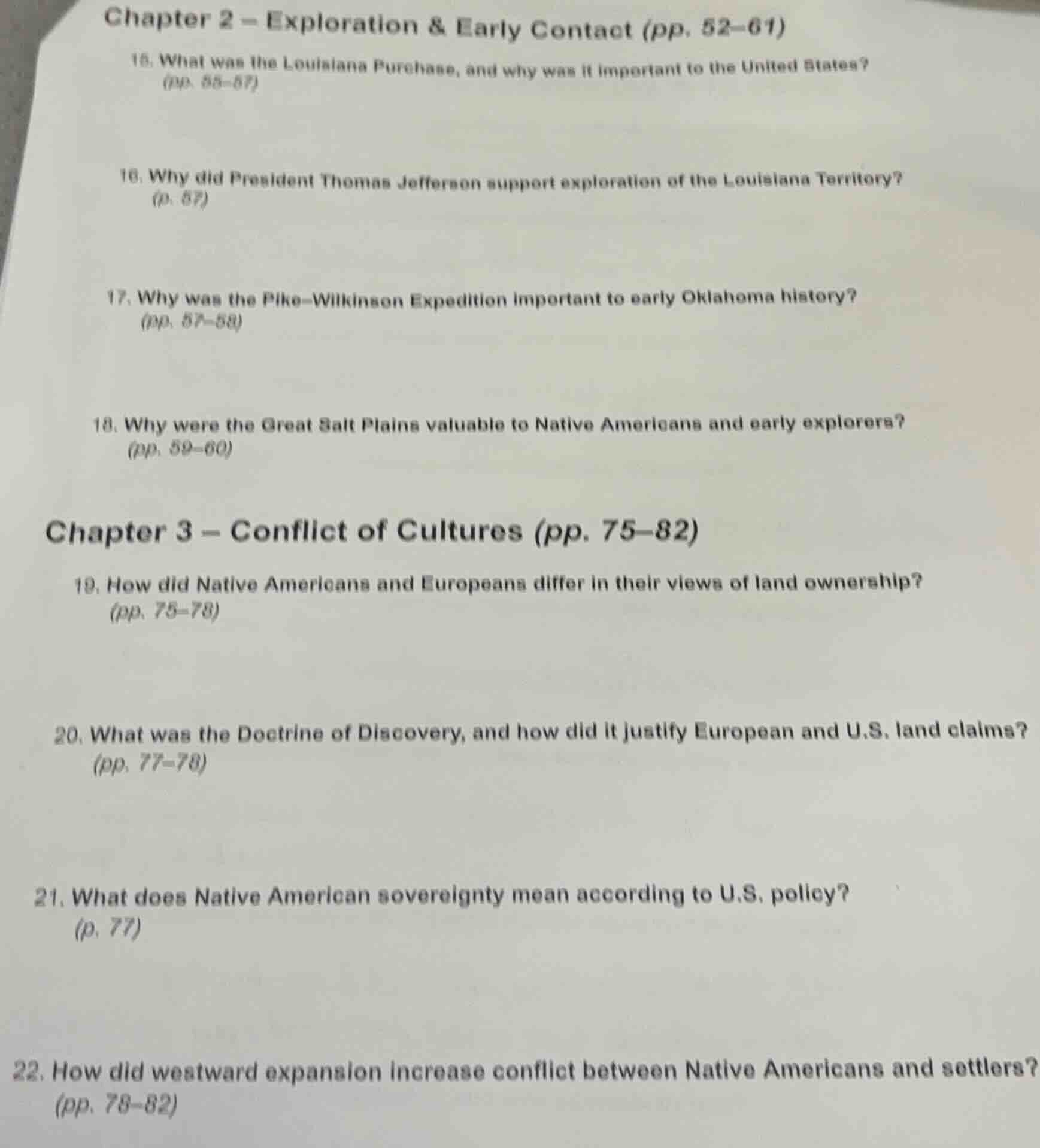
chapter 2 – exploration & early contact (pp. 52–61)
- what was the louisiana purchase, and why was it important to the united states?
(pp. 55–57)
- why did president thomas jefferson support exploration of the louisiana territory?
(p. 57)
- why was the pike–wilkinson expedition important to early oklahoma history?
(pp. 57–58)
- why were the great salt plains valuable to native americans and early explorers?
(pp. 59–60)
chapter 3 – conflict of cultures (pp. 75–82)
- how did native americans and europeans differ in their views of land ownership?
(pp. 75–78)
- what was the doctrine of discovery, and how did it justify european and u.s. land claims?
(pp. 77–78)
- what does native american sovereignty mean according to u.s. policy?
(p. 77)
- how did westward expansion increase conflict between native americans and settlers?
(pp. 78–82)
These are history - related questions (subfield: History under Social Science). Here are the answers for each question:
Question 15
The Louisiana Purchase was when the US bought the Louisiana Territory from France in 1803 for about $15 million. It was important as it doubled the US's size, gave access to the Mississippi River and the port of New Orleans for trade, and opened up vast land for settlement and exploration.
Jefferson supported exploration to learn about the new territory's geography, resources, and native peoples. He also wanted to find a water route to the Pacific, promote trade, and establish US claims over the region before other nations.
The Pike - Wilkinson Expedition explored parts of what is now Oklahoma. It mapped the region, documented Native American tribes and their cultures, and provided information about the land's resources and geography, which was crucial for future settlement, understanding of the area, and US claims to the region.

Snap & solve any problem in the app
Get step-by-step solutions on Sovi AI
Photo-based solutions with guided steps
Explore more problems and detailed explanations
The Louisiana Purchase was the acquisition of the Louisiana Territory (around 828,000 square miles) by the United States from France in 1803 for approximately $15 million. It was important because it doubled the size of the United States, provided control of the Mississippi River and the port of New Orleans (critical for trade), and opened up huge amounts of land for westward expansion, settlement, and exploration.