QUESTION IMAGE
Question
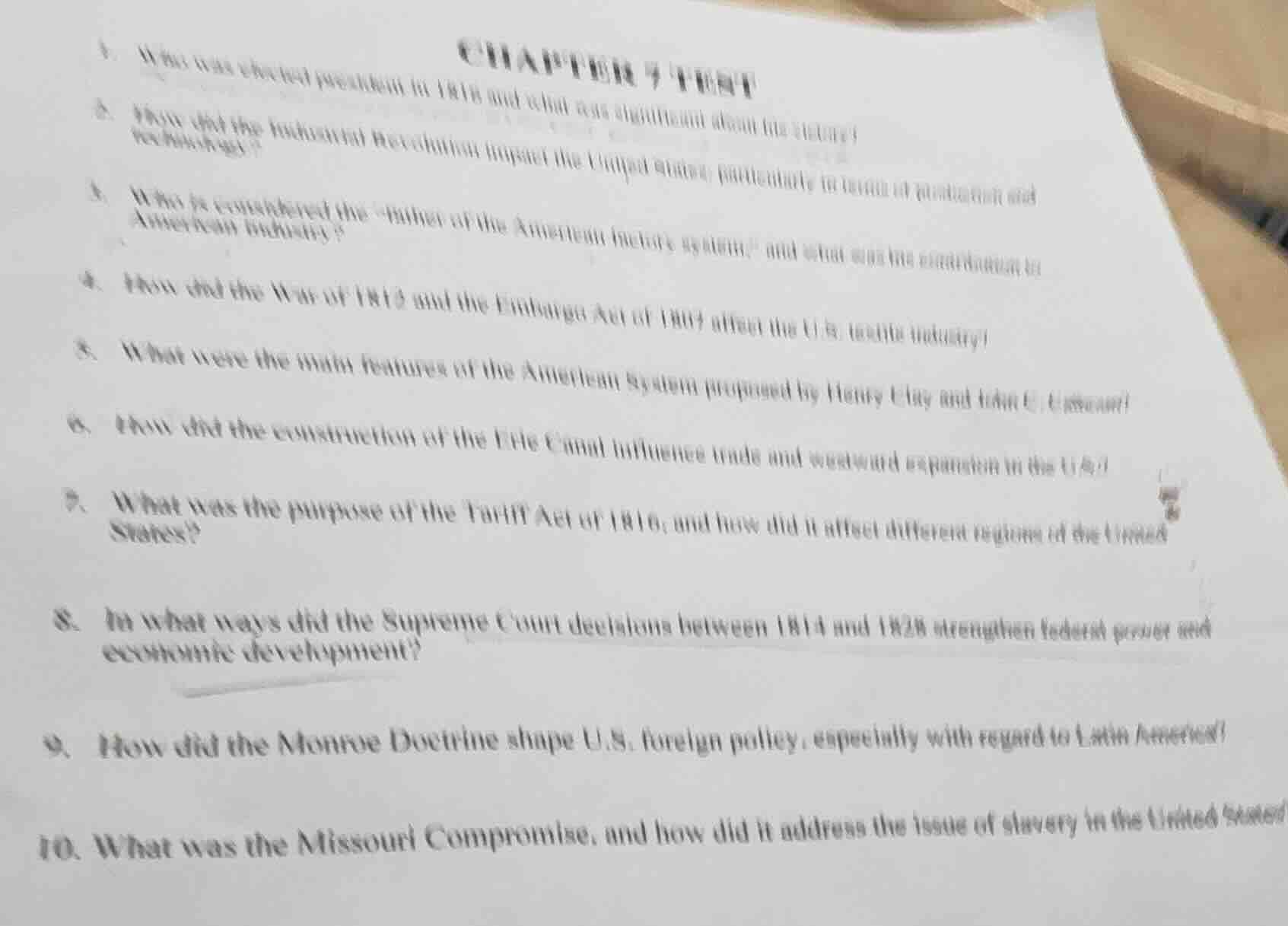
chapter 7 test1. who was elected president in 1816 and what was significant about his victory?2. how did the industrial revolution impact the united states, particularly in terms of plantation and technology?3. who is considered the \father of the american factory system,\ and what was his contribution to american industry?4. how did the war of 1812 and the embargo act of 1807 affect the u.s. textile industry?5. what were the main features of the american system proposed by henry clay and john c. calhoun?6. how did the construction of the erie canal influence trade and westward expansion in the u.s.?7. what was the purpose of the tariff act of 1816, and how did it affect different regions of the united states?8. in what ways did the supreme court decisions between 1814 and 1828 strengthen federal power and economic development?9. how did the monroe doctrine shape u.s. foreign policy, especially with regard to latin america?10. what was the missouri compromise, and how did it address the issue of slavery in the united states?
- Covers key 1816 U.S. presidential election details.
- Explains Industrial Revolution's U.S. impacts on labor and tech.
- Identifies the "Father of the American Factory System" and his contribution.
- Details War of 1812/1807 Embargo Act effects on textiles.
- Lists core features of Clay/Crawford's American System.
- Explains Erie Canal's trade and expansion impacts.
- Outlines 1816 Tariff's purpose and regional effects.
- Summarizes 1814-1828 Supreme Court rulings' federal/economic impacts.
- Describes Monroe Doctrine's foreign policy role, especially with Latin America.
- Defines the Missouri Compromise and its slavery-related provisions.

Snap & solve any problem in the app
Get step-by-step solutions on Sovi AI
Photo-based solutions with guided steps
Explore more problems and detailed explanations
- James Monroe was elected president in 1816. His victory was significant because it marked the end of the First Party System (Federalist Party collapsed, leaving Monroe's Democratic-Republicans nearly unopposed, creating the "Era of Good Feelings").
- The Industrial Revolution led to the growth of factory-based manufacturing in the U.S. (replacing home production), spurred technological innovations like the cotton gin, and shifted labor from rural agricultural work to urban factory jobs; it also increased demand for raw materials from Southern plantations, strengthening the link between Northern industry and Southern slavery.
- Samuel Slater is considered the "Father of the American Factory System." His contribution was adapting British textile mill technology and building the first successful water-powered cotton spinning mill in the U.S. (Pawtucket, Rhode Island in 1790), launching the American textile industry.
- The Embargo Act of 1807 cut off U.S. trade with Europe, forcing the U.S. to develop its own textile industry to replace imported British goods. The War of 1812 continued this trade disruption, further protecting and growing domestic textile manufacturing by eliminating competition from British textiles.
- The main features of the American System were: (1) a protective tariff to shield domestic industry, (2) the establishment of a national bank to standardize currency and fund economic development, (3) federal funding for internal improvements (roads, canals) to connect regional economies.
- The Erie Canal created a direct water route between the Great Lakes and the Atlantic Ocean, drastically reducing transportation costs for goods. It boosted trade by making Midwestern farm products (grain, livestock) cheaper to ship to Eastern markets, and it encouraged westward expansion by making settlement in the Midwest more economically viable.
- The purpose of the Tariff Act of 1816 was to protect newly developed American manufacturing from cheaper British imports. It benefited Northern industrial regions by making domestic goods more competitive, but harmed Southern regions: the South relied on imported manufactured goods, so the tariff raised their costs, and it risked British retaliation against Southern cotton exports.
- Supreme Court decisions like McCulloch v. Maryland (1819) upheld the national bank and established federal supremacy over state laws, strengthening federal economic authority. Gibbons v. Ogden (1824) expanded federal power to regulate interstate commerce, creating a unified national market that supported economic development. Dartmouth College v. Woodward (1819) protected private corporate charters, encouraging business investment.
- The Monroe Doctrine (1823) declared the Americas off-limits to further European colonization and stated that the U.S. would view European interference in Latin American affairs as a hostile act. It shaped U.S. foreign policy by establishing a framework for U.S. dominance in the Western Hemisphere, and it provided implicit support for Latin American nations that had recently gained independence from Europe.
- The Missouri Compromise (1820) was a legislative agreement to resolve sectional tensions over slavery. It admitted Missouri as a slave state, Maine as a free state, and established a line (36°30' parallel) across the Louisiana Territory: slavery was allowed south of the line, and prohibited north of it (except for Missouri). It temporarily balanced the number of free and slave states in Congress and delayed a major national crisis over slavery.