QUESTION IMAGE
Question
choose 1 answer:
a
| genotype | phenotype (no beryllium exposure) | phenot (berylli exposu) |
|---|---|---|
| no mutation | typical risk of cbd | elevate risk of cbd |
b
| genotype | phenotype (no beryllium exposure) | phenot (berylli exposu) |
|---|---|---|
| no mutation | typical risk of cbd | elevate risk of cbd |
c
| genotype | phenotype (no beryllium exposure) | phenot (berylli exposu) |
|---|---|---|
| no of 10 | typical risk | highly |
Response
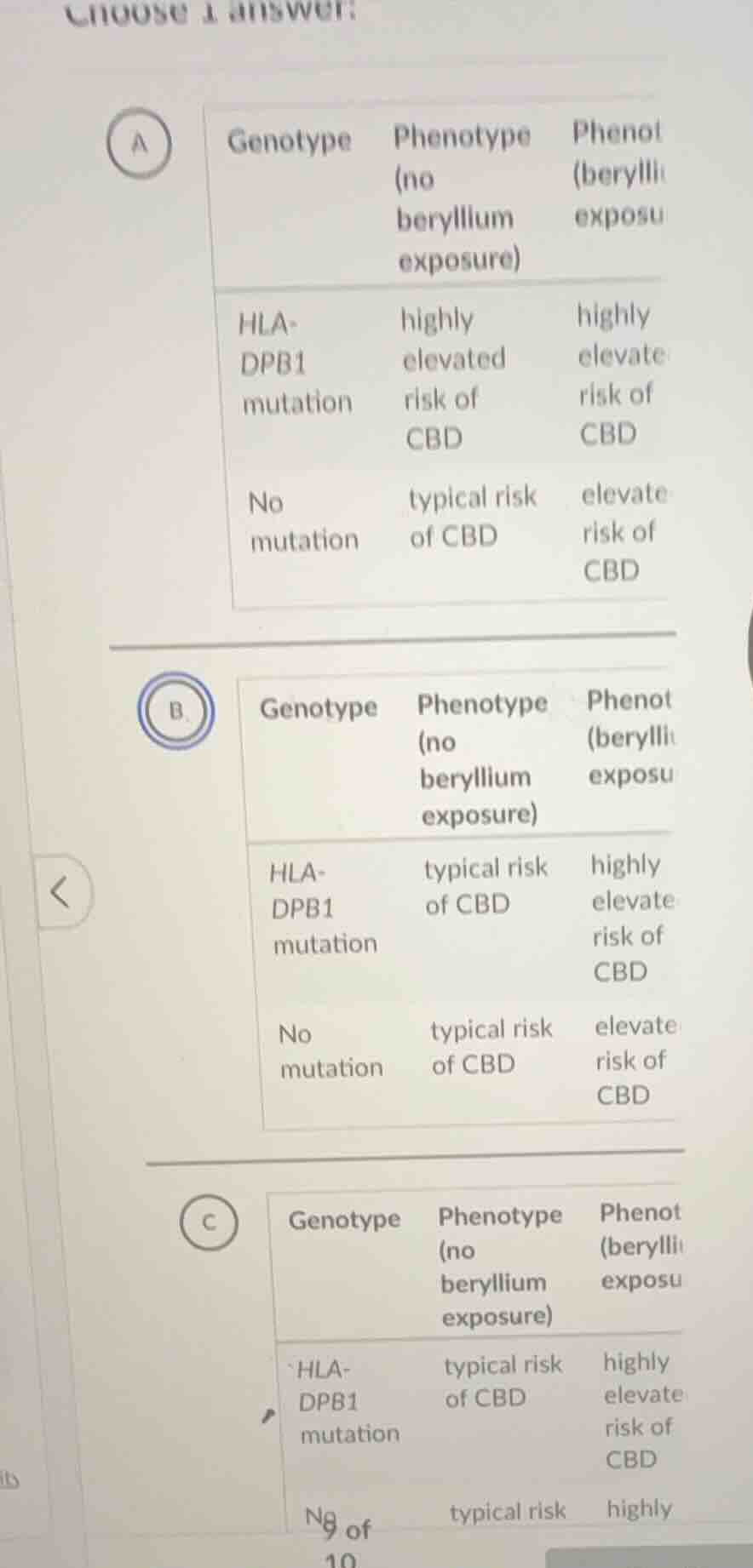
To solve this, we analyze the relationship between genotype, beryllium exposure, and CBD risk:
- Understand the Phenotype Logic:
- For a mutation (HLA - DPB1 mutation) to show its effect (high CBD risk), it should only do so with beryllium exposure (since genetic mutations often require environmental triggers). Without exposure, the mutation should not elevate risk (to distinguish it from non - mutated cases without exposure).
- Non - mutated individuals should have “typical risk” without exposure and “elevated risk” with exposure (consistent across options for non - mutation, but we focus on the mutation row).
- Analyze Each Option:
- Option A: The “HLA - DPB1 mutation” row has “highly elevated risk” without beryllium exposure. This is illogical because a genetic mutation for CBD risk should require beryllium exposure to express (otherwise, the mutation would always cause high risk, which contradicts the “exposure - dependent” pattern implied by the table structure).
- Option B:
- “HLA - DPB1 mutation” row: “typical risk” (no exposure) and “highly elevated risk” (with exposure) – this matches the expected logic (mutation + exposure = high risk; mutation + no exposure = typical risk).
- “No mutation” row: “typical risk” (no exposure) and “elevated risk” (with exposure) – consistent with non - mutated individuals having a smaller risk increase with exposure.
- Option C: The “No mutation” row is incomplete and inconsistent (shows “highly” risk with exposure, which does not match the “elevated” risk seen in other options for non - mutation).

Snap & solve any problem in the app
Get step-by-step solutions on Sovi AI
Photo-based solutions with guided steps
Explore more problems and detailed explanations
B. Option Text (the table in Option B where HLA - DPB1 mutation has typical risk without exposure and highly elevated risk with exposure, and no mutation has typical risk without exposure and elevated risk with exposure)