QUESTION IMAGE
Question
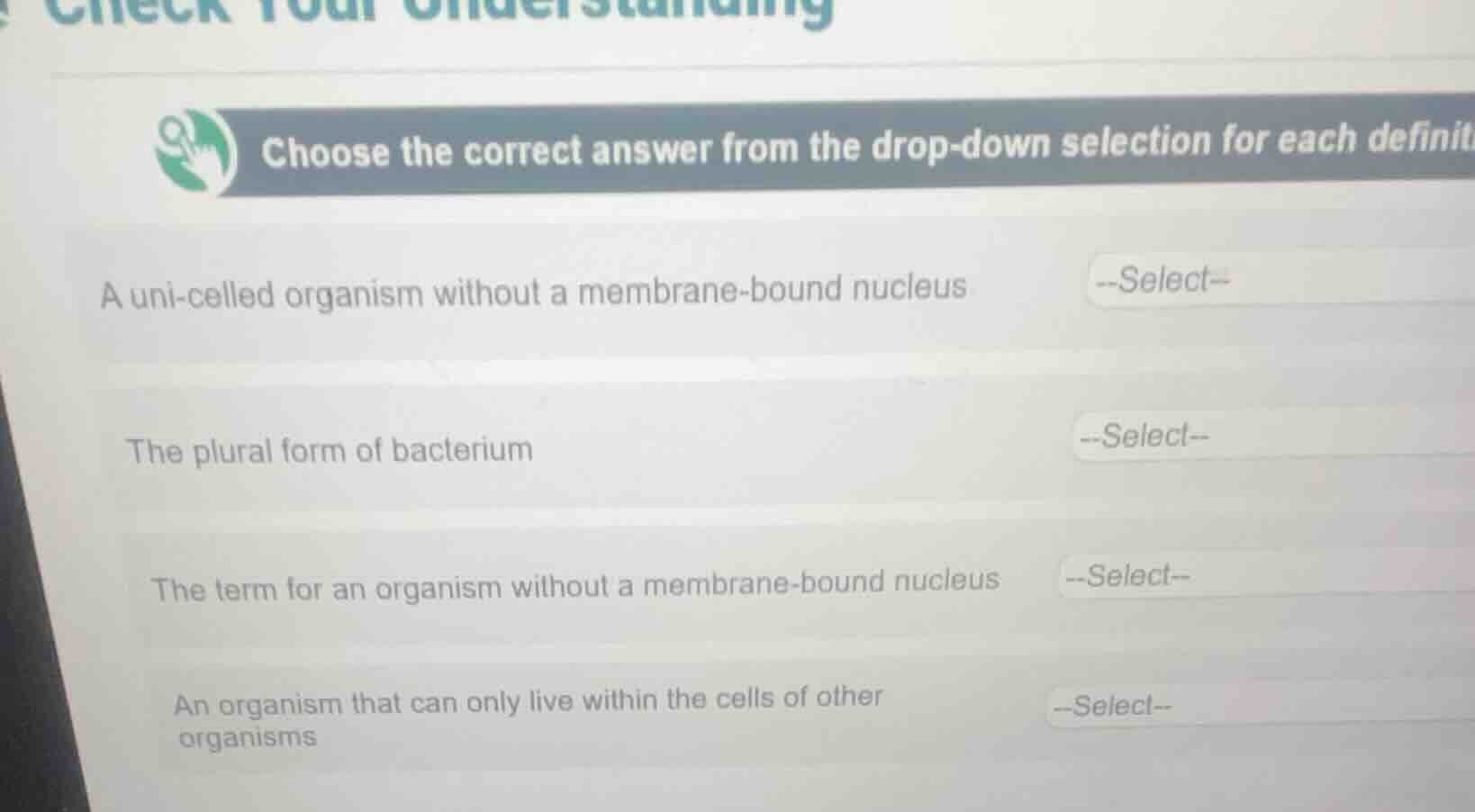
choose the correct answer from the drop - down selection for each definiti a uni - celled organism without a membrane - bound nucleus --select-- the plural form of bacterium --select-- the term for an organism without a membrane - bound nucleus --select-- an organism that can only live within the cells of other organisms --select--
First Sub - Question: "A uni - celled organism without a membrane - bound nucleus"
In biology, prokaryotes are unicellular organisms that lack a membrane - bound nucleus. Bacteria are a type of prokaryote. So the correct term for a uni - celled organism without a membrane - bound nucleus is "bacterium" (or in the context of the definition, the organism is a bacterium - like prokaryote, and the term that fits this definition is "bacterium" or "prokaryote", but in the context of the drop - down (assuming options include "bacterium", "bacteria", "prokaryote", "virus"), the correct answer for this definition is "bacterium" (as bacteria are unicellular prokaryotes).
The plural form of "bacterium" is "bacteria". This is a standard pluralization in biological terminology.
In biology, organisms without a membrane - bound nucleus are called "prokaryotes". Bacteria are prokaryotes, but the general term for such organisms is "prokaryote".

Snap & solve any problem in the app
Get step-by-step solutions on Sovi AI
Photo-based solutions with guided steps
Explore more problems and detailed explanations
The correct term for a uni - celled organism without a membrane - bound nucleus is "bacterium" (assuming the drop - down options include it. If options are like: A. bacterium, B. bacteria, C. prokaryote, D. virus, then the answer is A. bacterium)