QUESTION IMAGE
Question
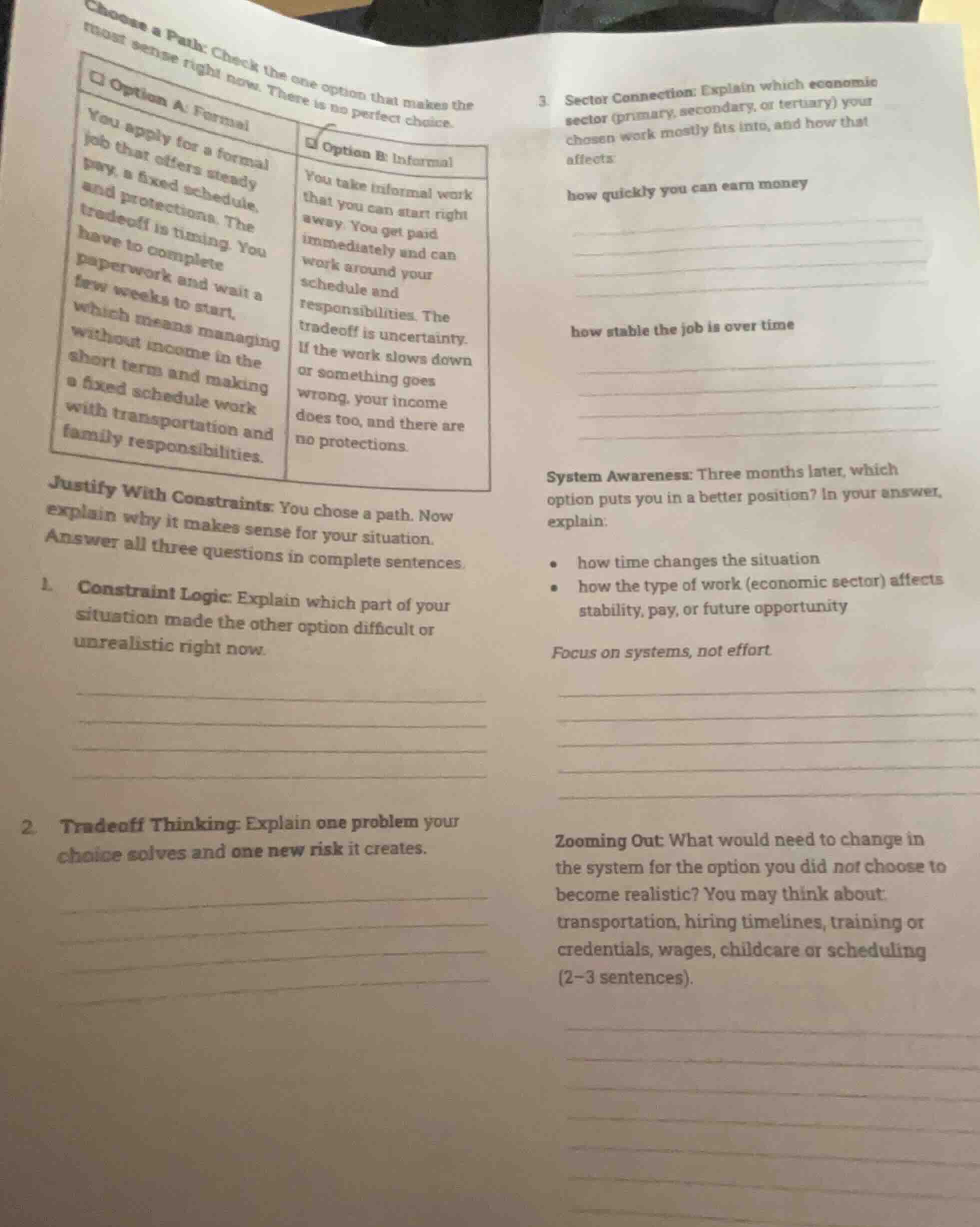
choose a path: check the one option that makes the most sense right now. there is no perfect choice.
option a: formal
you apply for a formal job that offers steady pay, a fixed schedule, and protections. the tradeoff is timing. you have to complete paperwork and wait a few weeks to start, which means managing without income in the short term and making a fixed schedule work with transportation and family responsibilities.
option b: informal
you take informal work that you can start right away. you get paid immediately and can work around your schedule and responsibilities. the tradeoff is uncertainty. if the work slows down or something goes wrong, your income does too, and there are no protections.
justify with constraints: you chose a path. now explain why it makes sense for your situation. answer all three questions in complete sentences.
- constraint logic: explain which part of your situation made the other option difficult or unrealistic right now.
- tradeoff thinking: explain one problem your choice solves and one new risk it creates.
- sector connection: explain which economic sector (primary, secondary, or tertiary) your chosen work mostly fits into, and how that affects
how quickly you can earn money
how stable the job is over time
system awareness: three months later, which option puts you in a better position? in your answer, explain.
- how time changes the situation
- how the type of work (economic sector) affects stability, pay, or future opportunity
focus on systems, not effort.
zooming out: what would need to change in the system for the option you did not choose to become realistic? you may think about: transportation, hiring timelines, training or credentials, wages, childcare or scheduling (2–3 sentences).
1. Constraint Logic
I currently rely on immediate income to cover ongoing family expenses like childcare and utility bills, so waiting weeks to start formal work (with no short-term income) is unrealistic for my situation.
2. Tradeoff Thinking
This choice solves the urgent problem of needing immediate income to cover my family’s daily costs. A new risk it creates is that my income could drop suddenly if the available informal work dries up with no advance notice.
3. Sector Connection
Informal work mostly fits into the tertiary sector (e.g., gig-based delivery or casual retail services).
- How quickly you can earn money: Since informal work pays immediately, I can earn money on the same day I start working, which lets me cover urgent costs right away.
- How stable the job is over time: Tertiary informal work is tied to variable consumer demand, so the job is unstable—work hours and income can shrink suddenly if demand drops, with no employment protections to fall back on.
System Awareness
After three months, the formal work option puts me in a better position.
- How time changes the situation: After three months, I would have already completed the formal job’s paperwork and waiting period, so I would be receiving steady, reliable pay instead of relying on unpredictable informal work shifts.
- How the type of work (economic sector) affects stability, pay, or future opportunity: Formal tertiary sector work (e.g., a permanent retail role) comes with consistent hours, employment protections, and potential for raises or promotions over time, while informal tertiary work offers no long-term security or growth paths.
Zooming Out
For the formal work option to become realistic, the system would need to offer a shortened hiring and onboarding timeline, so I could start the formal job within a few days instead of weeks. Additionally, the system would need to provide temporary emergency income support to cover my family’s costs during the waiting period before the formal job starts, eliminating the need for immediate informal work to make ends meet.

Snap & solve any problem in the app
Get step-by-step solutions on Sovi AI
Photo-based solutions with guided steps
Explore more problems and detailed explanations
1. Constraint Logic
I currently rely on immediate income to cover ongoing family expenses like childcare and utility bills, so waiting weeks to start formal work (with no short-term income) is unrealistic for my situation.
2. Tradeoff Thinking
This choice solves the urgent problem of needing immediate income to cover my family’s daily costs. A new risk it creates is that my income could drop suddenly if the available informal work dries up with no advance notice.
3. Sector Connection
Informal work mostly fits into the tertiary sector (e.g., gig-based delivery or casual retail services).
- How quickly you can earn money: Since informal work pays immediately, I can earn money on the same day I start working, which lets me cover urgent costs right away.
- How stable the job is over time: Tertiary informal work is tied to variable consumer demand, so the job is unstable—work hours and income can shrink suddenly if demand drops, with no employment protections to fall back on.
System Awareness
After three months, the formal work option puts me in a better position.
- How time changes the situation: After three months, I would have already completed the formal job’s paperwork and waiting period, so I would be receiving steady, reliable pay instead of relying on unpredictable informal work shifts.
- How the type of work (economic sector) affects stability, pay, or future opportunity: Formal tertiary sector work (e.g., a permanent retail role) comes with consistent hours, employment protections, and potential for raises or promotions over time, while informal tertiary work offers no long-term security or growth paths.
Zooming Out
For the formal work option to become realistic, the system would need to offer a shortened hiring and onboarding timeline, so I could start the formal job within a few days instead of weeks. Additionally, the system would need to provide temporary emergency income support to cover my family’s costs during the waiting period before the formal job starts, eliminating the need for immediate informal work to make ends meet.