QUESTION IMAGE
Question
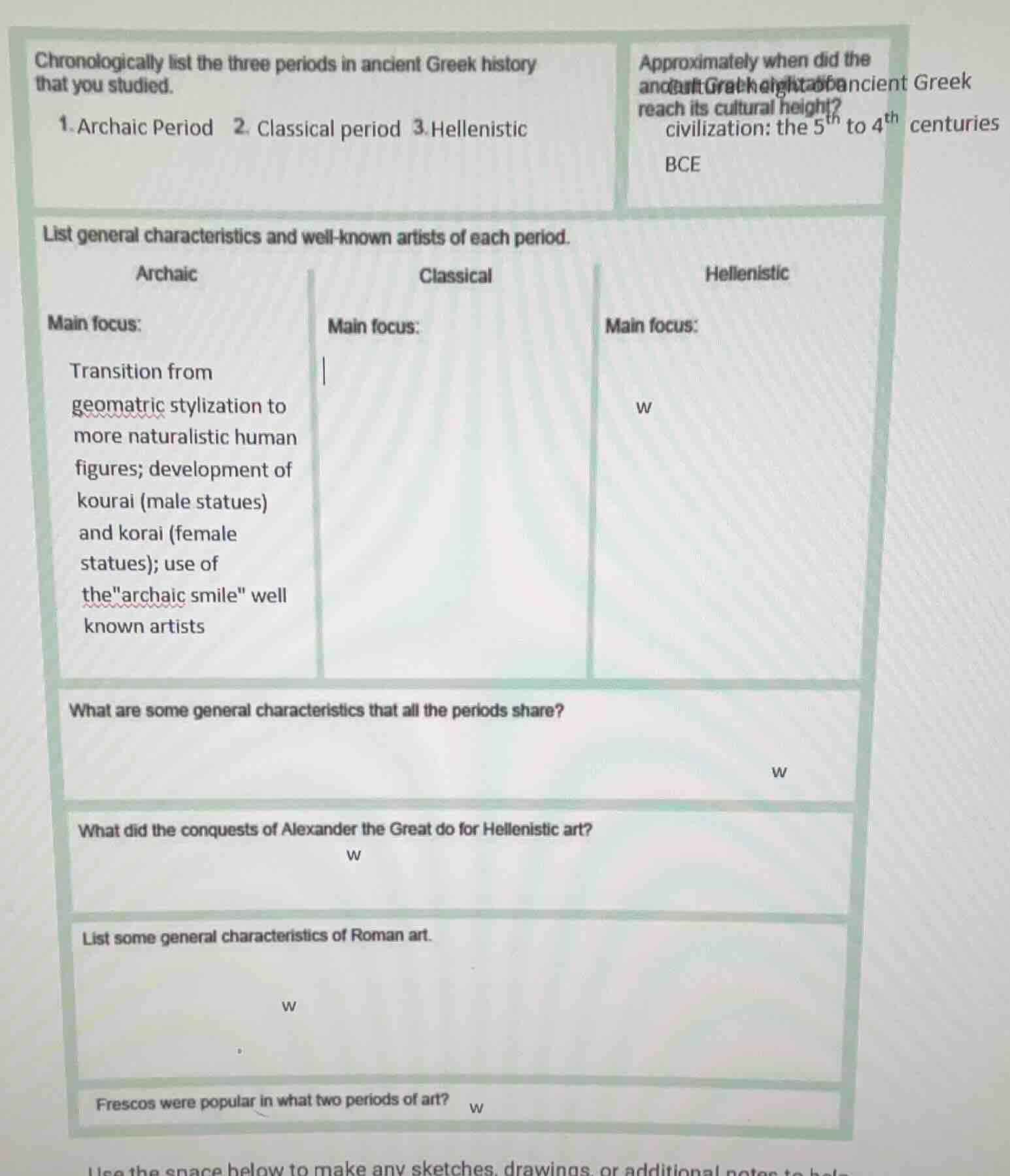
chronologically list the three periods in ancient greek history that you studied.
- archaic period 2. classical period 3. hellenistic
approximately when did the ancient greek civilization reach its cultural height?
and the height of ancient greek civilization: the $5^{th}$ to $4^{th}$ centuries bce
list general characteristics and well-known artists of each period.
archaic
main focus:
transition from geomatric stylization to more naturalistic human figures; development of kourai (male statues) and korai (female statues); use of the\archaic smile\ well known artists
classical
main focus:
hellenistic
main focus:
what are some general characteristics that all the periods share?
what did the conquests of alexander the great do for hellenistic art?
list some general characteristics of roman art.
frescos were popular in what two periods of art?
- Classical Period Characteristics & Artists: Focused on idealized, proportional human figures; balanced, harmonious compositions. Key artists include Phidias (sculptor of the Parthenon marbles) and Polykleitos (known for the Doryphoros).
- Hellenistic Period Characteristics & Artists: Emphasized dramatic emotion, realism, dynamic poses, and intricate detail. Key artists include Praxiteles (sculptor of Aphrodite of Knidos) and Lysippos (sculptor of Apoxyomenos).
- Shared Greek Period Characteristics: All centered on human-centric art (focus on the human form as a core subject); drew inspiration from mythology and daily life; used marble as a primary medium for sculpture; and developed architectural orders (Doric, Ionic, Corinthian) across the periods.
- Alexander the Great's Impact on Hellenistic Art: His conquests spread Greek artistic techniques and styles across the Mediterranean and Near East, blending Greek traditions with local cultural elements (Egyptian, Persian, etc.). This created a more diverse, cosmopolitan art form with expanded subject matter and new regional artistic centers.
- General Roman Art Characteristics: Focused on realism (especially in portraiture, capturing individual features); practical and functional art (e.g., mosaics, murals for domestic spaces, public monuments); adaptation and expansion of Greek artistic styles with a focus on commemorating power, history, and civic identity; and widespread use of concrete for large-scale architecture.
- Periods with Popular Frescos: Ancient Roman art (Pompeii and Herculaneum) and the Hellenistic period (used in domestic and public spaces across the Hellenistic world).

Snap & solve any problem in the app
Get step-by-step solutions on Sovi AI
Photo-based solutions with guided steps
Explore more problems and detailed explanations
- Classical Period
Main focus: Idealized human anatomy; balanced harmony
Well-known artists: Phidias, Polykleitos
- Hellenistic Period
Main focus: Dramatic emotion; dynamic realism
Well-known artists: Praxiteles, Lysippos
- Shared Greek Period Characteristics: Human-centric subject matter; marble sculpture focus; mythological/daily life inspiration; evolving architectural orders.
- Alexander the Great's Impact: Spread Greek art across regions, blended Greek and local styles, expanded artistic subject matter and centers.
- Roman Art Characteristics: Realistic portraiture; functional, civic-focused art; adapted Greek styles; concrete architecture.
- Periods with Popular Frescos: Hellenistic period, Ancient Roman period