QUESTION IMAGE
Question
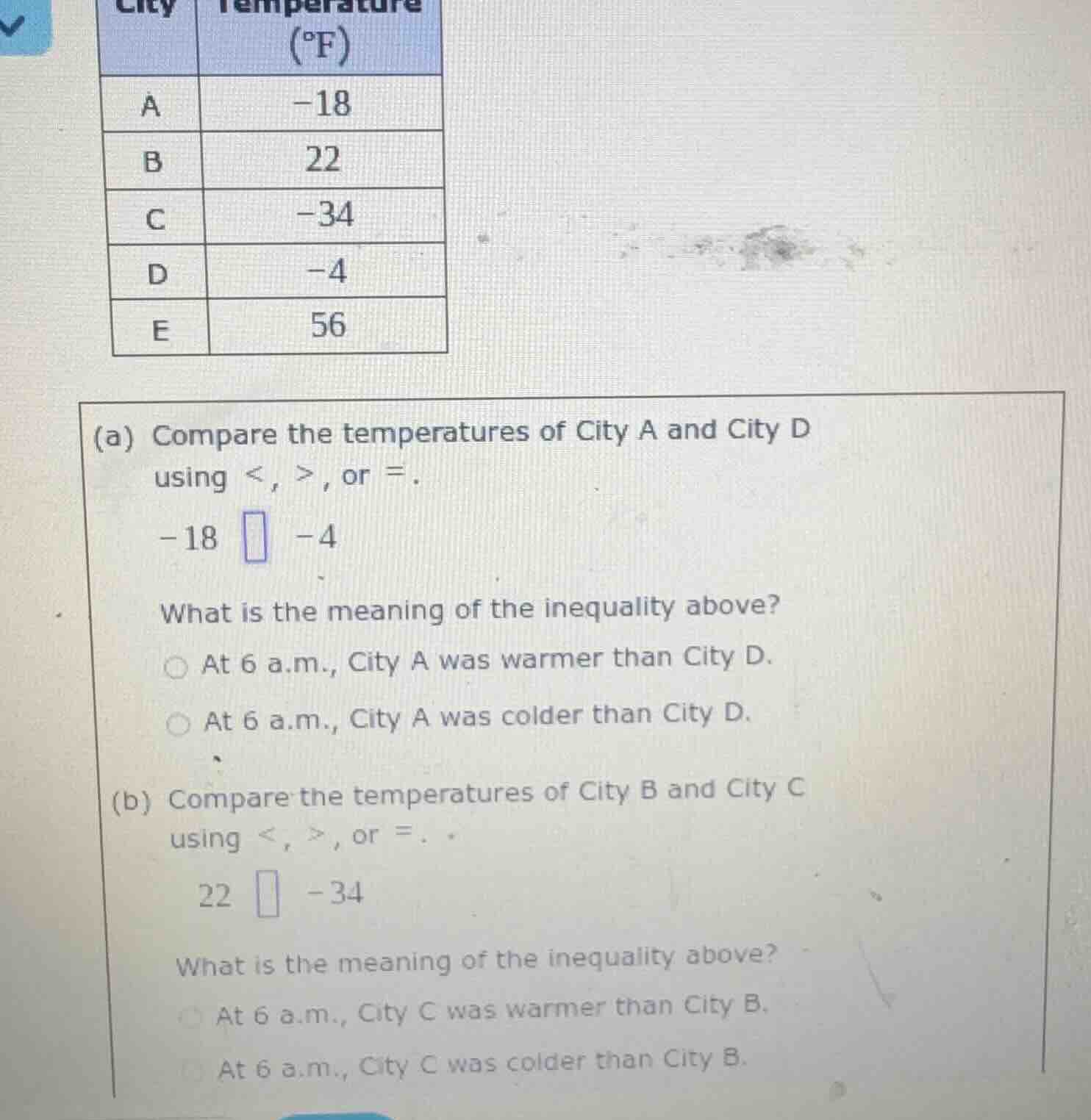
city | temperature (°f)
a | -18
b | 22
c | -34
d | -4
(a) compare the temperatures of city a and city d using <, >, or =.
-18 square -4
what is the meaning of the inequality above?
○ at 6 a.m., city a was warmer than city d.
○ at 6 a.m., city a was colder than city d.
(b) compare the temperatures of city b and city c using <, >, or =.
22 square -34
what is the meaning of the inequality above?
○ at 6 a.m., city c was warmer than city b.
○ at 6 a.m., city c was colder than city b.
Part (a)
Step1: Recall negative number comparison
For negative numbers, the larger the absolute value, the smaller the number. \(|-18| = 18\), \(|-4| = 4\). Since \(18>4\), \(-18 < -4\).
Step2: Interpret the inequality
A lower temperature (more negative or smaller number) means colder. Since \(-18 < -4\), City A's temperature is lower, so it's colder than City D.
Step1: Compare positive and negative number
A positive number is always greater than a negative number. So \(22 > -34\).
Step2: Interpret the inequality
A higher temperature (larger number) means warmer. Since \(22 > -34\), City C's temperature is lower (more negative), so it's colder than City B.

Snap & solve any problem in the app
Get step-by-step solutions on Sovi AI
Photo-based solutions with guided steps
Explore more problems and detailed explanations
\(-18\ \boldsymbol{<}\ -4\); At 6 a.m., City A was colder than City D.