QUESTION IMAGE
Question
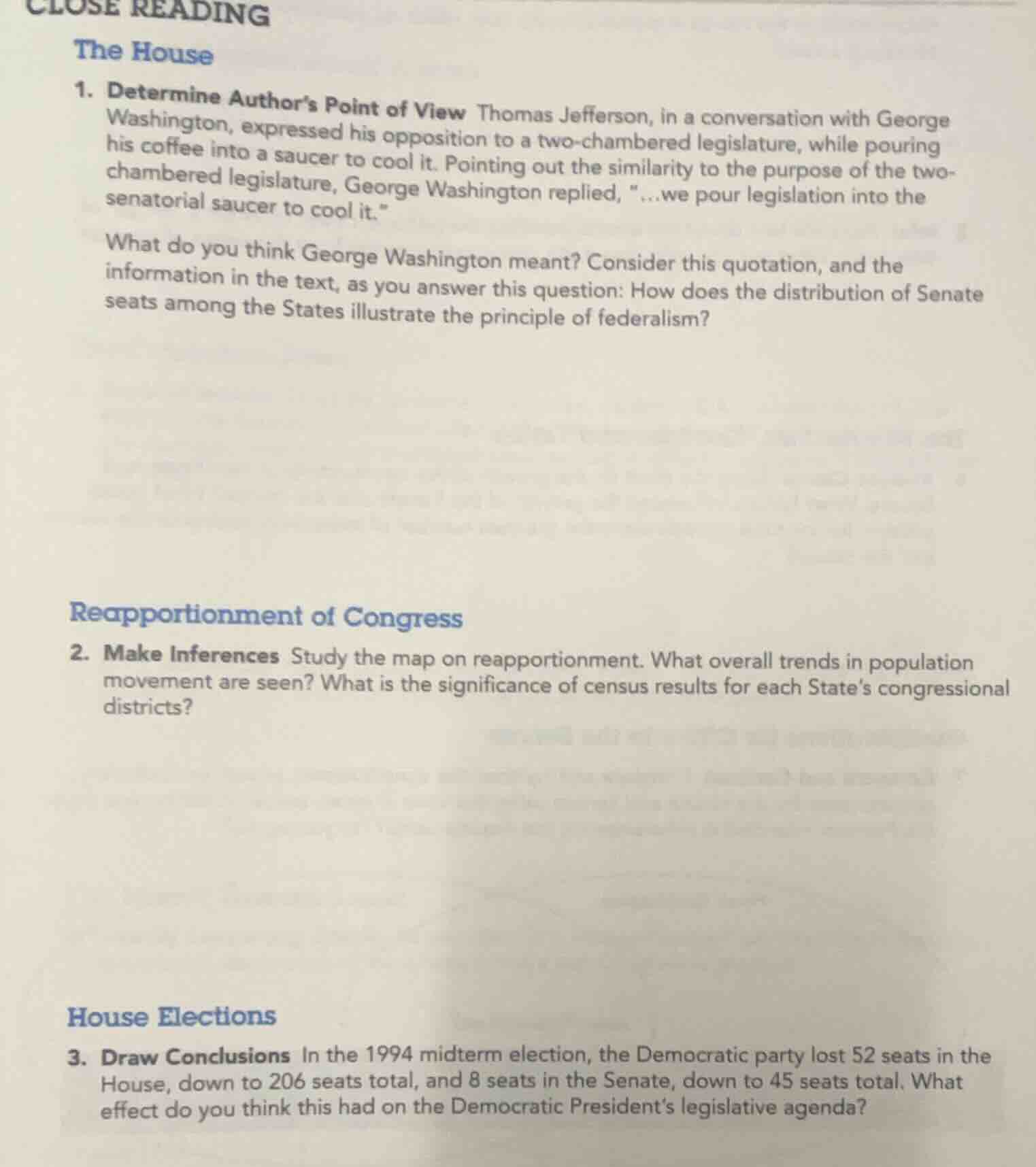
close reading
the house
- determine author’s point of view thomas jefferson, in a conversation with george washington, expressed his opposition to a two - chambered legislature, while pouring his coffee into a saucer to cool it. pointing out the similarity to the purpose of the two - chambered legislature, george washington replied, “...we pour legislation into the senatorial saucer to cool it.”
what do you think george washington meant? consider this quotation, and the information in the text, as you answer this question: how does the distribution of senate seats among the states illustrate the principle of federalism?
reapportionment of congress
- make inferences study the map on reapportionment. what overall trends in population movement are seen? what is the significance of census results for each state’s congressional districts?
house elections
- draw conclusions in the 1994 midterm election, the democratic party lost 52 seats in the house, down to 206 seats total, and 8 seats in the senate, down to 45 seats total. what effect do you think this had on the democratic president’s legislative agenda?
- For question 1:
- Washington meant the Senate acts to slow/moderate legislation, like a saucer cools coffee. Senate seats are evenly distributed (2 per state) regardless of population, balancing power between small and large states, which embodies federalism's goal of sharing power between national and state governments.
- For question 2:
(Note: Without the map, standard trends are population shift from Rust Belt/Northeast to Sun Belt (South/West). Census results determine congressional district reapportionment: states gaining population get more districts, states losing population lose districts, ensuring representation matches population.)
- For question 3:
With Republicans controlling both chambers after 1994, the Democratic President faced a divided government. Their legislative agenda would face heavy opposition, likely leading to gridlock, forced compromises, or inability to pass key partisan bills.

Snap & solve any problem in the app
Get step-by-step solutions on Sovi AI
Photo-based solutions with guided steps
Explore more problems and detailed explanations
- George Washington meant the Senate serves to slow and moderate legislation, just as a saucer cools hot coffee. The Senate's equal 2 seats per state (regardless of population) illustrates federalism by balancing the power of small and large states, ensuring state interests are represented at the national level alongside population-based representation in the House.
- Standard population trends: A shift from the Northeast and Rust Belt to the South and West Sun Belt states. Census results dictate reapportionment: states with population growth gain more congressional districts, while states with population loss lose districts, ensuring congressional representation is proportional to state population.
- This gave Republicans control of both the House and Senate, creating a divided government. The Democratic President's legislative agenda would face significant obstacles: most partisan bills would fail to pass, the President would need to compromise with Republican leadership to advance any policy, and gridlock would likely become common for major legislative priorities.