QUESTION IMAGE
Question
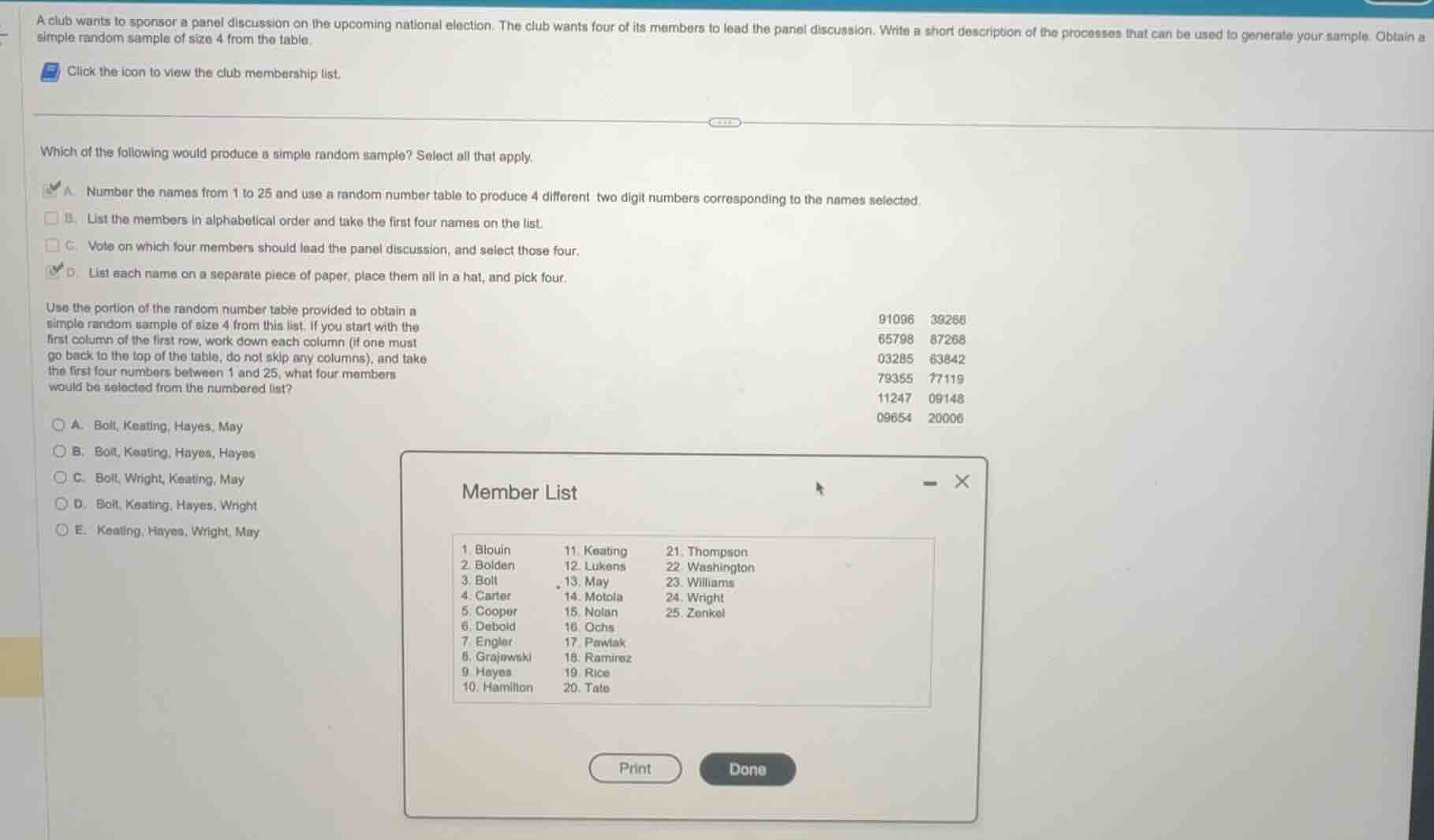
a club wants to sponsor a panel discussion on the upcoming national election. the club wants four of its members to lead the panel discussion. write a short description of the processes that can be used to generate your sample. obtain a simple random sample of size 4 from the table. click the icon to view the club membership list. which of the following would produce a simple random sample? select all that apply. a. number the names from 1 to 25 and use a random number table to produce 4 different two digit numbers corresponding to the names selected. b. list the members in alphabetical order and take the first four names on the list. c. vote on which four members should lead the panel discussion, and select those four. d. list each name on a separate piece of paper, place them all in a hat, and pick four. use the portion of the random number table provided to obtain a simple random sample of size 4 from this list. if you start with the first column of the first row, work down each column (if one must go back to the top of the table, do not skip any columns), and take the first four numbers between 1 and 25, what four members would be selected from the numbered list? a. bolt, keating, hayes, may b. bolt, keating, hayes, hayes c. bolt, wright, keating, may d. bolt, keating, hayes, wright e. keating, hayes, wright, may member list 1. blouin 11. keating 21. thompson 2. bolden 12. lukens 22. washington 3. bolt 13. may 23. williams 4. carter 14. motola 24. wright 5. cooper 15. nolan 25. zenkel 6. debold 16. ochs 7. engler 17. pawlak 8. grajewski 18. ramirez 9. hayes 19. rice 10. hamilton 20. tate
For the first part (selecting simple random sample methods):
- Option A: Numbering names and using a random number table to get 4 different two - digit numbers (corresponding to names) is a valid simple random sampling method as each member has an equal chance of being selected.
- Option B: Taking the first four names in alphabetical order is not a simple random sample as it is a systematic selection based on alphabetical order, not random.
- Option C: Voting is a non - random method as it is based on the preferences of the voters, not giving each member an equal chance.
- Option D: Listing each name on a separate paper and picking four from a hat is a classic simple random sampling method as each name has an equal probability of being picked.
Step 1: Analyze the random number table columns
We start with the first column of the first row. The random number table rows (first column values) are: 91 (too big, since we have 25 members), 65 (too big), 03 (valid, corresponds to member 3: Bolt), 79 (too big), 11 (valid, corresponds to member 11: Keating), 09 (valid, corresponds to member 9: Hayes), then next column? Wait, no, the problem says work down each column. Wait, let's re - examine. The first column of the first row is the first set of numbers. Wait, the random number table is given as:
First row: 91096, 39288
Second row: 65798, 87288
Third row: 03285, 63842
Fourth row: 79355, 77119
Fifth row: 11247, 09148
Sixth row: 09654, 20006
We take numbers between 1 and 25. So from the first column (first number in each row's first part):
- First number: 91 (invalid, >25)
- Second number: 65 (invalid, >25)
- Third number: 03 (valid, member 3: Bolt)
- Fourth number: 79 (invalid, >25)
- Fifth number: 11 (valid, member 11: Keating)
- Sixth number: 09 (valid, member 9: Hayes)
- Now, we need a fourth number. Let's check the next column? Wait, maybe we misread. Wait, the problem says "work down each column (if one must go back to the top of the table, do not skip any columns), and take the first four numbers between 1 and 25". Wait, maybe the columns are two - digit numbers? Wait, the member numbers are 1 - 25, so we can consider two - digit numbers (with leading zero for 1 - 9). So let's take two - digit numbers from the table.
Looking at the table as two - digit chunks:
First row: 91, 09, 63, 92, 88 (no, better to take columns as two - digit. Wait, the first column (first two digits of each row's first number):
Row 1: 91
Row 2: 65
Row 3: 03
Row 4: 79
Row 5: 11
Row 6: 09
Now, the second column (first two digits of each row's second number):
Row 1: 39
Row 2: 87
Row 3: 28
Row 4: 35
Row 5: 24 (valid, member 24: Wright)
Row 6: 20
Wait, maybe we made a mistake earlier. Let's re - do.
We need four numbers between 1 and 25.
First, from the first column (first number in each row, two - digit):
- 91 (invalid)
- 65 (invalid)
- 03 (member 3: Bolt)
- 79 (invalid)
- 11 (member 11: Keating)
- 09 (member 9: Hayes)
Now, we need a fourth number. Let's look at the next column (the second number in each row, two - digit):
- 39 (invalid)
- 87 (invalid)
- 28 (invalid)
- 35 (invalid)
- 24 (member 24: Wright)
- 20 (invalid)
So the four valid numbers are 03 (Bolt), 11 (Keating), 09 (Hayes), 24 (Wright).

Snap & solve any problem in the app
Get step-by-step solutions on Sovi AI
Photo-based solutions with guided steps
Explore more problems and detailed explanations
A. Number the names from 1 to 25 and use a random number table to produce 4 different two digit numbers corresponding to the names selected.
D. List each name on a separate piece of paper, place them all in a hat, and pick four.