QUESTION IMAGE
Question
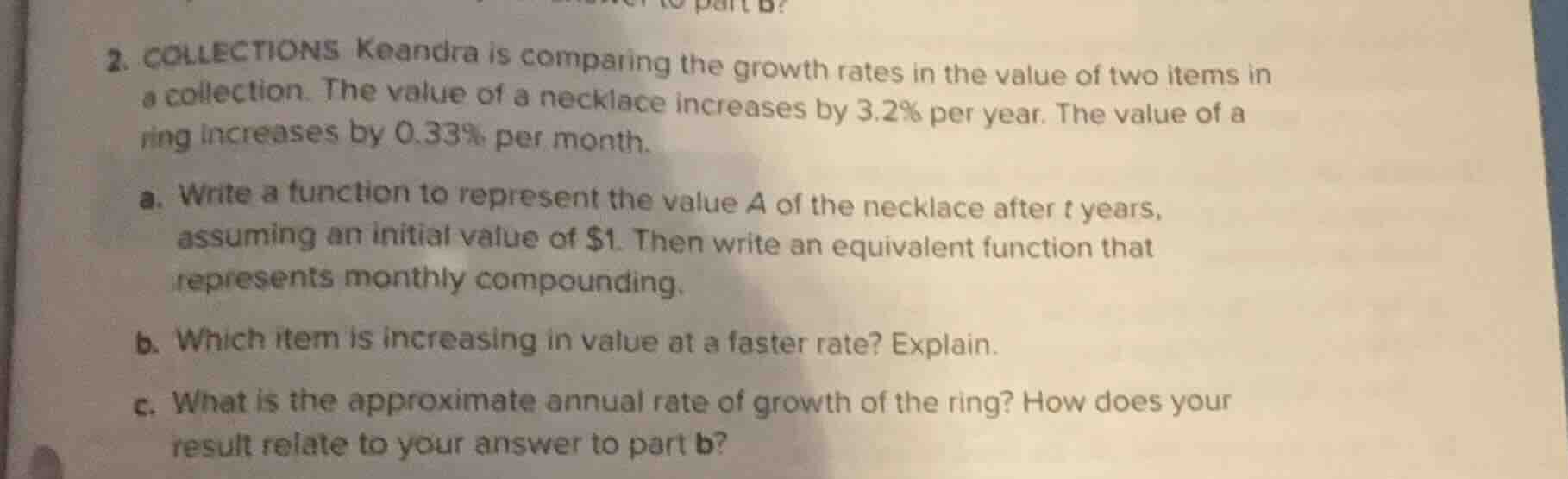
- collections keandra is comparing the growth rates in the value of two items in a collection. the value of a necklace increases by 3.2% per year. the value of a ring increases by 0.33% per month. a. write a function to represent the value a of the necklace after t years, assuming an initial value of $1. then write an equivalent function that represents monthly compounding. b. which item is increasing in value at a faster rate? explain. c. what is the approximate annual rate of growth of the ring? how does your result relate to your answer to part b?
Step1: Define annual growth function
For the necklace with initial value $\$1$ and annual growth rate $3.2\%$, the annual growth function is:
$A(t) = (1 + 0.032)^t = 1.032^t$
Step2: Convert to monthly compounding
Find the monthly growth factor by taking the 12th root of the annual factor.
Monthly factor: $\sqrt[12]{1.032} \approx 1.00262$
Monthly compounding function: $A(m) = (1.00262)^m$, where $m$ is number of months.
Step3: Calculate ring's annual rate
The ring has monthly rate $0.33\% = 0.0033$. Annual growth factor is $(1+0.0033)^{12}$.
$(1.0033)^{12} \approx 1.0403$
Annual growth rate: $1.0403 - 1 = 0.0403 = 4.03\%$
Step4: Compare growth rates
Necklace annual rate: $3.2\%$, ring annual rate: $\approx4.03\%$. The ring's rate is higher.

Snap & solve any problem in the app
Get step-by-step solutions on Sovi AI
Photo-based solutions with guided steps
Explore more problems and detailed explanations
a. Annual function: $A(t) = 1.032^t$
Monthly compounding function: $A(m) \approx 1.00262^m$ (where $m$ = number of months)
b. The ring is increasing in value at a faster rate. When converted to an annual equivalent rate, the ring's growth rate is higher than the necklace's 3.2% annual rate.
c. The approximate annual growth rate of the ring is 4.03%. This confirms the answer to part b, as 4.03% > 3.2%, so the ring grows faster annually.