QUESTION IMAGE
Question
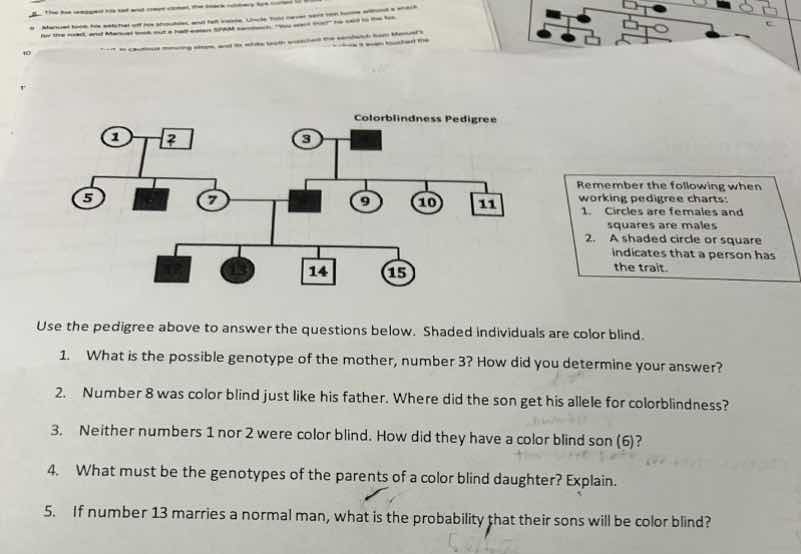
colorblindness pedigree
remember the following when
working pedigree charts:
- circles are females and
squares are males
- a shaded circle or square
indicates that a person has
the trait.
use the pedigree above to answer the questions below. shaded individuals are color blind.
- what is the possible genotype of the mother, number 3? how did you determine your answer?
- number 8 was color blind just like his father. where did the son get his allele for colorblindness?
- neither numbers 1 nor 2 were color blind. how did they have a color blind son (6)?
- what must be the genotypes of the parents of a color blind daughter? explain.
- if number 13 marries a normal man, what is the probability that their sons will be color blind?
Brief Explanations
- Colorblindness is an X-linked recessive trait. Males have an XY genotype, so a single recessive X allele ($X^c$) causes colorblindness. Females have XX genotypes, so they need two recessive alleles ($X^cX^c$) to be colorblind, or can be carriers with one recessive allele ($X^CX^c$). Individual 3 is not colorblind, so she has at least one dominant $X^C$ allele. She has a colorblind son (individual 8), who must have inherited his $X^c$ allele from his mother (since males get their X chromosome from their mother and Y from their father). Thus, individual 3 must carry the recessive allele.
- Males inherit their only X chromosome from their mother, and their Y chromosome from their father. Since colorblindness is carried on the X chromosome, the son's colorblind allele comes from his mother.
- Individual 6 is a colorblind male, so his genotype is $X^cY$. He inherited his Y chromosome from his father (individual 2) and his $X^c$ allele from his mother (individual 1). This means individual 1 is a carrier ($X^CX^c$), so she can pass the recessive allele to her son even though she is not colorblind herself.
- A colorblind daughter has the genotype $X^cX^c$. She must inherit one $X^c$ allele from each parent. Her father, being male, only has one X chromosome, so it must be the recessive $X^c$ (meaning he is colorblind, $X^cY$). Her mother must contribute the second $X^c$ allele, so she can either be a carrier ($X^CX^c$) or colorblind ($X^cX^c$).
- Individual 13 is a female carrier ($X^CX^c$): she is not colorblind, but her father (individual 8) was colorblind, so she inherited his $X^c$ allele. A normal male has the genotype $X^CY$. When they have children, sons will inherit their Y chromosome from the father and either the $X^C$ or $X^c$ allele from the mother. There is a 50% chance of inheriting the $X^c$ allele (which causes colorblindness in males) and a 50% chance of inheriting the $X^C$ allele (which results in normal vision).

Snap & solve any problem in the app
Get step-by-step solutions on Sovi AI
Photo-based solutions with guided steps
Explore more problems and detailed explanations
- The possible genotype of individual 3 is $X^CX^c$. She is not colorblind, so she has one dominant $X^C$ allele, but she passed an $X^c$ allele to her colorblind son (individual 8), proving she is a carrier.
- Number 8 got his colorblind allele from his mother (individual 7).
- Individual 1 (the mother) is a carrier of the colorblind allele ($X^CX^c$). She passed the recessive $X^c$ allele to her son (individual 6), who inherited a Y chromosome from his father, resulting in his colorblindness.
- The father must be colorblind ($X^cY$), and the mother must be either a carrier ($X^CX^c$) or colorblind ($X^cX^c$). The daughter needs two $X^c$ alleles: one from her father (who only has an $X^c$ to pass to daughters) and one from her mother.
- The probability that their sons will be colorblind is 50% or $\frac{1}{2}$.