QUESTION IMAGE
Question
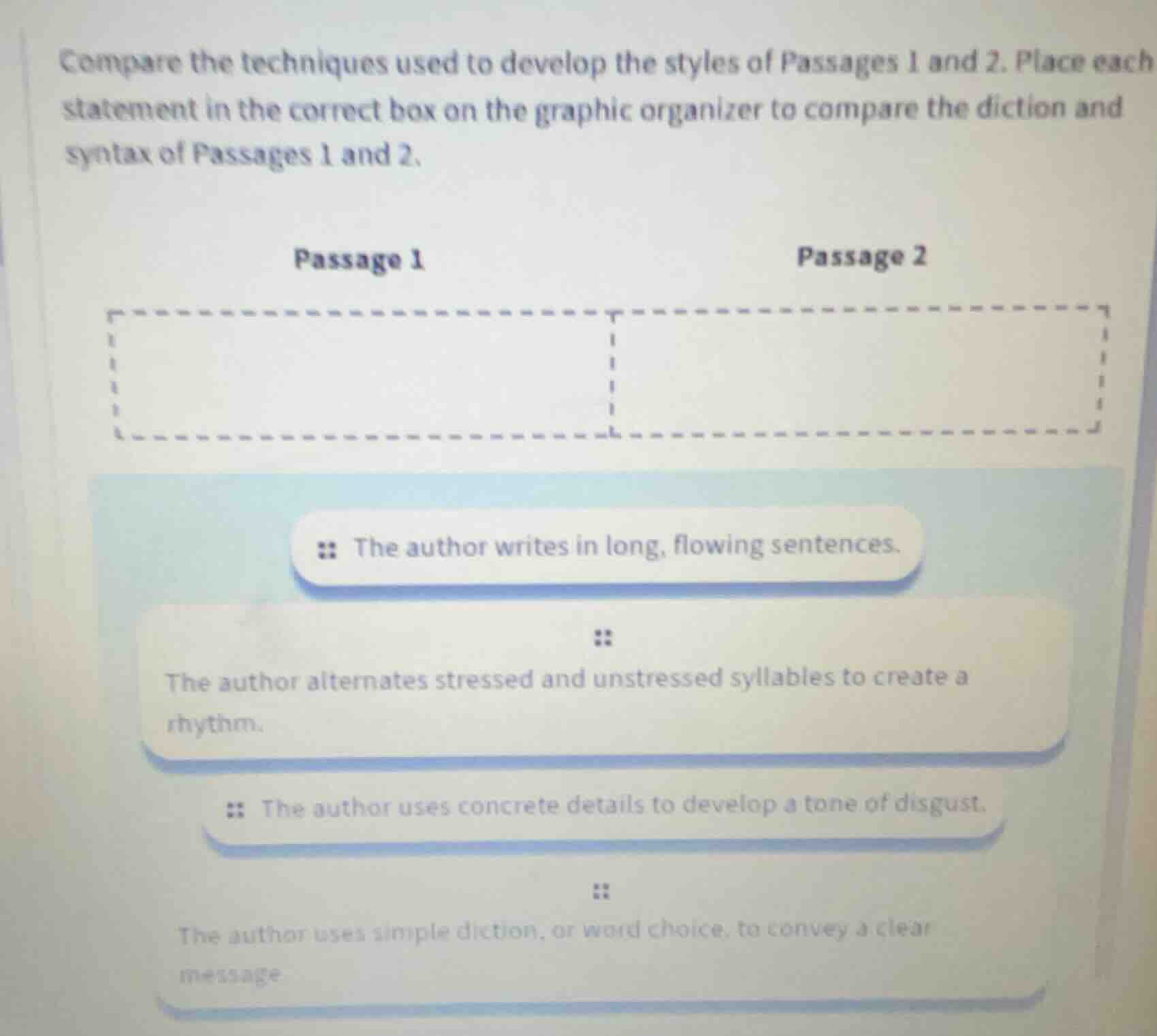
compare the techniques used to develop the styles of passages 1 and 2. place each statement in the correct box on the graphic organizer to compare the diction and syntax of passages 1 and 2.
passage 1 passage 2
the author writes in long, flowing sentences.
the author alternates stressed and unstressed syllables to create a rhythm.
the author uses concrete details to develop a tone of disgust.
the author uses simple diction, or word choice, to convey a clear message
To solve this, we analyze each statement for syntax (sentence structure) and diction (word choice):
Step 1: Analyze "long, flowing sentences"
This describes syntax (sentence length/structure). It likely belongs to a passage with elaborate, extended sentences (e.g., literary or descriptive writing).
Step 2: Analyze "alternates stressed/unstressed syllables (rhythm)"
This relates to prosody (rhythmic patterns in language), often seen in poetry or lyrical prose. It involves syllable stress, a stylistic choice for rhythm.
Step 3: Analyze "concrete details → tone of disgust"
This involves diction (word choice: concrete details) and tone. Concrete details (specific, sensory language) to create disgust suggest vivid, descriptive word choice.
Step 4: Analyze "simple diction → clear message"
This is diction (word choice: simple vocabulary) to ensure clarity. It suggests plain, straightforward language.
To organize (assuming Passage 1 is more literary/complex, Passage 2 is simpler/direct, but the key is matching each statement to syntax/diction):
- "The author writes in long, flowing sentences" → Syntax (Passage 1, if it uses complex sentence structure).
- "The author alternates stressed and unstressed syllables to create a rhythm" → Prosody/Syntax (Passage 1, if it has rhythmic prose/poetry).
- "The author uses concrete details to develop a tone of disgust" → Diction (Passage 1, if it uses vivid, descriptive words).
- "The author uses simple diction, or word choice, to convey a clear message" → Diction (Passage 2, if it uses plain language).
Without the full passages, we categorize by technique:
- Syntax: "long, flowing sentences" (describes sentence structure).
- Prosody/Syntax: "alternates stressed/unstressed syllables" (rhythmic sentence structure).
- Diction (tone): "concrete details → disgust" (word choice for tone).
- Diction (clarity): "simple diction → clear message" (word choice for clarity).
If we assume Passage 1 is more elaborate (literary) and Passage 2 is direct:
- Passage 1 (literary style):
- The author writes in long, flowing sentences (syntax).
- The author alternates stressed and unstressed syllables to create a rhythm (prosody/syntax).
- The author uses concrete details to develop a tone of disgust (diction/tone).
- Passage 2 (direct style):
- The author uses simple diction, or word choice, to convey a clear message (diction/clarity).
Final organization (matching each statement to the correct passage’s style):
| Passage 1 (Elaborate Style) | Passage 2 (Direct Style) |
|---|---|
| The author alternates stressed and unstressed syllables to create a rhythm. | |
| The author uses concrete details to develop a tone of disgust. |
(Note: The exact placement depends on the actual passages’ styles, but this framework matches each statement to its stylistic technique.)

Snap & solve any problem in the app
Get step-by-step solutions on Sovi AI
Photo-based solutions with guided steps
Explore more problems and detailed explanations
To solve this, we analyze each statement for syntax (sentence structure) and diction (word choice):
Step 1: Analyze "long, flowing sentences"
This describes syntax (sentence length/structure). It likely belongs to a passage with elaborate, extended sentences (e.g., literary or descriptive writing).
Step 2: Analyze "alternates stressed/unstressed syllables (rhythm)"
This relates to prosody (rhythmic patterns in language), often seen in poetry or lyrical prose. It involves syllable stress, a stylistic choice for rhythm.
Step 3: Analyze "concrete details → tone of disgust"
This involves diction (word choice: concrete details) and tone. Concrete details (specific, sensory language) to create disgust suggest vivid, descriptive word choice.
Step 4: Analyze "simple diction → clear message"
This is diction (word choice: simple vocabulary) to ensure clarity. It suggests plain, straightforward language.
To organize (assuming Passage 1 is more literary/complex, Passage 2 is simpler/direct, but the key is matching each statement to syntax/diction):
- "The author writes in long, flowing sentences" → Syntax (Passage 1, if it uses complex sentence structure).
- "The author alternates stressed and unstressed syllables to create a rhythm" → Prosody/Syntax (Passage 1, if it has rhythmic prose/poetry).
- "The author uses concrete details to develop a tone of disgust" → Diction (Passage 1, if it uses vivid, descriptive words).
- "The author uses simple diction, or word choice, to convey a clear message" → Diction (Passage 2, if it uses plain language).
Without the full passages, we categorize by technique:
- Syntax: "long, flowing sentences" (describes sentence structure).
- Prosody/Syntax: "alternates stressed/unstressed syllables" (rhythmic sentence structure).
- Diction (tone): "concrete details → disgust" (word choice for tone).
- Diction (clarity): "simple diction → clear message" (word choice for clarity).
If we assume Passage 1 is more elaborate (literary) and Passage 2 is direct:
- Passage 1 (literary style):
- The author writes in long, flowing sentences (syntax).
- The author alternates stressed and unstressed syllables to create a rhythm (prosody/syntax).
- The author uses concrete details to develop a tone of disgust (diction/tone).
- Passage 2 (direct style):
- The author uses simple diction, or word choice, to convey a clear message (diction/clarity).
Final organization (matching each statement to the correct passage’s style):
| Passage 1 (Elaborate Style) | Passage 2 (Direct Style) |
|---|---|
| The author alternates stressed and unstressed syllables to create a rhythm. | |
| The author uses concrete details to develop a tone of disgust. |
(Note: The exact placement depends on the actual passages’ styles, but this framework matches each statement to its stylistic technique.)