QUESTION IMAGE
Question
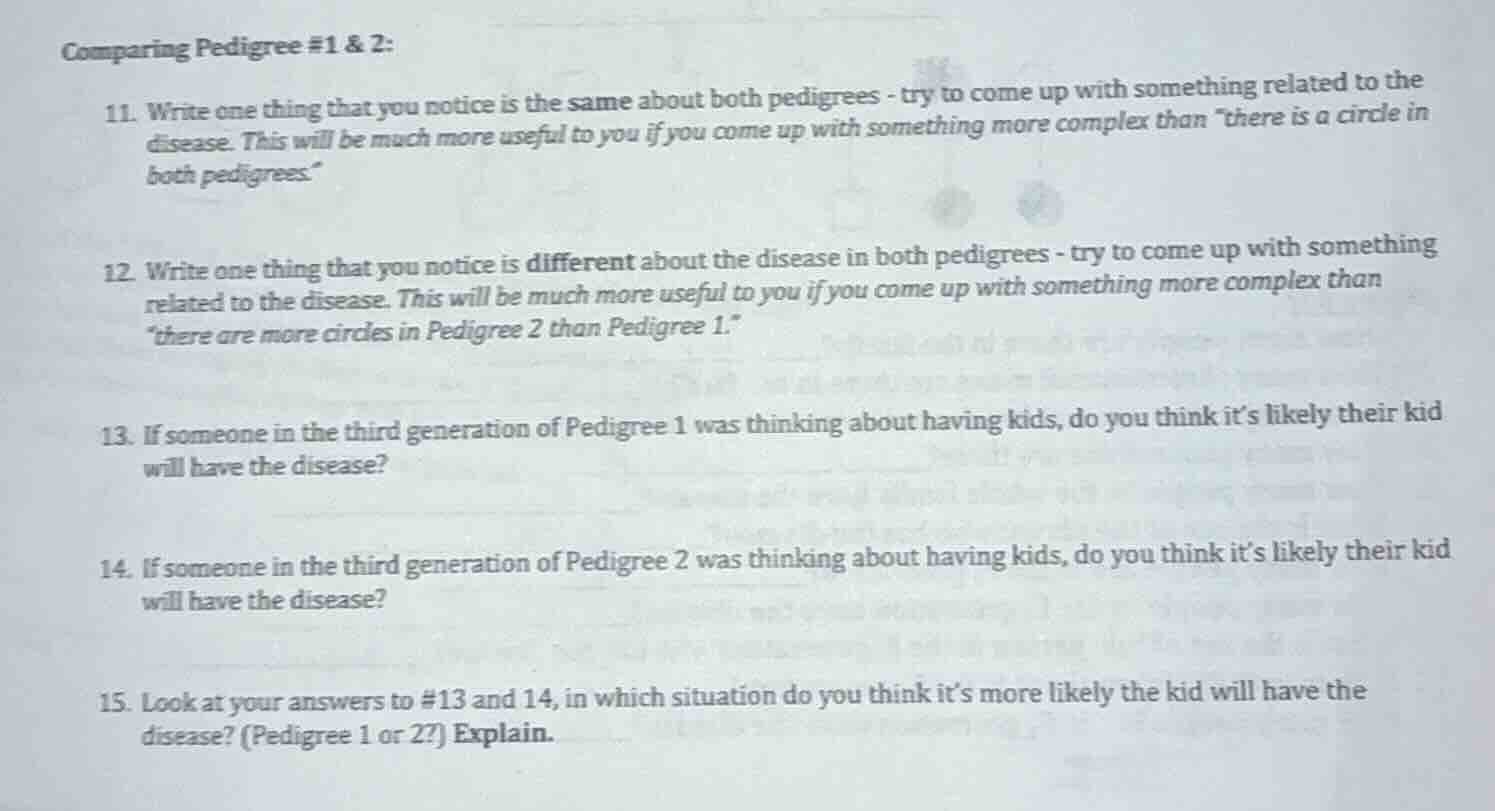
comparing pedigree #1 & 2:
- write one thing that you notice is the same about both pedigrees - try to come up with something related to the disease. this will be much more useful to you if you come up with something more complex than \there is a circle in both pedigrees.\
- write one thing that you notice is different about the disease in both pedigrees - try to come up with something related to the disease. this will be much more useful to you if you come up with something more complex than \there are more circles in pedigree 2 than pedigree 1.\
- if someone in the third generation of pedigree 1 was thinking about having kids, do you think it’s likely their kid will have the disease?
- if someone in the third generation of pedigree 2 was thinking about having kids, do you think it’s likely their kid will have the disease?
- look at your answers to #13 and 14, in which situation do you think it’s more likely the kid will have the disease? (pedigree 1 or 2?) explain.
Since the actual pedigree charts (Pedigree #1 and Pedigree #2) are not provided, I can give general guidance on how to approach each question based on typical pedigree analysis (which falls under the subfield of Biology, specifically Genetics):
Question 11 (Same about both pedigrees)
To answer this, analyze the inheritance pattern (e.g., autosomal dominant/recessive, X - linked) or disease prevalence:
- Example: “Both pedigrees show the disease affecting individuals across multiple generations (indicating a heritable pattern).”
Question 12 (Different about the disease)
Compare inheritance patterns or affected genders:
- Example: “In Pedigree 1, the disease affects males and females equally (autosomal), while in Pedigree 2, more males are affected (suggesting X - linked recessive).”
Question 13 (Likelihood for Pedigree 1)
Depends on the pedigree’s pattern:
- If Pedigree 1 is autosomal dominant: A third - generation affected individual (with at least one dominant allele) has a 50% (if heterozygous) or 100% (if homozygous) chance of passing the disease.
- If autosomal recessive: If the individual is a carrier (heterozygous) and their partner is also a carrier, there’s a 25% chance; if the partner is not a carrier, the chance is lower.
Question 14 (Likelihood for Pedigree 2)
Depends on Pedigree 2’s pattern:
- If X - linked recessive: A male with the disease (XᵈY) will pass the disease - causing allele to all daughters (who may be carriers) and no sons. A female carrier (XᴰXᵈ) has a 50% chance of passing the allele to sons (who would then have the disease).
Question 15 (Compare likelihood)
Explain based on inheritance:
- Example: “If Pedigree 1 is autosomal dominant and Pedigree 2 is X - linked recessive, Pedigree 1 is more likely. In autosomal dominant, an affected parent has a high (50–100%) chance of passing the disease, while X - linked recessive depends on gender and carrier status.”
To provide precise answers, share the pedigree charts (or describe their key features: affected/unaffected symbols, generations, gender distribution).

Snap & solve any problem in the app
Get step-by-step solutions on Sovi AI
Photo-based solutions with guided steps
Explore more problems and detailed explanations
Since the actual pedigree charts (Pedigree #1 and Pedigree #2) are not provided, I can give general guidance on how to approach each question based on typical pedigree analysis (which falls under the subfield of Biology, specifically Genetics):
Question 11 (Same about both pedigrees)
To answer this, analyze the inheritance pattern (e.g., autosomal dominant/recessive, X - linked) or disease prevalence:
- Example: “Both pedigrees show the disease affecting individuals across multiple generations (indicating a heritable pattern).”
Question 12 (Different about the disease)
Compare inheritance patterns or affected genders:
- Example: “In Pedigree 1, the disease affects males and females equally (autosomal), while in Pedigree 2, more males are affected (suggesting X - linked recessive).”
Question 13 (Likelihood for Pedigree 1)
Depends on the pedigree’s pattern:
- If Pedigree 1 is autosomal dominant: A third - generation affected individual (with at least one dominant allele) has a 50% (if heterozygous) or 100% (if homozygous) chance of passing the disease.
- If autosomal recessive: If the individual is a carrier (heterozygous) and their partner is also a carrier, there’s a 25% chance; if the partner is not a carrier, the chance is lower.
Question 14 (Likelihood for Pedigree 2)
Depends on Pedigree 2’s pattern:
- If X - linked recessive: A male with the disease (XᵈY) will pass the disease - causing allele to all daughters (who may be carriers) and no sons. A female carrier (XᴰXᵈ) has a 50% chance of passing the allele to sons (who would then have the disease).
Question 15 (Compare likelihood)
Explain based on inheritance:
- Example: “If Pedigree 1 is autosomal dominant and Pedigree 2 is X - linked recessive, Pedigree 1 is more likely. In autosomal dominant, an affected parent has a high (50–100%) chance of passing the disease, while X - linked recessive depends on gender and carrier status.”
To provide precise answers, share the pedigree charts (or describe their key features: affected/unaffected symbols, generations, gender distribution).