QUESTION IMAGE
Question
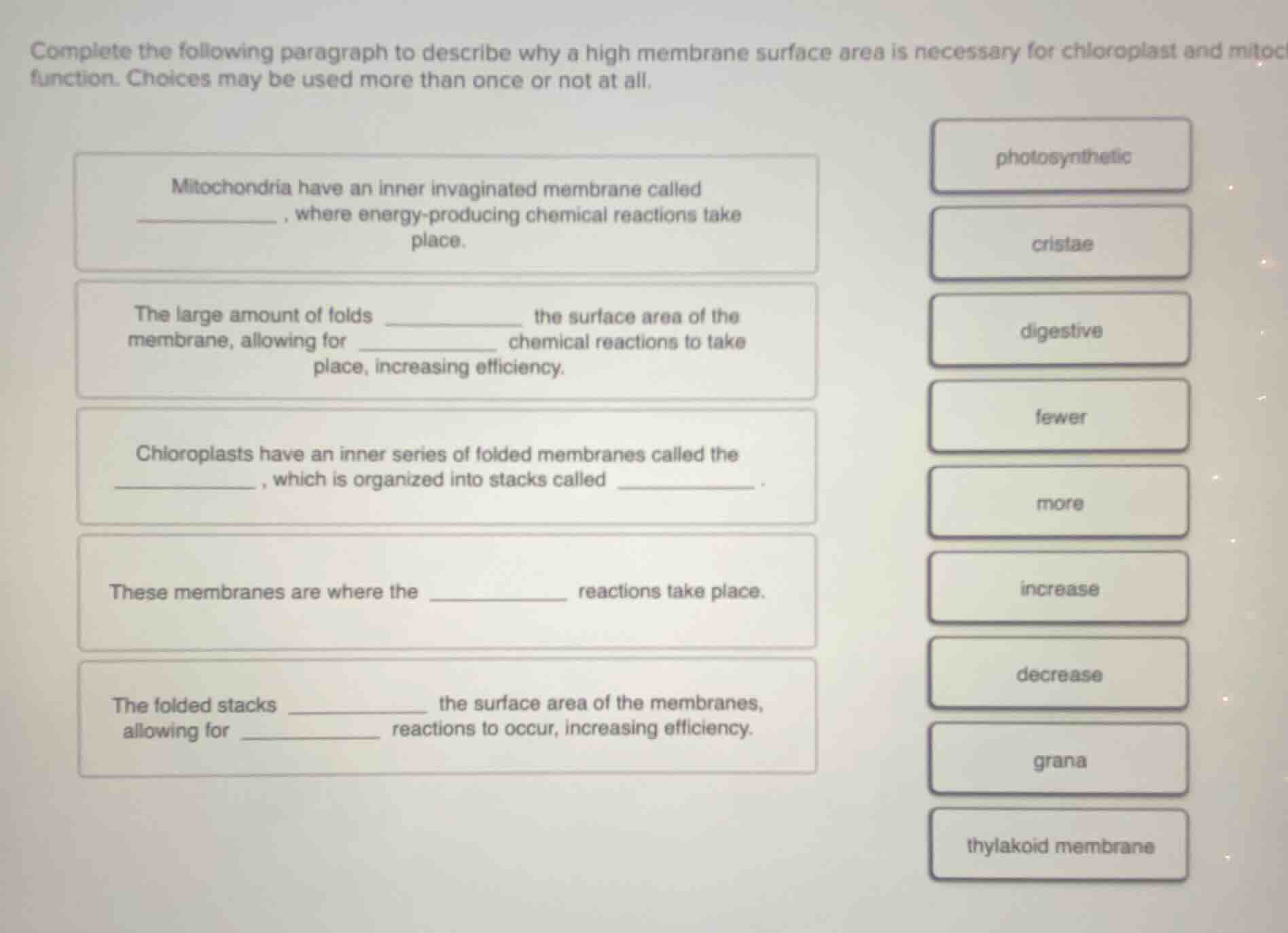
complete the following paragraph to describe why a high membrane surface area is necessary for chloroplast and mitoc function. choices may be used more than once or not at all.
mitochondria have an inner invaginated membrane called
________ , where energy - producing chemical reactions take
place.
the large amount of folds
________ the surface area of the
membrane, allowing for
________ chemical reactions to take
place, increasing efficiency.
chloroplasts have an inner series of folded membranes called the
________ , which is organized into stacks called
________ .
these membranes are where the
________ reactions take place.
the folded stacks
________ the surface area of the membranes,
allowing for
________ reactions to occur, increasing efficiency.
choices: photosynthetic, cristae, digestive, fewer, more, increase, decrease, grana, thylakoid membrane
1. Mitochondria's inner membrane:
Mitochondria have an inner invaginated membrane called cristae, where energy - producing chemical reactions take place. (Cristae are the folded inner membranes of mitochondria that provide a large surface area for cellular respiration reactions.)
2. Effect of folds on membrane surface area and reactions:
The large amount of folds increase the surface area of the membrane (folding a membrane naturally increases its surface area), allowing for more chemical reactions to take place (a larger surface area provides more space for enzymes and reactants, so more reactions can occur), increasing efficiency.
3. Chloroplast's inner folded membranes:
Chloroplasts have an inner series of folded membranes called the thylakoid membrane, which is organized into stacks called grana. (Thylakoid membranes are the site of the light - dependent reactions of photosynthesis, and they are stacked into grana.)
4. Reactions on chloroplast membranes:
These membranes are where the photosynthetic reactions take place. (The thylakoid membranes in chloroplasts are involved in photosynthesis, specifically the light - dependent reactions.)
5. Effect of folded stacks on chloroplast membranes:
The folded stacks increase the surface area of the membranes (the stacking of thylakoids into grana increases the surface area), allowing for more reactions to occur (a larger surface area in the chloroplast membranes means more space for photosynthetic pigments and enzymes, leading to more photosynthetic reactions), increasing efficiency.
Final Answers (filling in the blanks in order):
- cristae
- increase; more
- thylakoid membrane; grana
- photosynthetic
- increase; more

Snap & solve any problem in the app
Get step-by-step solutions on Sovi AI
Photo-based solutions with guided steps
Explore more problems and detailed explanations
1. Mitochondria's inner membrane:
Mitochondria have an inner invaginated membrane called cristae, where energy - producing chemical reactions take place. (Cristae are the folded inner membranes of mitochondria that provide a large surface area for cellular respiration reactions.)
2. Effect of folds on membrane surface area and reactions:
The large amount of folds increase the surface area of the membrane (folding a membrane naturally increases its surface area), allowing for more chemical reactions to take place (a larger surface area provides more space for enzymes and reactants, so more reactions can occur), increasing efficiency.
3. Chloroplast's inner folded membranes:
Chloroplasts have an inner series of folded membranes called the thylakoid membrane, which is organized into stacks called grana. (Thylakoid membranes are the site of the light - dependent reactions of photosynthesis, and they are stacked into grana.)
4. Reactions on chloroplast membranes:
These membranes are where the photosynthetic reactions take place. (The thylakoid membranes in chloroplasts are involved in photosynthesis, specifically the light - dependent reactions.)
5. Effect of folded stacks on chloroplast membranes:
The folded stacks increase the surface area of the membranes (the stacking of thylakoids into grana increases the surface area), allowing for more reactions to occur (a larger surface area in the chloroplast membranes means more space for photosynthetic pigments and enzymes, leading to more photosynthetic reactions), increasing efficiency.
Final Answers (filling in the blanks in order):
- cristae
- increase; more
- thylakoid membrane; grana
- photosynthetic
- increase; more