QUESTION IMAGE
Question
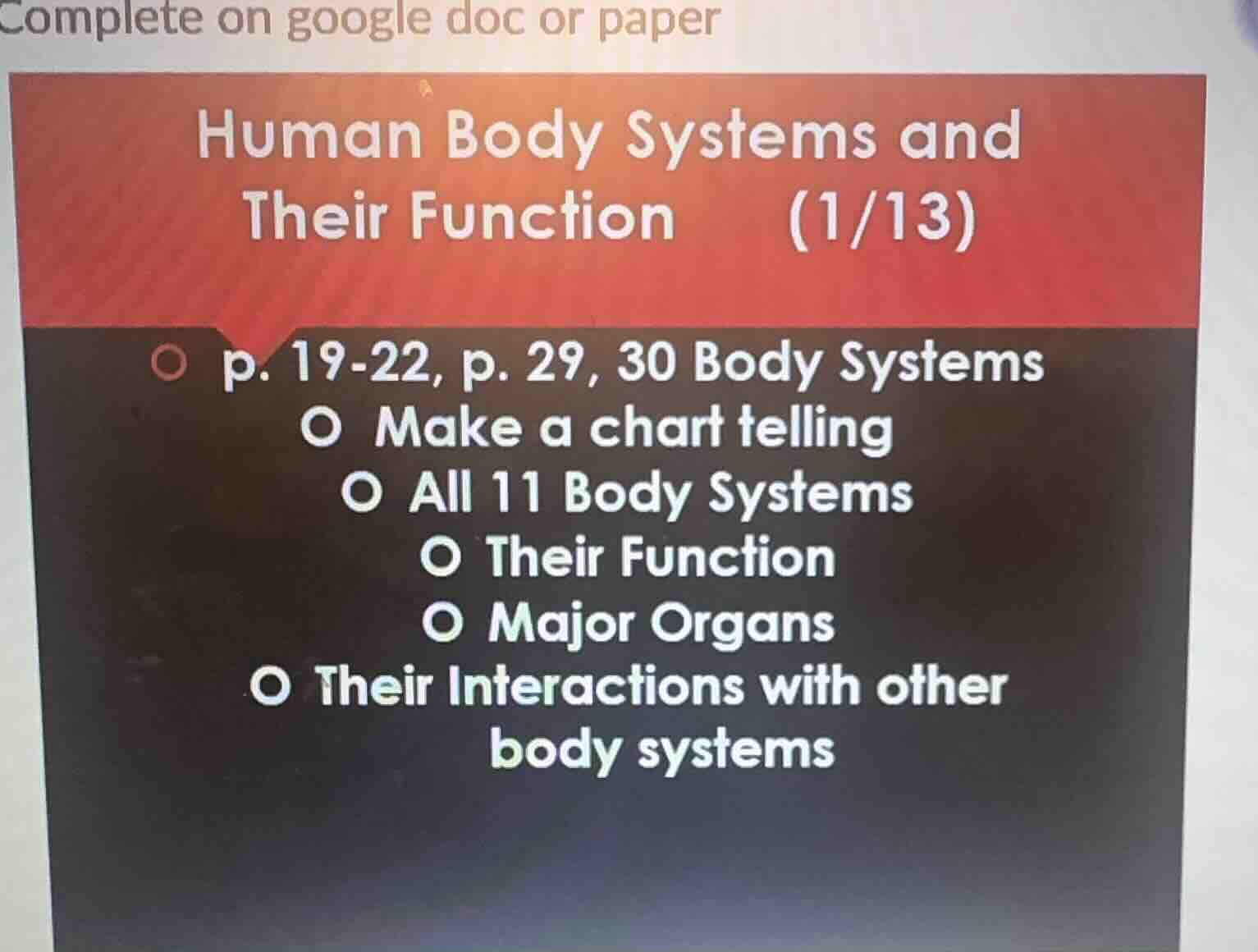
complete on google doc or paper
human body systems and their function (1/13)
p. 19-22, p. 29, 30 body systems
make a chart telling
all 11 body systems
their function
major organs
their interactions with other body systems
Brief Explanations
This is a biology task to create a structured chart of the 11 human body systems, including their core functions, key organs, and how they work with other systems. Below is the completed chart with accurate, concise details for each system.

Snap & solve any problem in the app
Get step-by-step solutions on Sovi AI
Photo-based solutions with guided steps
Explore more problems and detailed explanations
| Body System | Primary Function | Major Organs | Interactions with Other Systems |
|---|---|---|---|
| Skeletal | Supports body, protects organs, enables movement, stores minerals | Bones, cartilage, ligaments, tendons | Works with the muscular system for movement; with the circulatory system (bone marrow makes blood cells); with the endocrine system (stores calcium for hormone function). |
| Muscular | Enables voluntary/involuntary movement, generates heat | Skeletal muscles, smooth muscles, cardiac muscle | Works with the skeletal system for locomotion; with the nervous system to control contractions; with the circulatory system to receive oxygen for muscle function. |
| Nervous | Controls body functions, processes sensory information, coordinates responses | Brain, spinal cord, peripheral nerves | Communicates with all systems to regulate activity (e.g., signals endocrine glands to release hormones; tells muscular system to contract; regulates digestive system speed). |
| Endocrine | Regulates body functions via hormone secretion | Pituitary gland, thyroid, pancreas, adrenal glands, ovaries/testes | Works with the nervous system to maintain homeostasis; with the circulatory system to transport hormones; with the reproductive system to regulate fertility. |
| Cardiovascular (Circulatory) | Transports oxygen, nutrients, hormones, and waste products | Heart, blood vessels (arteries, veins, capillaries), blood | Works with the respiratory system to exchange oxygen/carbon dioxide; with the digestive system to carry absorbed nutrients; with the immune system to transport white blood cells. |
| Lymphatic/Immune | Fights infection, maintains fluid balance, absorbs fats | Lymph nodes, spleen, thymus, lymph vessels, white blood cells | Works with the circulatory system to filter excess fluid; with the integumentary system to block pathogens; with the digestive system to absorb dietary fats. |
| Respiratory | Facilitates gas exchange (oxygen in, carbon dioxide out) | Lungs, trachea, bronchi, diaphragm | Works with the cardiovascular system to deliver oxygen to cells; with the nervous system to regulate breathing rate; with the muscular system (diaphragm for inhalation/exhalation). |
| Digestive | Breaks down food, absorbs nutrients, eliminates waste | Mouth, esophagus, stomach, small intestine, large intestine, liver, pancreas | Works with the circulatory system to carry absorbed nutrients; with the muscular system to move food via peristalsis; with the endocrine system (pancreas releases insulin to regulate blood sugar). |
| Urinary | Filters blood, eliminates waste, regulates fluid/electrolyte balance | Kidneys, ureters, bladder, urethra | Works with the circulatory system to filter blood; with the endocrine system (ADH hormone regulates water reabsorption); with the respiratory system to balance acid-base levels. |
| Reproductive | Produces gametes, enables sexual reproduction, secretes sex hormones | Ovaries, uterus, fallopian tubes (female); testes, penis, prostate (male) | Works with the endocrine system to regulate hormone production and fertility; with the circulatory system to transport sex hormones; with the nervous system to control reproductive functions. |