QUESTION IMAGE
Question
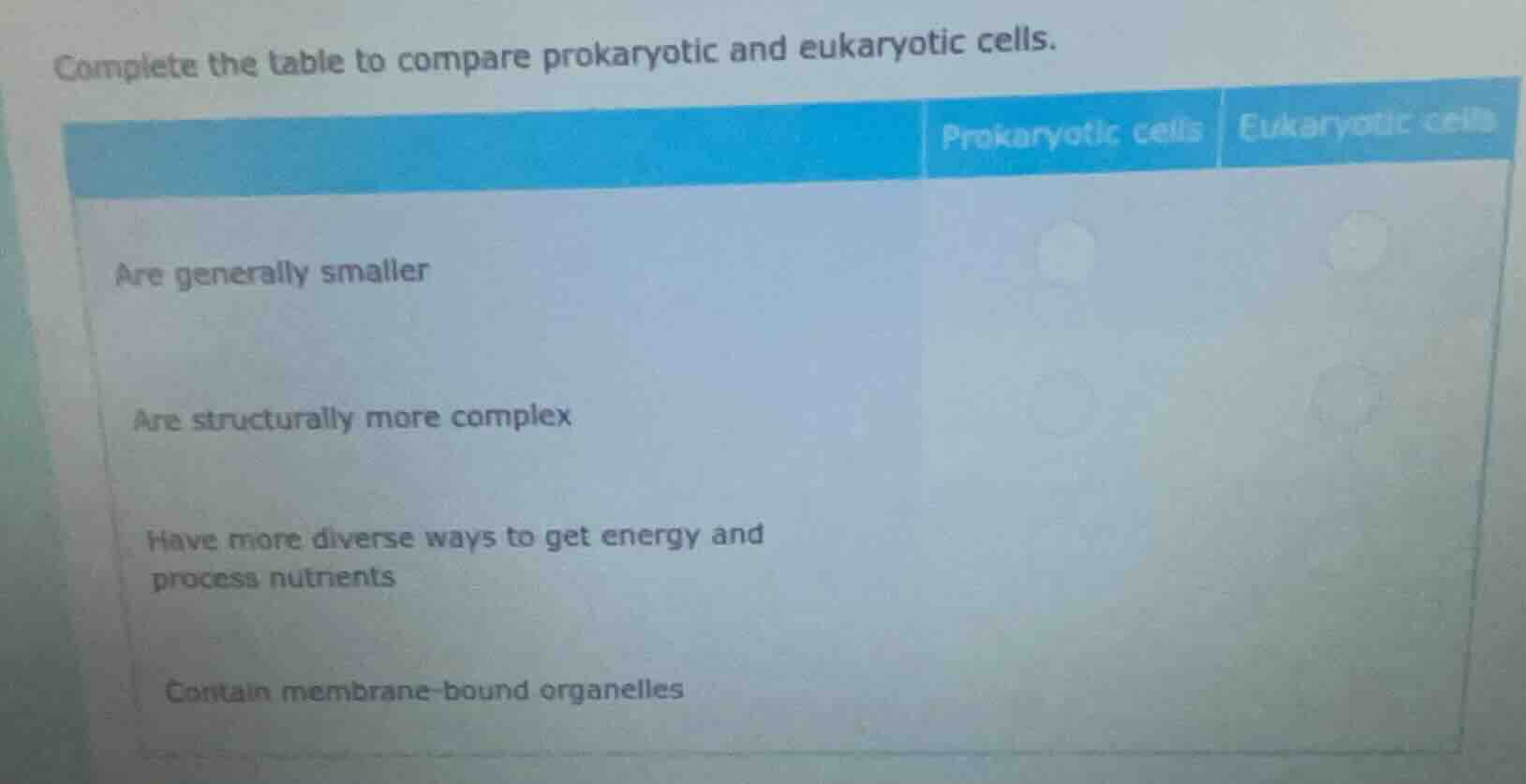
complete the table to compare prokaryotic and eukaryotic cells.
prokaryotic cells eukaryotic cells
are generally smaller
are structurally more complex
have more diverse ways to get energy and process nutrients
contain membrane - bound organelles
To complete the table comparing prokaryotic and eukaryotic cells, we use the key characteristics of each cell type:
Step 1: Analyze "Are generally smaller"
Prokaryotic cells (e.g., bacteria) are typically smaller (1–5 μm) than eukaryotic cells (10–100 μm). So, Prokaryotic cells → Yes; Eukaryotic cells → No.
Step 2: Analyze "Are structurally more complex"
Eukaryotic cells have membrane - bound organelles (e.g., nucleus, mitochondria) and a more elaborate internal structure. Prokaryotic cells have a simpler structure (no membrane - bound organelles). So, Prokaryotic cells → No; Eukaryotic cells → Yes.
Step 3: Analyze "Have more diverse ways to get energy and process nutrients"
Eukaryotic cells (e.g., plants, animals, fungi) have diverse metabolic pathways (e.g., photosynthesis, cellular respiration, nutrient - specific breakdown). Prokaryotic cells have fewer specialized metabolic strategies. So, Prokaryotic cells → No; Eukaryotic cells → Yes.
Step 4: Analyze "Contain membrane - bound organelles"
Eukaryotic cells have organelles like the nucleus, endoplasmic reticulum, etc., surrounded by membranes. Prokaryotic cells lack these. So, Prokaryotic cells → No; Eukaryotic cells → Yes.
| Prokaryotic cells | Eukaryotic cells | |
|---|---|---|
| Are structurally more complex | No | Yes |
| Have more diverse ways to get energy and process nutrients | No | Yes |
| Contain membrane - bound organelles | No | Yes |

Snap & solve any problem in the app
Get step-by-step solutions on Sovi AI
Photo-based solutions with guided steps
Explore more problems and detailed explanations
To complete the table comparing prokaryotic and eukaryotic cells, we use the key characteristics of each cell type:
Step 1: Analyze "Are generally smaller"
Prokaryotic cells (e.g., bacteria) are typically smaller (1–5 μm) than eukaryotic cells (10–100 μm). So, Prokaryotic cells → Yes; Eukaryotic cells → No.
Step 2: Analyze "Are structurally more complex"
Eukaryotic cells have membrane - bound organelles (e.g., nucleus, mitochondria) and a more elaborate internal structure. Prokaryotic cells have a simpler structure (no membrane - bound organelles). So, Prokaryotic cells → No; Eukaryotic cells → Yes.
Step 3: Analyze "Have more diverse ways to get energy and process nutrients"
Eukaryotic cells (e.g., plants, animals, fungi) have diverse metabolic pathways (e.g., photosynthesis, cellular respiration, nutrient - specific breakdown). Prokaryotic cells have fewer specialized metabolic strategies. So, Prokaryotic cells → No; Eukaryotic cells → Yes.
Step 4: Analyze "Contain membrane - bound organelles"
Eukaryotic cells have organelles like the nucleus, endoplasmic reticulum, etc., surrounded by membranes. Prokaryotic cells lack these. So, Prokaryotic cells → No; Eukaryotic cells → Yes.
| Prokaryotic cells | Eukaryotic cells | |
|---|---|---|
| Are structurally more complex | No | Yes |
| Have more diverse ways to get energy and process nutrients | No | Yes |
| Contain membrane - bound organelles | No | Yes |