QUESTION IMAGE
Question
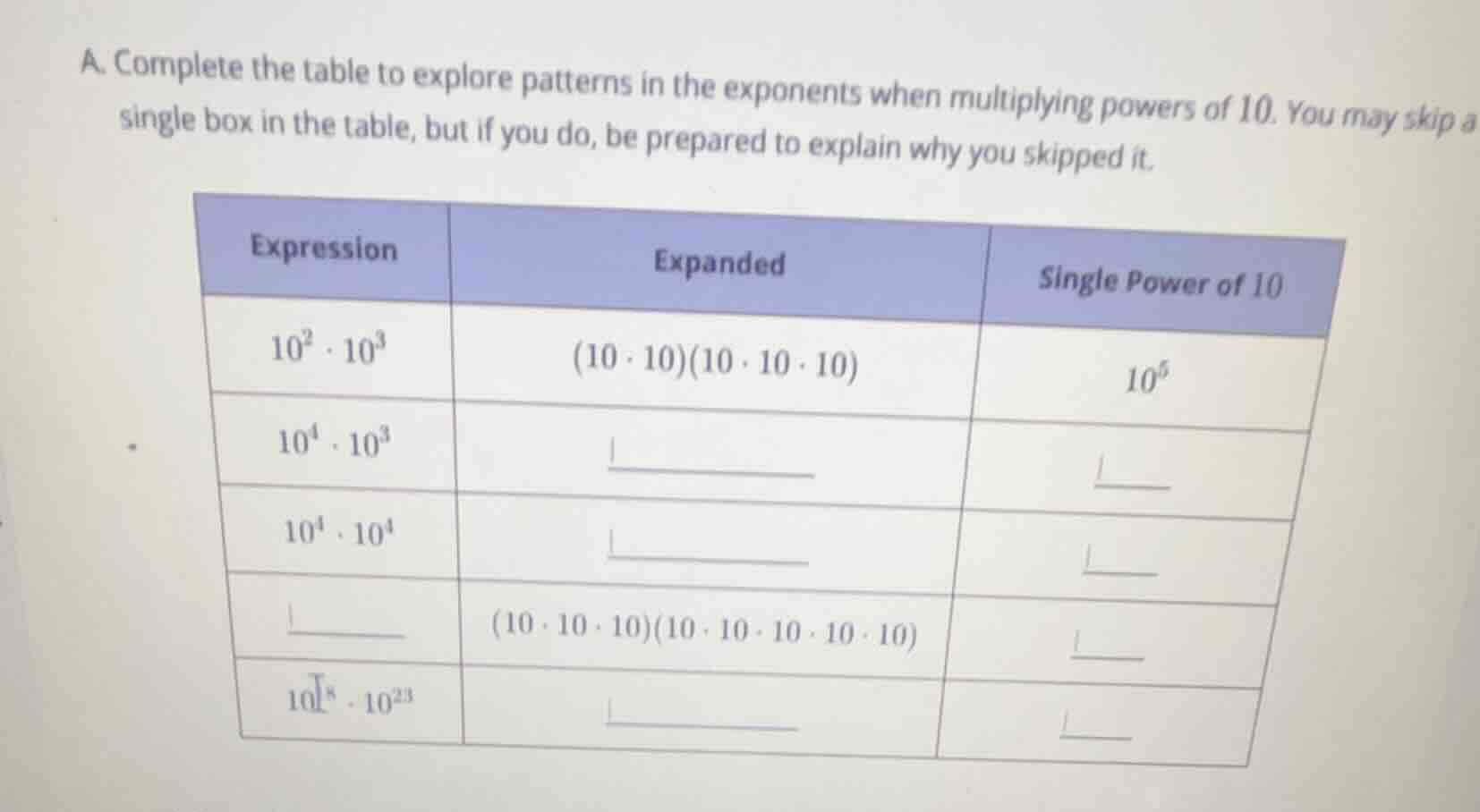
a. complete the table to explore patterns in the exponents when multiplying powers of 10. you may skip a single box in the table, but if you do, be prepared to explain why you skipped it.
| expression | expanded | single power of 10 |
|---|---|---|
| $10^4 \cdot 10^3$ | \underline{qquad} | \underline{qquad} |
| $10^4 \cdot 10^4$ | \underline{qquad} | \underline{qquad} |
| \underline{qquad} | $(10 \cdot 10 \cdot 10)(10 \cdot 10 \cdot 10 \cdot 10 \cdot 10)$ | \underline{qquad} |
| $10^{18} \cdot 10^{23}$ | \underline{qquad} | \underline{qquad} |
Step1: Analyze \(10^4 \cdot 10^3\)
\(10^4\) means \(10 \cdot 10 \cdot 10 \cdot 10\) and \(10^3\) means \(10 \cdot 10 \cdot 10\). So expanded form is \((10 \cdot 10 \cdot 10 \cdot 10)(10 \cdot 10 \cdot 10)\). For single power, add exponents: \(4 + 3 = 7\), so \(10^7\).
Step2: Analyze \(10^4 \cdot 10^4\)
\(10^4\) is \(10 \cdot 10 \cdot 10 \cdot 10\), so two of them: \((10 \cdot 10 \cdot 10 \cdot 10)(10 \cdot 10 \cdot 10 \cdot 10)\). Exponents: \(4 + 4 = 8\), so \(10^8\).
Step3: Analyze the expanded \((10 \cdot 10 \cdot 10)(10 \cdot 10 \cdot 10 \cdot 10 \cdot 10)\)
First part is \(10^3\), second is \(10^5\), so expression is \(10^3 \cdot 10^5\). Exponents: \(3 + 5 = 8\), so \(10^8\).
Step4: Analyze \(10^{18} \cdot 10^{23}\)
Expanded: \(10\) multiplied \(18\) times times \(10\) multiplied \(23\) times, so \(\underbrace{(10 \cdot \dots \cdot 10)}_{18\text{ times}}\underbrace{(10 \cdot \dots \cdot 10)}_{23\text{ times}}\). Exponents: \(18 + 23 = 41\), so \(10^{41}\).
Filled Table:
| Expression | Expanded | Single Power of 10 |
|---|---|---|
| \(10^4 \cdot 10^3\) | \((10 \cdot 10 \cdot 10 \cdot 10)(10 \cdot 10 \cdot 10)\) | \(10^7\) |
| \(10^4 \cdot 10^4\) | \((10 \cdot 10 \cdot 10 \cdot 10)(10 \cdot 10 \cdot 10 \cdot 10)\) | \(10^8\) |
| \(10^3 \cdot 10^5\) | \((10 \cdot 10 \cdot 10)(10 \cdot 10 \cdot 10 \cdot 10 \cdot 10)\) | \(10^8\) |
| \(10^{18} \cdot 10^{23}\) | \(\underbrace{(10 \cdot \dots \cdot 10)}_{18\text{ times}}\underbrace{(10 \cdot \dots \cdot 10)}_{23\text{ times}}\) | \(10^{41}\) |
(For the expanded form of \(10^{18} \cdot 10^{23}\), it's written as the product of two strings of 10s with lengths 18 and 23 respectively, but for simplicity, we use the exponent addition rule directly after showing the pattern with smaller exponents.)

Snap & solve any problem in the app
Get step-by-step solutions on Sovi AI
Photo-based solutions with guided steps
Explore more problems and detailed explanations
Step1: Analyze \(10^4 \cdot 10^3\)
\(10^4\) means \(10 \cdot 10 \cdot 10 \cdot 10\) and \(10^3\) means \(10 \cdot 10 \cdot 10\). So expanded form is \((10 \cdot 10 \cdot 10 \cdot 10)(10 \cdot 10 \cdot 10)\). For single power, add exponents: \(4 + 3 = 7\), so \(10^7\).
Step2: Analyze \(10^4 \cdot 10^4\)
\(10^4\) is \(10 \cdot 10 \cdot 10 \cdot 10\), so two of them: \((10 \cdot 10 \cdot 10 \cdot 10)(10 \cdot 10 \cdot 10 \cdot 10)\). Exponents: \(4 + 4 = 8\), so \(10^8\).
Step3: Analyze the expanded \((10 \cdot 10 \cdot 10)(10 \cdot 10 \cdot 10 \cdot 10 \cdot 10)\)
First part is \(10^3\), second is \(10^5\), so expression is \(10^3 \cdot 10^5\). Exponents: \(3 + 5 = 8\), so \(10^8\).
Step4: Analyze \(10^{18} \cdot 10^{23}\)
Expanded: \(10\) multiplied \(18\) times times \(10\) multiplied \(23\) times, so \(\underbrace{(10 \cdot \dots \cdot 10)}_{18\text{ times}}\underbrace{(10 \cdot \dots \cdot 10)}_{23\text{ times}}\). Exponents: \(18 + 23 = 41\), so \(10^{41}\).
Filled Table:
| Expression | Expanded | Single Power of 10 |
|---|---|---|
| \(10^4 \cdot 10^3\) | \((10 \cdot 10 \cdot 10 \cdot 10)(10 \cdot 10 \cdot 10)\) | \(10^7\) |
| \(10^4 \cdot 10^4\) | \((10 \cdot 10 \cdot 10 \cdot 10)(10 \cdot 10 \cdot 10 \cdot 10)\) | \(10^8\) |
| \(10^3 \cdot 10^5\) | \((10 \cdot 10 \cdot 10)(10 \cdot 10 \cdot 10 \cdot 10 \cdot 10)\) | \(10^8\) |
| \(10^{18} \cdot 10^{23}\) | \(\underbrace{(10 \cdot \dots \cdot 10)}_{18\text{ times}}\underbrace{(10 \cdot \dots \cdot 10)}_{23\text{ times}}\) | \(10^{41}\) |
(For the expanded form of \(10^{18} \cdot 10^{23}\), it's written as the product of two strings of 10s with lengths 18 and 23 respectively, but for simplicity, we use the exponent addition rule directly after showing the pattern with smaller exponents.)