QUESTION IMAGE
Question
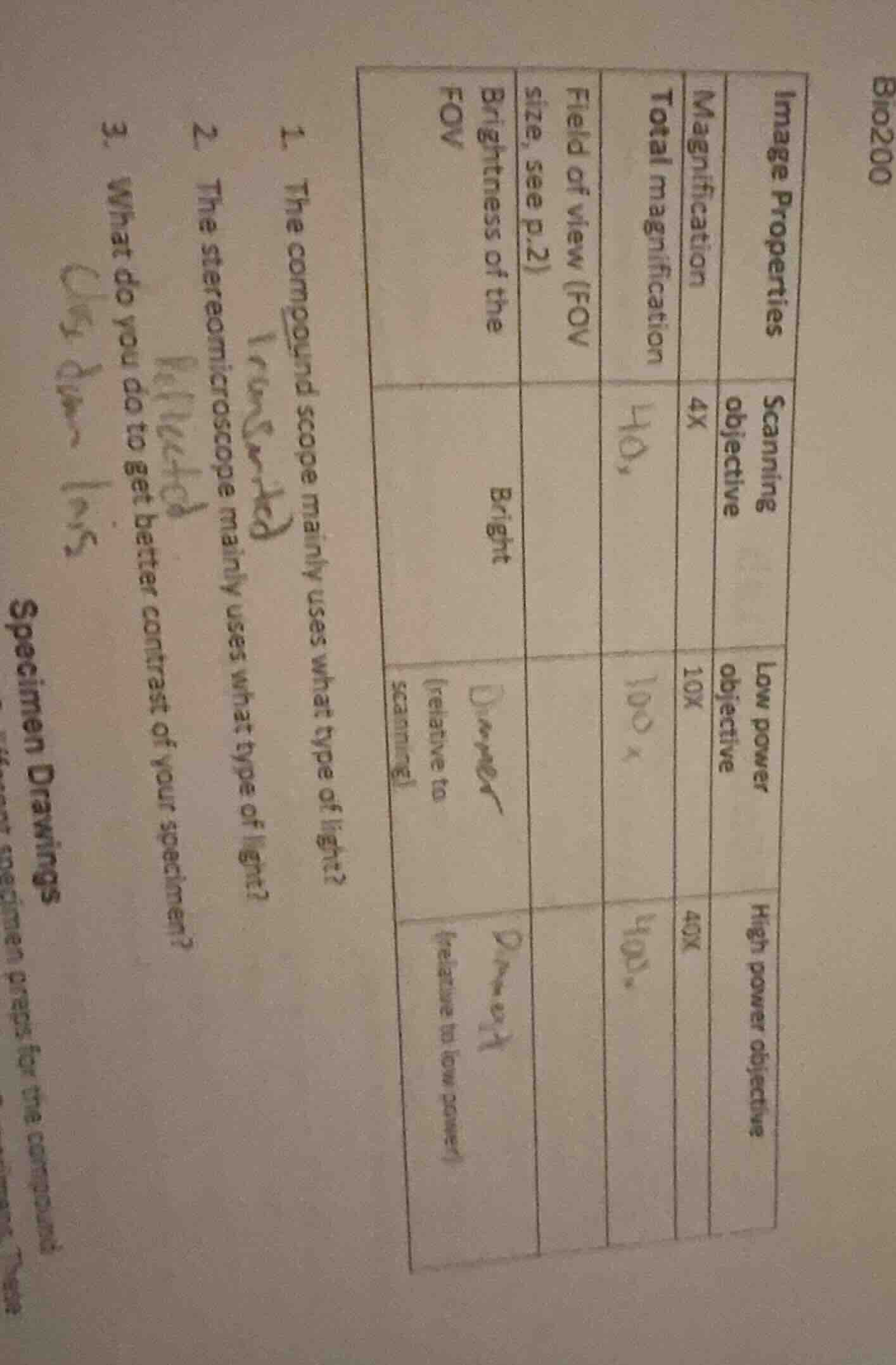
- the compound scope mainly uses what type of light?
- the stereomicroscope mainly uses what type of light?
- what do you do to get better contrast of your specimen?
Question 1:
A compound microscope mainly uses transmitted light (light that passes through the specimen). This is because the compound microscope is designed to view thin, transparent specimens, and the light passes through the specimen to be magnified by the objective and ocular lenses.
A stereomicroscope (also known as a dissecting microscope) mainly uses reflected light (light that bounces off the surface of the specimen) or sometimes a combination of reflected and transmitted light, but it is often used for viewing opaque or three - dimensional specimens, so reflected light is a major type it uses (for surface - level, non - transparent or semi - transparent specimens).
To get better contrast of a specimen:
- Use staining techniques (for specimens that can be stained, like in biological samples, different stains can highlight different structures).
- Adjust the light source (e.g., use a diaphragm to adjust the amount of light, or use a phase - contrast or differential interference contrast (DIC) setup if available on the microscope, which is useful for unstained specimens).
- Use a dark - field condenser (to make the specimen appear bright against a dark background, which can enhance contrast for certain specimens).

Snap & solve any problem in the app
Get step-by-step solutions on Sovi AI
Photo-based solutions with guided steps
Explore more problems and detailed explanations
Transmitted light (light that passes through the specimen)