QUESTION IMAGE
Question
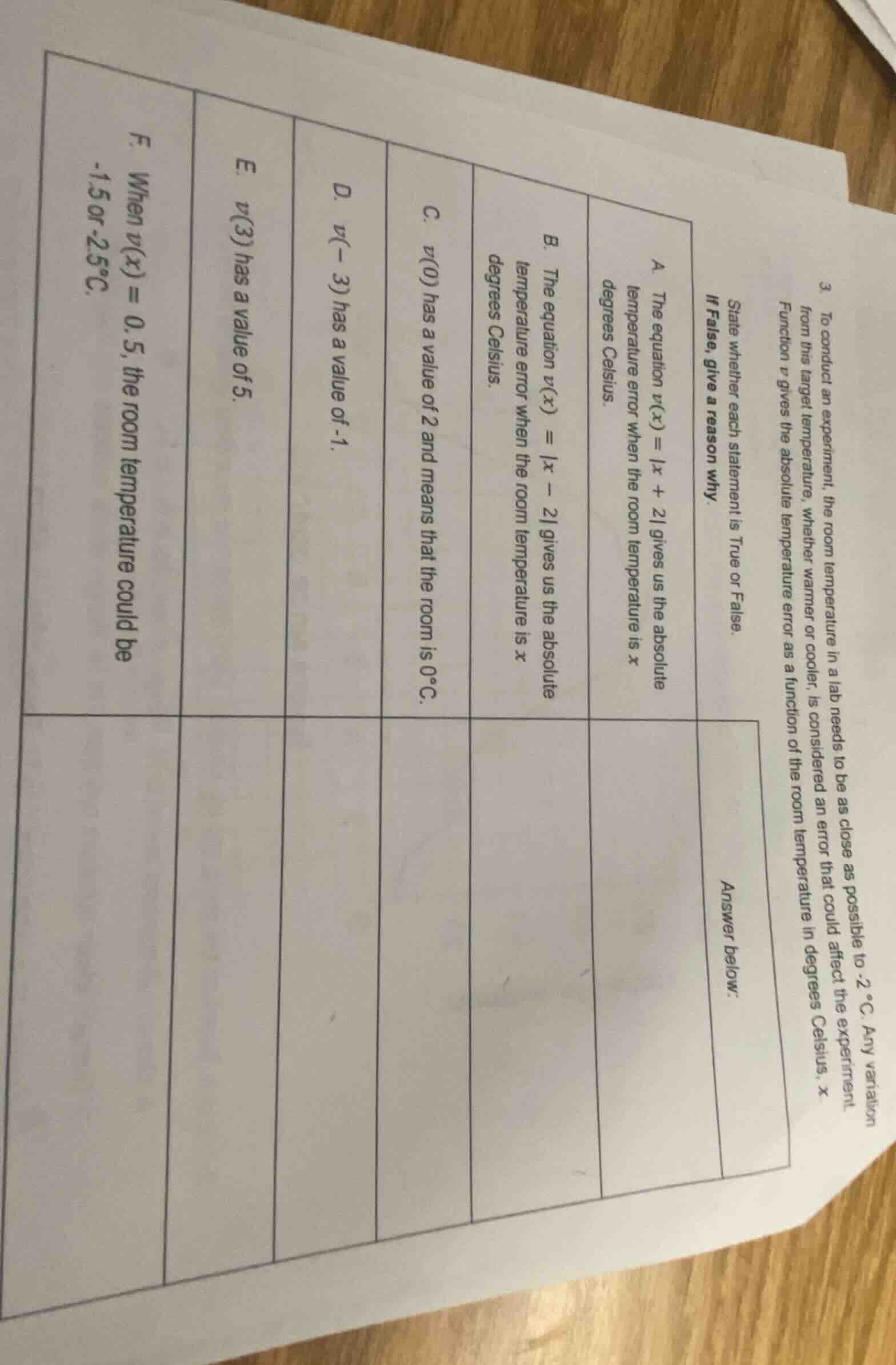
- to conduct an experiment, the room temperature in a lab needs to be as close as possible to -2 °c. any variation from this target temperature, whether warmer or cooler, is considered an error that could affect the experiment. function ( v ) gives the absolute temperature error as a function of the room temperature in degrees celsius, ( x ). state whether each statement is true or false. if false, give a reason why.
a. the equation ( v(x) = |x + 2| ) gives us the absolute temperature error when the room temperature is ( x ) degrees celsius.
b. the equation ( v(x) = |x - 2| ) gives us the absolute temperature error when the room temperature is ( x ) degrees celsius.
c. ( v(0) ) has a value of 2 and means that the room is ( 0^circ \text{c} ).
d. ( v(-3) ) has a value of -1.
e. ( v(3) ) has a value of 5.
f. when ( v(x) = 0.5 ), the room temperature could be -1.5 or -2.5 ( ^circ \text{c} ).
To solve this, we analyze each statement about the absolute temperature error function \( v(x) \) (target temperature is \(-2^\circ\text{C}\), so \( v(x)=|x - (-2)|=|x + 2| \) for the error, or maybe other interpretations depending on context, but let's check each part):
Part A
Statement: The equation \( v(x)=|x + 2| \) gives the absolute temperature error when the room temperature is \( x \) degrees Celsius.
- The target temperature is \(-2^\circ\text{C}\). Absolute error is \( |\text{measured} - \text{target}|=|x - (-2)|=|x + 2| \). So this matches.

Snap & solve any problem in the app
Get step-by-step solutions on Sovi AI
Photo-based solutions with guided steps
Explore more problems and detailed explanations
**: True
Part B
Statement: The equation \( v(x)=|x - 2| \) gives the absolute temperature error when the room temperature is \( x \) degrees Celsius.
- Target is \(-2^\circ\text{C}\), so error should be \( |x - (-2)|=|x + 2| \), not \( |x - 2| \) (which would be error from \( 2^\circ\text{C} \), not \(-2^\circ\text{C}\)).