QUESTION IMAGE
Question
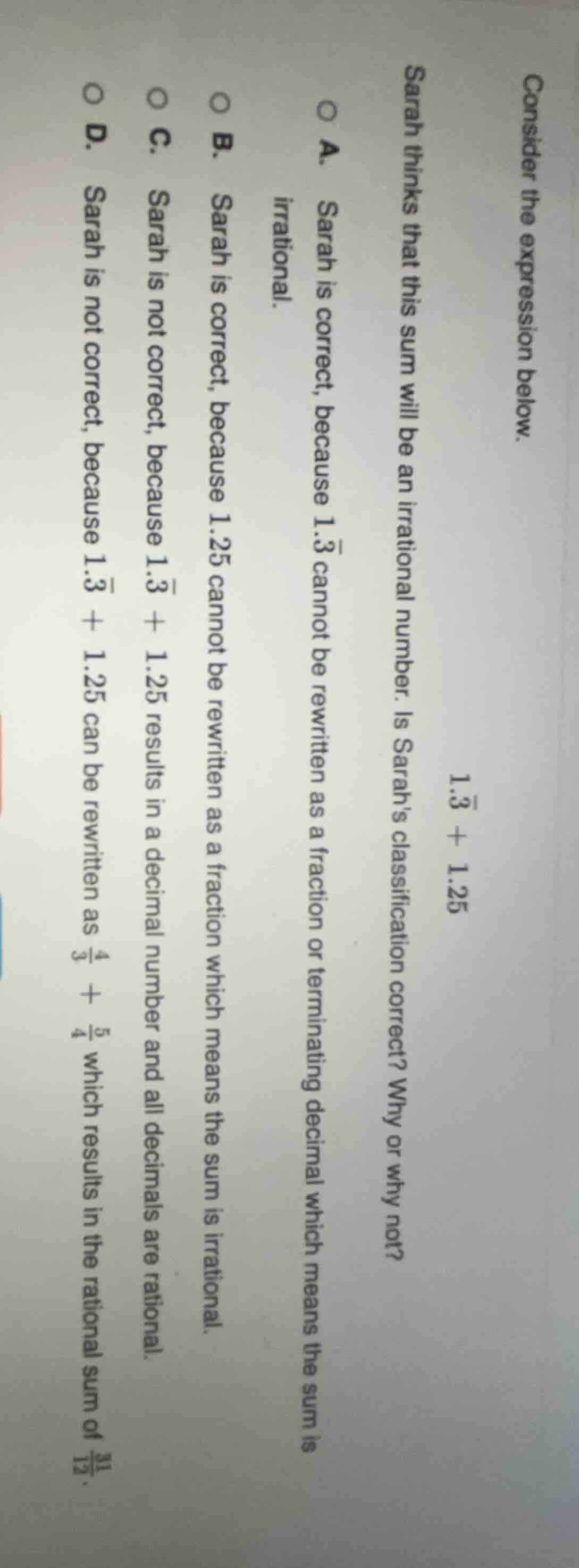
consider the expression below.
$1.\overline{3} + 1.25$
sarah thinks that this sum will be an irrational number. is sarahs classification correct? why or why not?
○ a. sarah is correct, because $1.\overline{3}$ cannot be rewritten as a fraction or terminating decimal which means the sum is irrational.
○ b. sarah is correct, because 1.25 cannot be rewritten as a fraction which means the sum is irrational.
○ c. sarah is not correct, because $1.\overline{3} + 1.25$ results in a decimal number and all decimals are rational.
○ d. sarah is not correct, because $1.\overline{3} + 1.25$ can be rewritten as $\frac{4}{3} + \frac{5}{4}$ which results in the rational sum of $\frac{31}{12}$.
Step1: Convert $1.\overline{3}$ to fraction
Let $x = 1.\overline{3} = 1.333...$
Multiply by 10: $10x = 13.333...$
Subtract: $10x - x = 13.333... - 1.333...$
$9x = 12 \implies x = \frac{12}{9} = \frac{4}{3}$
Step2: Convert $1.25$ to fraction
$1.25 = \frac{125}{100} = \frac{5}{4}$
Step3: Add the two fractions
$\frac{4}{3} + \frac{5}{4} = \frac{16 + 15}{12} = \frac{31}{12}$
Step4: Classify the result
$\frac{31}{12}$ is a ratio of integers, so it is rational. Sarah is incorrect.

Snap & solve any problem in the app
Get step-by-step solutions on Sovi AI
Photo-based solutions with guided steps
Explore more problems and detailed explanations
D. Sarah is not correct, because $1.\overline{3} + 1.25$ can be rewritten as $\frac{4}{3} + \frac{5}{4}$ which results in the rational sum of $\frac{31}{12}$.