QUESTION IMAGE
Question
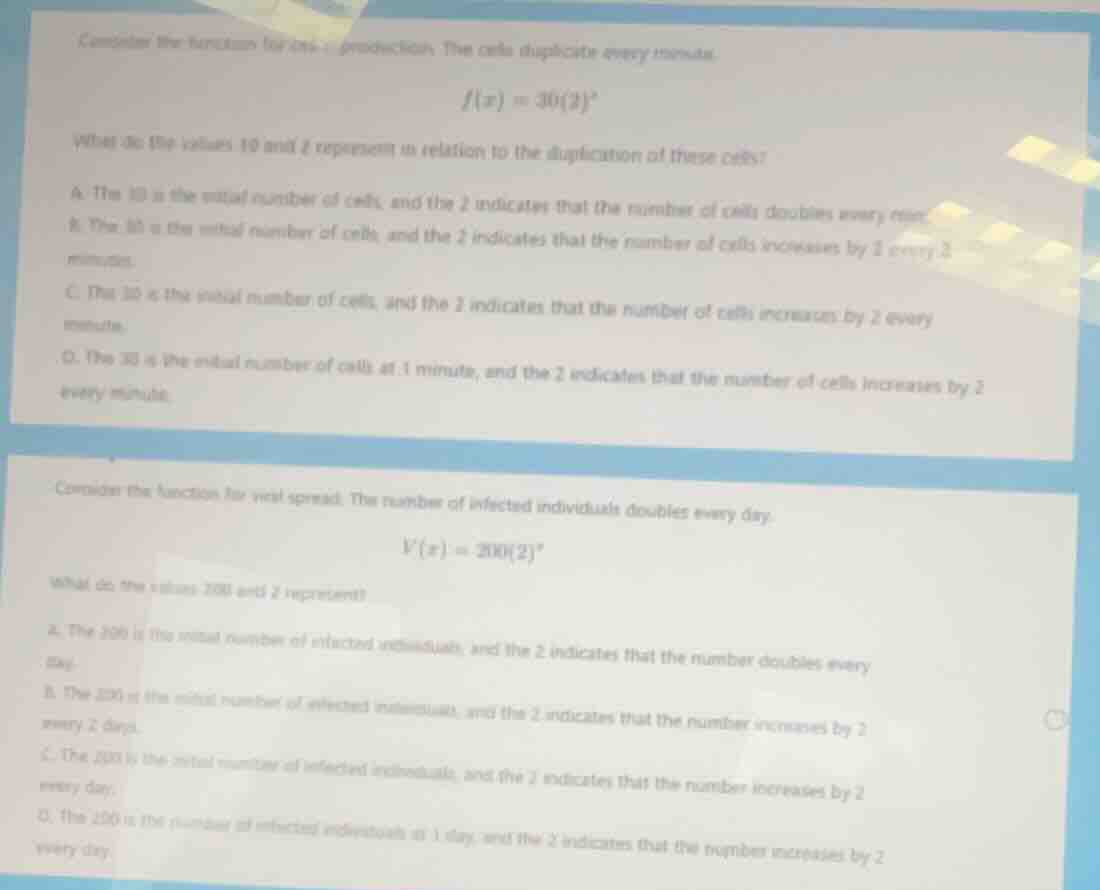
consider the function for cell production. the cells duplicate every minute.
$f(x) = 30(2)^x$
what do the values 30 and 2 represent in relation to the duplication of these cells?
a. the 30 is the initial number of cells, and the 2 indicates that the number of cells doubles every minute.
b. the 30 is the initial number of cells, and the 2 indicates that the number of cells increases by 2 every 2 minutes.
c. the 30 is the initial number of cells, and the 2 indicates that the number of cells increases by 2 every minute.
d. the 30 is the initial number of cells at 1 minute, and the 2 indicates that the number of cells increases by 2 every minute.
consider the function for viral spread. the number of infected individuals doubles every day.
$v(x) = 200(2)^x$
what do the values 200 and 2 represent?
a. the 200 is the initial number of infected individuals, and the 2 indicates that the number doubles every day.
b. the 200 is the initial number of infected individuals, and the 2 indicates that the number increases by 2 every 2 days.
c. the 200 is the initial number of infected individuals, and the 2 indicates that the number increases by 2 every day.
d. the 200 is the number of infected individuals at 1 day, and the 2 indicates that the number increases by 2 every day.
First Sub - Question (Cell Production)
The function for cell production is \(f(x)=30(2)^{x}\), where \(x\) represents time in minutes. In an exponential growth function of the form \(y = a(b)^{x}\), \(a\) is the initial amount and \(b\) is the growth factor. If \(b = 2\), it means the quantity doubles (since \(2\) represents a factor of multiplication by \(2\)) for each unit increase in \(x\) (each minute here). So, \(30\) is the initial number of cells, and \(2\) indicates the number of cells doubles every minute. Option A matches this description. Option B is wrong as \(2\) does not mean increase by \(2\) every \(2\) minutes. Option C is wrong as \(2\) is a growth factor (doubling) not an addition of \(2\) per minute. Option D is wrong as \(30\) is the initial number (at \(x = 0\), not at \(1\) minute) and \(2\) is a growth factor, not an addition of \(2\) per minute.
The function for viral spread is \(V(x)=200(2)^{x}\), where \(x\) represents time in days. Using the exponential growth function form \(y=a(b)^{x}\), \(a = 200\) is the initial number of infected individuals and \(b = 2\) is the growth factor. A growth factor of \(2\) means the number of infected individuals doubles for each unit increase in \(x\) (each day here). Option A matches this. Option B is wrong as \(2\) is a growth factor (doubling) not an increase by \(2\) every \(2\) days. Option C is wrong as \(2\) is a growth factor (doubling) not an addition of \(2\) per day. Option D is wrong as \(200\) is the initial number (at \(x = 0\), not at \(1\) day) and \(2\) is a growth factor, not an addition of \(2\) per day.

Snap & solve any problem in the app
Get step-by-step solutions on Sovi AI
Photo-based solutions with guided steps
Explore more problems and detailed explanations
A. The 30 is the initial number of cells, and the 2 indicates that the number of cells doubles every minute.