QUESTION IMAGE
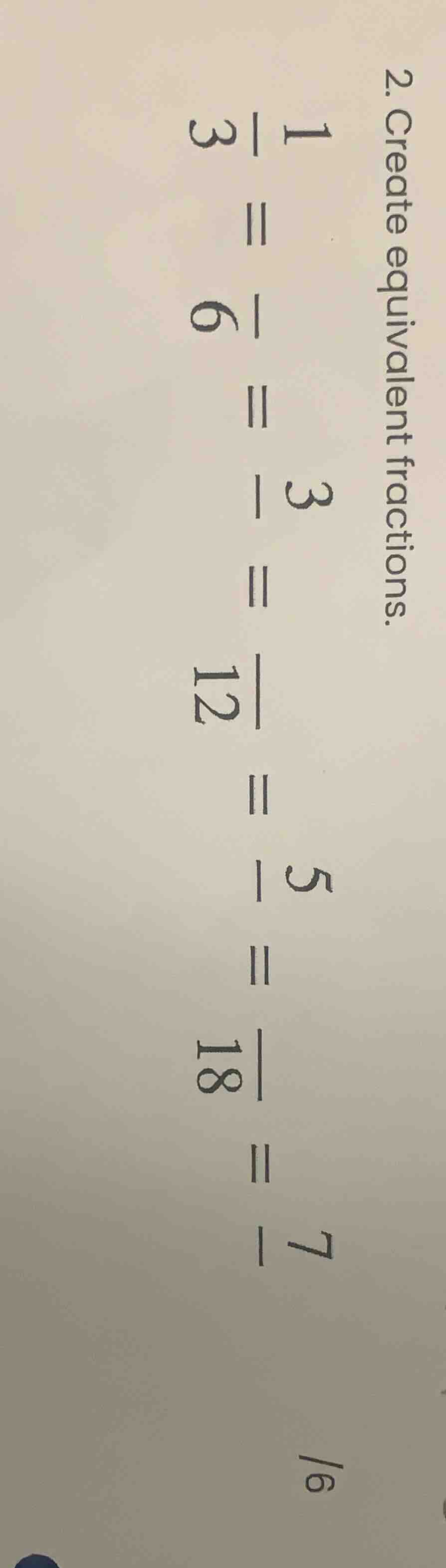
Question
- create equivalent fractions.
\\(\frac{1}{3}=\frac{}{6}\\)\\(\frac{3}{}=\frac{}{12}\\)\\(\frac{5}{}=\frac{}{18}\\)\\(\frac{7}{}=\frac{}{6}\\)
To create equivalent fractions, we use the property that multiplying the numerator and denominator of a fraction by the same non - zero number gives an equivalent fraction. The general formula for equivalent fractions is $\frac{a}{b}=\frac{a\times k}{b\times k}$ where $k
eq0$.
Step 1: For $\frac{1}{3}$ to get denominator 6
We know that to get from 3 to 6 in the denominator, we multiply by 2 ($3\times2 = 6$). So we also multiply the numerator by 2.
$\frac{1\times2}{3\times2}=\frac{2}{6}$
Step 2: For $\frac{1}{3}$ to get numerator 3
We know that to get from 1 to 3 in the numerator, we multiply by 3 ($1\times3=3$). So we also multiply the denominator by 3.
$\frac{1\times3}{3\times3}=\frac{3}{9}$
Step 3: For $\frac{1}{3}$ to get denominator 12
We know that to get from 3 to 12 in the denominator, we multiply by 4 ($3\times4 = 12$). So we also multiply the numerator by 4.
$\frac{1\times4}{3\times4}=\frac{4}{12}$
Step 4: For $\frac{1}{3}$ to get numerator 5
We know that to get from 1 to 5 in the numerator, we multiply by 5 ($1\times5 = 5$). So we also multiply the denominator by 5.
$\frac{1\times5}{3\times5}=\frac{5}{15}$
Step 5: For $\frac{1}{3}$ to get denominator 18
We know that to get from 3 to 18 in the denominator, we multiply by 6 ($3\times6=18$). So we also multiply the numerator by 6.
$\frac{1\times6}{3\times6}=\frac{6}{18}$
Step 6: For $\frac{1}{3}$ to get numerator 7
We know that to get from 1 to 7 in the numerator, we multiply by 7 ($1\times7 = 7$). So we also multiply the denominator by 7.
$\frac{1\times7}{3\times7}=\frac{7}{21}$

Snap & solve any problem in the app
Get step-by-step solutions on Sovi AI
Photo-based solutions with guided steps
Explore more problems and detailed explanations
$\frac{1}{3}=\frac{2}{6}=\frac{3}{9}=\frac{4}{12}=\frac{5}{15}=\frac{6}{18}=\frac{7}{21}$ (The equivalent fractions are calculated by multiplying numerator and denominator by the same non - zero integer as shown in the steps above)