QUESTION IMAGE
Question
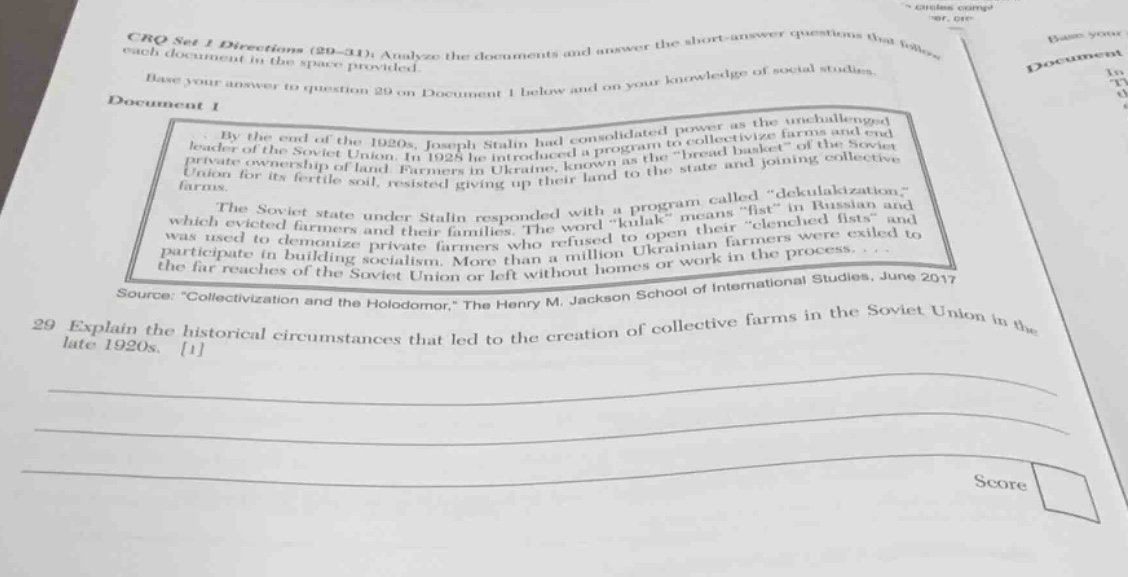
crq set 1 directions (29–31): analyze the documents and answer the short - answer questions that follow each document in the space provided.
base your answer to question 29 on document 1 below and on your knowledge of social studies.
document 1
by the end of the 1920s, joseph stalin had consolidated power as the unchallenged leader of the soviet union. in 1928 he introduced a program to collectivize farms and end private ownership of land. farmers in ukraine, known as the “bread basket” of the soviet union for its fertile soil, resisted giving up their land to the state and joining collective farms.
the soviet state under stalin responded with a program called “dekulakization,” which evicted farmers and their families. the word “kulak” means “fist” in russian and was used to demonize private farmers who refused to open their “clenched fists” and participate in building socialism. more than a million ukrainian farmers were exiled to the far reaches of the soviet union or left without homes or work in the process....
source: “collectivization and the holodomor,” the henry m. jackson school of international studies, june 2017
29 explain the historical circumstances that led to the creation of collective farms in the soviet union in the late 1920s. 1
score
By the late 1920s, Joseph Stalin had consolidated power in the Soviet Union. To transform the Soviet economy towards socialism and ensure food supply for industrialization, he introduced collectivization in 1928. The goal was to end private land ownership and have farms (like in Ukraine, the "bread basket") be state - controlled collective farms. Ukrainian farmers resisted giving up their land, but the Soviet state pushed for collectivization to enforce socialist agricultural policies and support the broader socialist construction, including industrial growth, by controlling agricultural production and resources.

Snap & solve any problem in the app
Get step-by-step solutions on Sovi AI
Photo-based solutions with guided steps
Explore more problems and detailed explanations
By the late 1920s, Joseph Stalin consolidated power in the Soviet Union. To advance socialism, ensure food supply for industrialization, and end private land ownership, he introduced a collectivization program in 1928. Ukrainian farmers (the Soviet “bread basket”) resisted giving up land, but the Soviet state sought to enforce socialist agricultural policies through collective farms to support socialist construction (including industrial growth) by controlling agricultural production and resources.