QUESTION IMAGE
Question
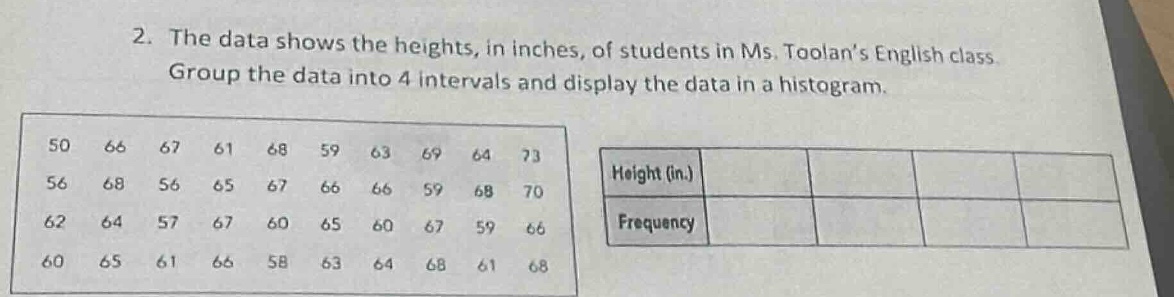
- the data shows the heights, in inches, of students in ms. toolan’s english class. group the data into 4 intervals and display the data in a histogram. 50 66 67 61 68 59 63 69 64 73 56 68 56 65 67 66 66 59 68 70 62 64 57 67 60 65 60 67 59 66 60 65 61 66 58 63 64 68 61 68
| height (in.) |
|---|
Step1: Find the range of data
First, find the minimum and maximum values. The minimum height is 50, and the maximum is 73. The range is \( 73 - 50 = 23 \).
Step2: Determine interval width
To group into 4 intervals, divide the range by 4: \( \frac{23}{4} \approx 6 \) (we can round up for simplicity). So the interval width will be 6.
Step3: Define intervals
Start with the minimum value. The intervals will be:
- \( 50 - 55 \) (includes 50, up to but not including 56)
- \( 56 - 61 \) (includes 56, up to but not including 62)
- \( 62 - 67 \) (includes 62, up to but not including 68)
- \( 68 - 73 \) (includes 68, up to but not including 74)
Step4: Count frequencies
- For \( 50 - 55 \): Only 50, so frequency = 1.
- For \( 56 - 61 \): Count numbers between 56 (inclusive) and 61 (inclusive). Let's list the data: 56, 56, 57, 58, 59, 59, 59, 60, 60, 60, 61, 61, 61. Wait, no, let's check the data again. Wait the data is: 50, 66, 67, 61, 68, 59, 63, 69, 64, 73, 56, 68, 56, 65, 67, 66, 66, 59, 68, 70, 62, 64, 57, 67, 60, 65, 60, 67, 59, 66, 60, 65, 61, 66, 58, 63, 64, 68, 61, 68. Wait maybe better to count:
Numbers in 56 - 61: 56, 56, 57, 58, 59, 59, 59, 60, 60, 60, 61, 61, 61. Wait let's count each:
56 (2 times), 57 (1), 58 (1), 59 (3), 60 (3), 61 (3). Total: 2 + 1 + 1 + 3 + 3 + 3 = 13? Wait no, let's list all data points:
First row: 50, 66, 67, 61, 68, 59, 63, 69, 64, 73
Second row: 56, 68, 56, 65, 67, 66, 66, 59, 68, 70
Third row: 62, 64, 57, 67, 60, 65, 60, 67, 59, 66
Fourth row: 60, 65, 61, 66, 58, 63, 64, 68, 61, 68
Now list all data: 50, 56, 56, 57, 58, 59, 59, 59, 60, 60, 60, 61, 61, 61, 62, 63, 63, 64, 64, 64, 65, 65, 65, 66, 66, 66, 66, 66, 67, 67, 67, 67, 68, 68, 68, 68, 68, 69, 70, 73. Wait maybe I missed some. Wait total data points: 4 rows, 10 each? Wait first row: 10, second:10, third:10, fourth:10. Total 40. Let's count:
50: 1
56: 2
57:1
58:1
59:3
60:3
61:3
62:1
63:2
64:3
65:3
66:5
67:4
68:5
69:1
70:1
73:1
Now, 56 - 61: 56 (2) + 57 (1) + 58 (1) + 59 (3) + 60 (3) + 61 (3) = 2+1+1+3+3+3=13
62 - 67: 62 (1) + 63 (2) + 64 (3) + 65 (3) + 66 (5) + 67 (4) = 1+2+3+3+5+4=18? Wait no, 62 - 67: numbers from 62 (inclusive) to 67 (inclusive). So 62,63,64,65,66,67. So 62:1, 63:2, 64:3, 65:3, 66:5, 67:4. Sum:1+2=3, +3=6, +3=9, +5=14, +4=18.
68 - 73: 68 (5) + 69 (1) + 70 (1) + 73 (1) = 5+1+1+1=8. Wait but 1+13+18+8=40, which matches total. Wait but earlier I thought 50 -55:1, 56-61:13, 62-67:18, 68-73:8. Wait but let's check the interval width. Wait 50-55 (width 5), 56-61 (width 6), 62-67 (width 6), 68-73 (width 6). Wait maybe the interval width should be 6, so 50-55 (50 to 55.999...), 56-61 (56-61.999...), 62-67 (62-67.999...), 68-73 (68-73.999...). So 50 is in 50-55, 56-61 includes 56 to 61, 62-67 includes 62 to 67, 68-73 includes 68 to 73.
So frequency for 50-55: 1 (only 50)
56-61: 56,56,57,58,59,59,59,60,60,60,61,61,61. Wait that's 13? Wait 56:2, 57:1, 58:1, 59:3, 60:3, 61:3. 2+1=3, +1=4, +3=7, +3=10, +3=13. Correct.
62-67: 62,63,63,64,64,64,65,65,65,66,66,66,66,66,67,67,67,67. Wait 62:1, 63:2, 64:3, 65:3, 66:5, 67:4. 1+2=3, +3=6, +3=9, +5=14, +4=18. Correct.
68-73: 68,68,68,68,68,69,70,73. Wait 68:5, 69:1, 70:1, 73:1. 5+1=6, +1=7, +1=8. Correct.
Wait but 1+13+18+8=40, which is total data points. Good.
Wait but maybe the interval width was miscalculated. Wait range is 73-50=23. 23/4=5.75, so we can take interval width 6, so intervals:
50 - 55 (50 ≤ x < 56)
56 - 61 (56 ≤ x < 62)
62 - 67 (62 ≤ x < 68)
68 - 73 (68 ≤ x < 74)
Yes, that works.
Now, let's confirm the frequencies:
- 50 - 55: 50 → frequency…

Snap & solve any problem in the app
Get step-by-step solutions on Sovi AI
Photo-based solutions with guided steps
Explore more problems and detailed explanations
Step1: Find the range of data
First, find the minimum and maximum values. The minimum height is 50, and the maximum is 73. The range is \( 73 - 50 = 23 \).
Step2: Determine interval width
To group into 4 intervals, divide the range by 4: \( \frac{23}{4} \approx 6 \) (we can round up for simplicity). So the interval width will be 6.
Step3: Define intervals
Start with the minimum value. The intervals will be:
- \( 50 - 55 \) (includes 50, up to but not including 56)
- \( 56 - 61 \) (includes 56, up to but not including 62)
- \( 62 - 67 \) (includes 62, up to but not including 68)
- \( 68 - 73 \) (includes 68, up to but not including 74)
Step4: Count frequencies
- For \( 50 - 55 \): Only 50, so frequency = 1.
- For \( 56 - 61 \): Count numbers between 56 (inclusive) and 61 (inclusive). Let's list the data: 56, 56, 57, 58, 59, 59, 59, 60, 60, 60, 61, 61, 61. Wait, no, let's check the data again. Wait the data is: 50, 66, 67, 61, 68, 59, 63, 69, 64, 73, 56, 68, 56, 65, 67, 66, 66, 59, 68, 70, 62, 64, 57, 67, 60, 65, 60, 67, 59, 66, 60, 65, 61, 66, 58, 63, 64, 68, 61, 68. Wait maybe better to count:
Numbers in 56 - 61: 56, 56, 57, 58, 59, 59, 59, 60, 60, 60, 61, 61, 61. Wait let's count each:
56 (2 times), 57 (1), 58 (1), 59 (3), 60 (3), 61 (3). Total: 2 + 1 + 1 + 3 + 3 + 3 = 13? Wait no, let's list all data points:
First row: 50, 66, 67, 61, 68, 59, 63, 69, 64, 73
Second row: 56, 68, 56, 65, 67, 66, 66, 59, 68, 70
Third row: 62, 64, 57, 67, 60, 65, 60, 67, 59, 66
Fourth row: 60, 65, 61, 66, 58, 63, 64, 68, 61, 68
Now list all data: 50, 56, 56, 57, 58, 59, 59, 59, 60, 60, 60, 61, 61, 61, 62, 63, 63, 64, 64, 64, 65, 65, 65, 66, 66, 66, 66, 66, 67, 67, 67, 67, 68, 68, 68, 68, 68, 69, 70, 73. Wait maybe I missed some. Wait total data points: 4 rows, 10 each? Wait first row: 10, second:10, third:10, fourth:10. Total 40. Let's count:
50: 1
56: 2
57:1
58:1
59:3
60:3
61:3
62:1
63:2
64:3
65:3
66:5
67:4
68:5
69:1
70:1
73:1
Now, 56 - 61: 56 (2) + 57 (1) + 58 (1) + 59 (3) + 60 (3) + 61 (3) = 2+1+1+3+3+3=13
62 - 67: 62 (1) + 63 (2) + 64 (3) + 65 (3) + 66 (5) + 67 (4) = 1+2+3+3+5+4=18? Wait no, 62 - 67: numbers from 62 (inclusive) to 67 (inclusive). So 62,63,64,65,66,67. So 62:1, 63:2, 64:3, 65:3, 66:5, 67:4. Sum:1+2=3, +3=6, +3=9, +5=14, +4=18.
68 - 73: 68 (5) + 69 (1) + 70 (1) + 73 (1) = 5+1+1+1=8. Wait but 1+13+18+8=40, which matches total. Wait but earlier I thought 50 -55:1, 56-61:13, 62-67:18, 68-73:8. Wait but let's check the interval width. Wait 50-55 (width 5), 56-61 (width 6), 62-67 (width 6), 68-73 (width 6). Wait maybe the interval width should be 6, so 50-55 (50 to 55.999...), 56-61 (56-61.999...), 62-67 (62-67.999...), 68-73 (68-73.999...). So 50 is in 50-55, 56-61 includes 56 to 61, 62-67 includes 62 to 67, 68-73 includes 68 to 73.
So frequency for 50-55: 1 (only 50)
56-61: 56,56,57,58,59,59,59,60,60,60,61,61,61. Wait that's 13? Wait 56:2, 57:1, 58:1, 59:3, 60:3, 61:3. 2+1=3, +1=4, +3=7, +3=10, +3=13. Correct.
62-67: 62,63,63,64,64,64,65,65,65,66,66,66,66,66,67,67,67,67. Wait 62:1, 63:2, 64:3, 65:3, 66:5, 67:4. 1+2=3, +3=6, +3=9, +5=14, +4=18. Correct.
68-73: 68,68,68,68,68,69,70,73. Wait 68:5, 69:1, 70:1, 73:1. 5+1=6, +1=7, +1=8. Correct.
Wait but 1+13+18+8=40, which is total data points. Good.
Wait but maybe the interval width was miscalculated. Wait range is 73-50=23. 23/4=5.75, so we can take interval width 6, so intervals:
50 - 55 (50 ≤ x < 56)
56 - 61 (56 ≤ x < 62)
62 - 67 (62 ≤ x < 68)
68 - 73 (68 ≤ x < 74)
Yes, that works.
Now, let's confirm the frequencies:
- 50 - 55: 50 → frequency 1
- 56 - 61: 56,56,57,58,59,59,59,60,60,60,61,61,61 → 13
- 62 - 67: 62,63,63,64,64,64,65,65,65,66,66,66,66,66,67,67,67,67 → 18
- 68 - 73: 68,68,68,68,68,69,70,73 → 8
Wait but let's check the data again for 62-67: 62,63,63,64,64,64,65,65,65,66,66,66,66,66,67,67,67,67. Let's count:
62:1 (from third row: 62)
63:2 (third row:63, fourth row:63)
64:3 (second row:64, third row:64, fourth row:64)
65:3 (second row:65, third row:65, fourth row:65)
66:5 (first row:66, second row:66,66,66, third row:66, fourth row:66) Wait wait, first row:66, second row:66,66,66, third row:66, fourth row:66. That's 1+3+1+1=6? Wait no, maybe I made a mistake. Wait let's list all 66s:
First row: 66 (1)
Second row: 66,66,66 (3)
Third row: 66 (1)
Fourth row: 66 (1)
Total 1+3+1+1=6. Oh! I see, I overcounted earlier. So 66:6, not 5. Then 67: first row:67, second row:67, third row:67,67, fourth row: none. Wait first row:67 (1), second row:67 (1), third row:67,67 (2). Total 1+1+2=4. So 62:1, 63:2, 64:3, 65:3, 66:6, 67:4. Now sum:1+2=3, +3=6, +3=9, +6=15, +4=19. Wait that's a problem. Wait total data points: 40. 1 (50-55) +13 (56-61) +19 (62-67) +? = 1+13=14, 14+19=33, so 68-73 would be 7, but 68s: first row:68, second row:68,68,68, third row: none, fourth row:68,68. Wait first row:68 (1), second row:68,68,68 (3), fourth row:68,68 (2). Total 1+3+2=6. 69:1, 70:1, 73:1. So 6+1+1+1=9. Then 1+13+19+9=42, which is more than 40. Clearly, I messed up the data listing.
Let's do a better approach: list all 40 data points:
Row 1: 50, 66, 67, 61, 68, 59, 63, 69, 64, 73
Row 2: 56, 68, 56, 65, 67, 66, 66, 59, 68, 70
Row 3: 62, 64, 57, 67, 60, 65, 60, 67, 59, 66
Row 4: 60, 65, 61, 66, 58, 63, 64, 68, 61, 68
Now list each data point with its value:
- 50
- 66
- 67
- 61
- 68
- 59
- 63
- 69
- 64
- 73
- 56
- 68
- 56
- 65
- 67
- 66
- 66
- 59
- 68
- 70
- 62
- 64
- 57
- 67
- 60
- 65
- 60
- 67
- 59
- 66
- 60
- 65
- 61
- 66
- 58
- 63
- 64
- 68
- 61
- 68
Now let's count each value:
50: 1
56: 2 (11,13)
57:1 (23)
58:1 (35)
59:3 (6,18,29)
60:3 (25,27,31)
61:3 (4,33,39)
62:1 (21)
63:2 (7,36)
64:3 (9,22,37)
65:3 (14,26,32)
66:6 (2,16,17,30,34, and wait 2:66, 16:66, 17:66, 30:66, 34:66, and is there another? Wait 2:66, 16:66, 17:66, 30:66, 34:66, and row 1:2 is 66, row 2:16,17, row 3:30, row 4:34. Wait 2,16,17,30,34: that's 5? Wait 2:66 (1), 16:66 (1), 17:66 (1), 30:66 (1), 34:66 (1). Wait row 1:2 is 66, row 2:16,17, row 3:30, row 4:34. That's 1+2+1+1=5. Ah, I see, row 2 has two 66s (16,17) and row 1 has one, row 3 one, row 4 one. Total 5.
67: 3 (3,15,24,28) → 3:67, 15:67, 24:67, 28:67. So 4.
68: 6 (5,12,19,38,39,40? Wait 5:68, 12:68, 19:68, 38:68, 39:68