QUESTION IMAGE
Question
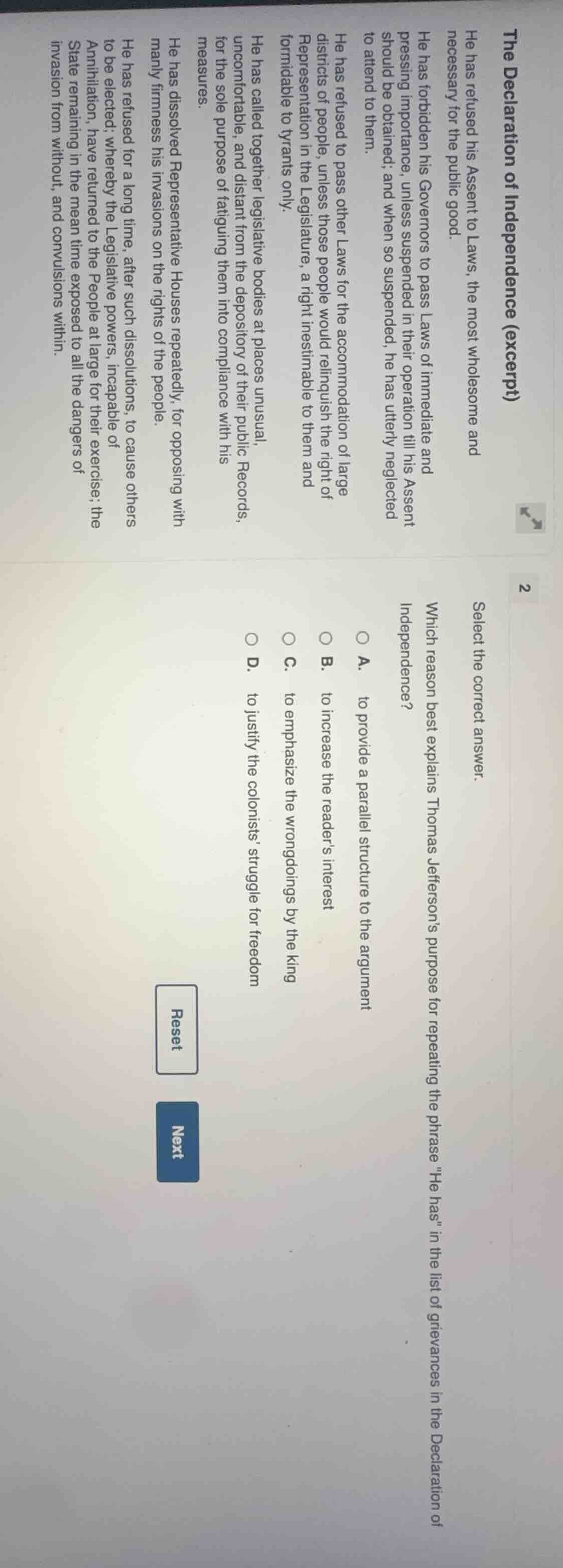
the declaration of independence (excerpt)
he has refused his assent to laws, the most wholesome and necessary for the public good.
he has forbidden his governors to pass laws of immediate and pressing importance, unless suspended in their operation till his assent should be obtained; and when so suspended, he has utterly neglected to attend to them.
he has refused to pass other laws for the accommodation of large districts of people, unless those people would relinquish the right of representation in the legislature, a right inestimable to them and formidable to tyrants only.
he has called together legislative bodies at places unusual, uncomfortable, and distant from the depository of their public records, for the sole purpose of fatiguing them into compliance with his measures.
he has dissolved representative houses repeatedly, for opposing with manly firmness his invasions on the rights of the people.
he has refused for a long time, after such dissolutions, to cause others to be elected; whereby the legislative powers, incapable of annihilation, have returned to the people at large for their exercise; the state remaining in the mean time exposed to all the dangers of invasion from without, and convulsions within.
select the correct answer.
which reason best explains thomas jeffersons purpose for repeating the phrase \he has\ in the list of grievances in the declaration of independence?
a. to provide a parallel structure to the argument
b. to increase the readers interest
c. to emphasize the wrongdoings by the king
d. to justify the colonists struggle for freedom
The phrase "He has" is repeated to list the king's wrongdoings (grievances) to emphasize them, which helps justify the colonists' fight for freedom. Option A is incorrect as it's not about parallel structure for argument. Option B is incorrect as it's not to increase reader interest. Option C is partially related but the ultimate goal is to justify the struggle, but wait, no—repeating "He has" lists the king's actions (wrongdoings) to show why the colonists need independence, so the best reason is to emphasize the king's wrongdoings (option C? Wait, no, let's re - evaluate. The Declaration of Independence's list of grievances (starting with "He has") is to show the king's unjust actions, which in turn justifies the colonists' struggle (option D). Wait, no: the purpose of listing the grievances (each "He has" clause) is to show the king's wrongs (emphasize his misdeeds) to justify the fight for freedom. Wait, the options: C is "to emphasize the wrongdoings by the king", D is "to justify the colonists' struggle for freedom". The repetition of "He has" is to list the king's wrongs (emphasize them) which then serves to justify the struggle. But the question is about the purpose of repeating "He has". Let's analyze each option:
- Option A: Parallel structure for argument? No, the repetition is about listing actions, not structuring the argument's parallelism.
- Option B: Increase reader interest? No, it's a formal document, not for entertainment - style interest.
- Option C: Emphasize the king's wrongdoings. Each "He has" introduces a wrong action of the king, so repeating it emphasizes these wrongs.
- Option D: Justify the colonists' struggle. While the wrongs lead to justification, the act of repeating "He has" is to present the wrongs (emphasize them), which is a step to justify. But the question is about the purpose of repeating the phrase. The primary purpose of the repeated "He has" is to list (and thus emphasize) the king's misdeeds. Wait, but let's check the options again. The correct answer is C? Wait, no, maybe D. Wait, the Declaration's grievances are to show why the colonists have the right to rebel (justify their struggle). The repetition of "He has" is to present the evidence (the king's wrongs) to justify the struggle. But the options: C says "to emphasize the wrongdoings by the king" and D says "to justify the colonists' struggle for freedom". The repetition of "He has" is a rhetorical device to emphasize the king's actions (wrongs) which is done to justify the struggle. But which is the best? Let's think about the Declaration's purpose: to declare independence by showing the king's tyranny. The list of "He has..." is to show the king's unjust acts (emphasize his wrongs) to make the case for independence (justify the struggle). But the question is about the purpose of repeating the phrase. The repetition is to emphasize each of the king's wrongs (each "He has" clause is a wrong), so the purpose is to emphasize the wrongdoings (option C). Wait, no, maybe D. Wait, the answer is C? Wait, no, let's see: the Declaration of Independence's list of grievances (the "He has" statements) is to demonstrate the king's violations of rights, which is to emphasize his wrongdoings, and this in turn justifies the rebellion. But the question is the purpose of repeating "He has". So the act of repeating "He has" is to present (and thus emphasize) each of the king's wrong actions. So option C is correct. Wait, no, I think I made a mistake. Let's re - read the options. The question is "Which reason best explains Thomas Jefferson’s purpose for…

Snap & solve any problem in the app
Get step-by-step solutions on Sovi AI
Photo-based solutions with guided steps
Explore more problems and detailed explanations
C. to emphasize the wrongdoings by the king