QUESTION IMAGE
Question
describing mutually exclusive events
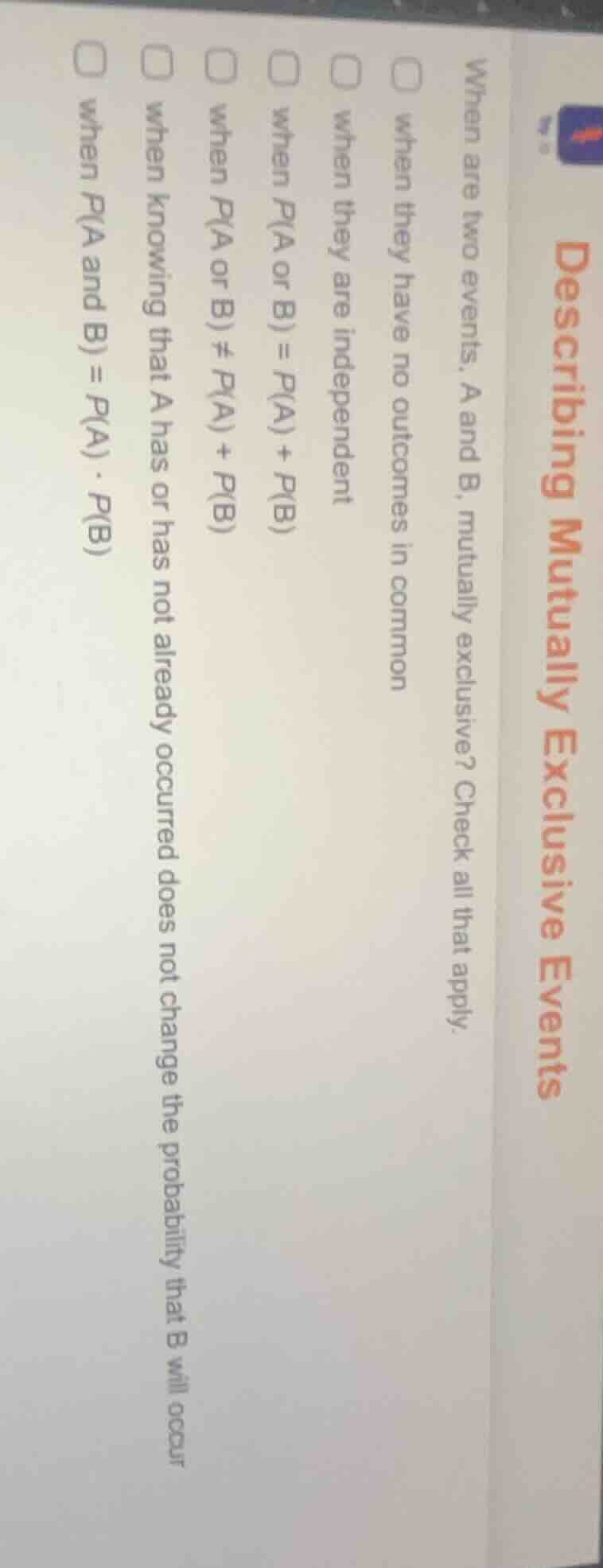
when are two events, a and b, mutually exclusive? check all that apply.
□ when they have no outcomes in common
□ when they are independent
□ when p(a or b) = p(a) + p(b)
□ when p(a or b) ≠ p(a) + p(b)
□ when knowing that a has or has not already occurred does not change the probability that b will occur
□ when p(a and b) = p(a) · p(b)
- Option 1: when they have no outcomes in common
Mutually exclusive events cannot occur at the same time, so they share no common outcomes. This is a core definition of mutual exclusivity.
- Option 3: when \( P(A \text{ or } B) = P(A) + P(B) \)
For mutually exclusive events, the probability of \( A \) or \( B \) occurring is the sum of their individual probabilities (since \( P(A \text{ and } B) = 0 \), the general addition rule \( P(A \cup B) = P(A) + P(B) - P(A \cap B) \) simplifies to \( P(A) + P(B) \)).
- **Option 4: when \( P(A \text{ or } B)
eq P(A) + P(B) \)**
This is incorrect. For mutually exclusive events, \( P(A \cup B) = P(A) + P(B) \), so this inequality does not hold.
- Option 2: when they are independent
Independent events are defined by \( P(A \cap B) = P(A)P(B) \), which is unrelated to mutual exclusivity (mutually exclusive events are dependent unless one has probability 0).
- Option 5: when knowing that \( A \) has or has not occurred does not change the probability that \( B \) will occur
This describes independence, not mutual exclusivity.
- Option 6: when \( P(A \text{ and } B) = P(A) \cdot P(B) \)
This is the formula for independent events, not mutually exclusive events (for mutually exclusive events, \( P(A \cap B) = 0 \)).

Snap & solve any problem in the app
Get step-by-step solutions on Sovi AI
Photo-based solutions with guided steps
Explore more problems and detailed explanations
- when they have no outcomes in common
- when \( P(A \text{ or } B) = P(A) + P(B) \)