QUESTION IMAGE
Question
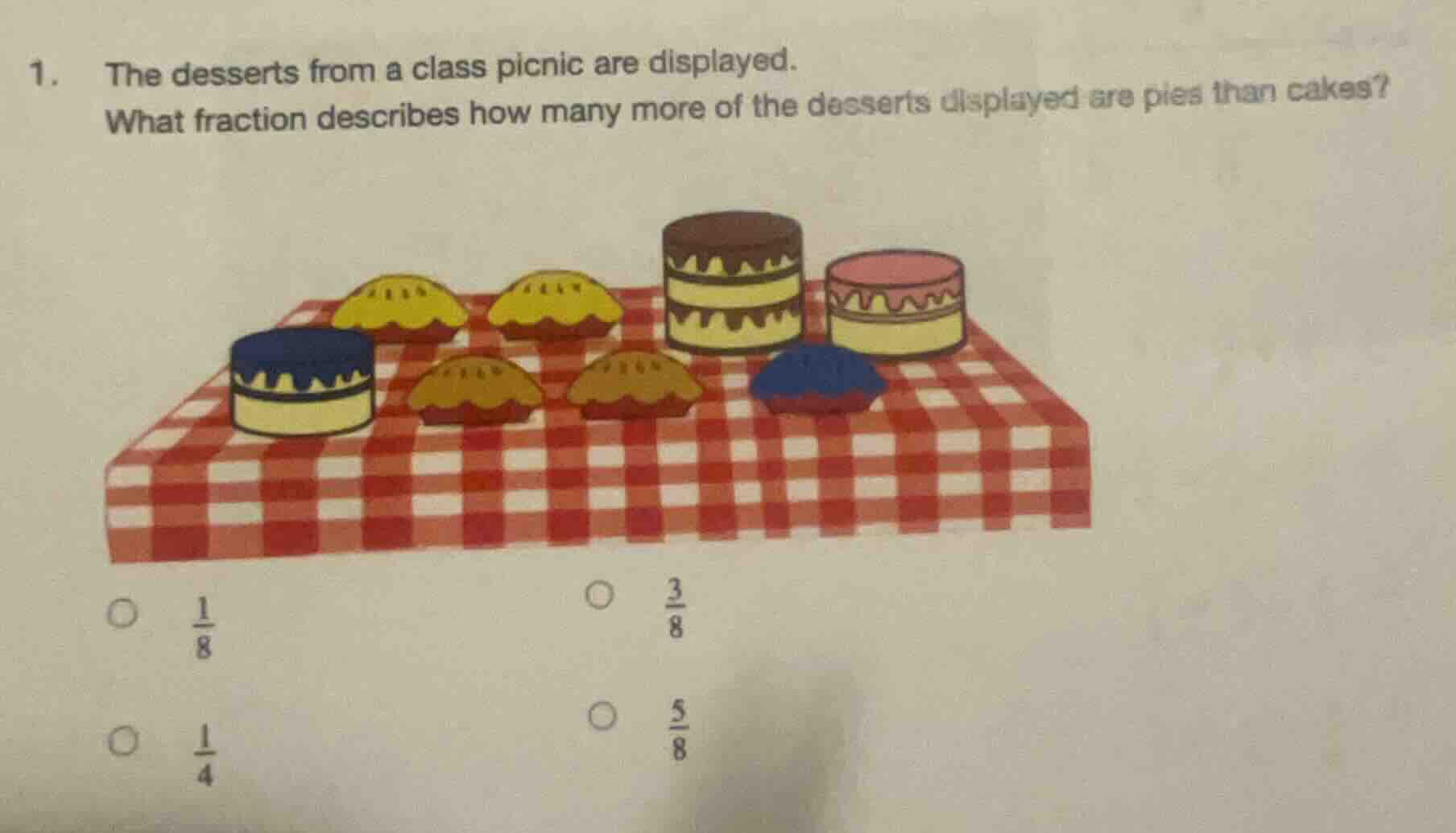
- the desserts from a class picnic are displayed. what fraction describes how many more of the desserts displayed are pies than cakes? options: \\(\frac{1}{8}\\), \\(\frac{3}{8}\\), \\(\frac{1}{4}\\), \\(\frac{5}{8}\\)
Step1: Count total desserts
From the image, count the number of pies and cakes. Let's see: pies are 4 (yellow and brown ones), cakes are 3 (the layered ones and the blue one? Wait, no, let's re - count. Wait, looking at the image: the pies are 4 (two yellow, two brown) and cakes are 3 (the three with icing: blue, brown - yellow, pink - yellow). Wait, total desserts: 4 pies + 3 cakes + 1 blue cupcake? Wait, no, maybe I miscounted. Wait, let's list them:
Pies: Let's see the yellow ones (2), brown ones (2) → 4 pies.
Cakes: The blue - yellow layered, brown - yellow layered, pink - yellow layered → 3 cakes.
Wait, but the total number of desserts: 4 + 3=7? No, wait, there's also a blue cupcake? Wait, maybe the total is 8? Wait, maybe I made a mistake. Wait, let's look again. The problem is about pies and cakes, maybe the cupcake is not considered? Wait, no, the question is about pies and cakes. Wait, maybe the total number of desserts is 8. Let's assume that. Wait, maybe the number of pies is 4, cakes is 3, so the difference is 4 - 3 = 1. But the fractions are with denominator 8. Wait, maybe the total number of desserts is 8. Let's re - count:
Looking at the image:
Pies: 4 (the four with the pie - like shape: two yellow, two brown)
Cakes: 3 (the three with the cake - like shape: blue - yellow, brown - yellow, pink - yellow)
Wait, but 4+3 = 7, which doesn't match the denominator 8. Maybe the blue cupcake is a cake? Then cakes would be 4? No, that doesn't make sense. Wait, maybe I miscounted. Let's try again.
Wait, the options have denominators 8 and 4. Let's think differently. Let's count the number of pies and cakes correctly.
From the image:
Number of pies: Let's see the four items that look like pies (the ones with the crimped edges and filling on top) → 4.
Number of cakes: The three items that look like cakes (the ones with the layered structure and icing) → 3.
Wait, but 4 - 3=1. But the fractions are 1/8, 3/8, 1/4 (which is 2/8), 5/8. Wait, maybe the total number of desserts is 8. So if there are 4 pies and 3 cakes, that's 7, which is wrong. Wait, maybe the number of pies is 5? No, the image shows 4 pies. Wait, maybe the total number of desserts is 8. Let's assume that the total number of desserts is 8. So number of pies: let's say 5? No, the image shows 4 pies (two yellow, two brown) and 3 cakes (three with icing) and 1 cupcake. Wait, maybe the cupcake is a pie? No. Wait, maybe the problem is that the number of pies is 4, cakes is 3, and the total is 8 (maybe the cupcake is a cake). Then pies = 4, cakes = 4? No. Wait, I think I made a mistake. Let's look at the options. The options are 1/8, 3/8, 1/4, 5/8.
Let's calculate the fraction of (number of pies - number of cakes)/total number of desserts.
Suppose total number of desserts is 8.
Number of pies: Let's count again. The four pie - shaped items: 4.
Number of cakes: 3 (the three cake - shaped items).
So the difference is 4 - 3 = 1. But 1/8 is an option. Wait, but 4/8 - 3/8=1/8. Ah! So if the total number of desserts is 8, number of pies is 4 (so 4/8 of the desserts are pies), number of cakes is 3 (so 3/8 of the desserts are cakes). Then the difference is 4/8 - 3/8 = 1/8.
Step2: Calculate the fraction
The fraction of pies is $\frac{4}{8}$, the fraction of cakes is $\frac{3}{8}$. To find how many more pies than cakes (as a fraction of total desserts), we subtract: $\frac{4}{8}-\frac{3}{8}=\frac{1}{8}$.

Snap & solve any problem in the app
Get step-by-step solutions on Sovi AI
Photo-based solutions with guided steps
Explore more problems and detailed explanations
$\frac{1}{8}$ (corresponding to the option with $\frac{1}{8}$)