QUESTION IMAGE
Question
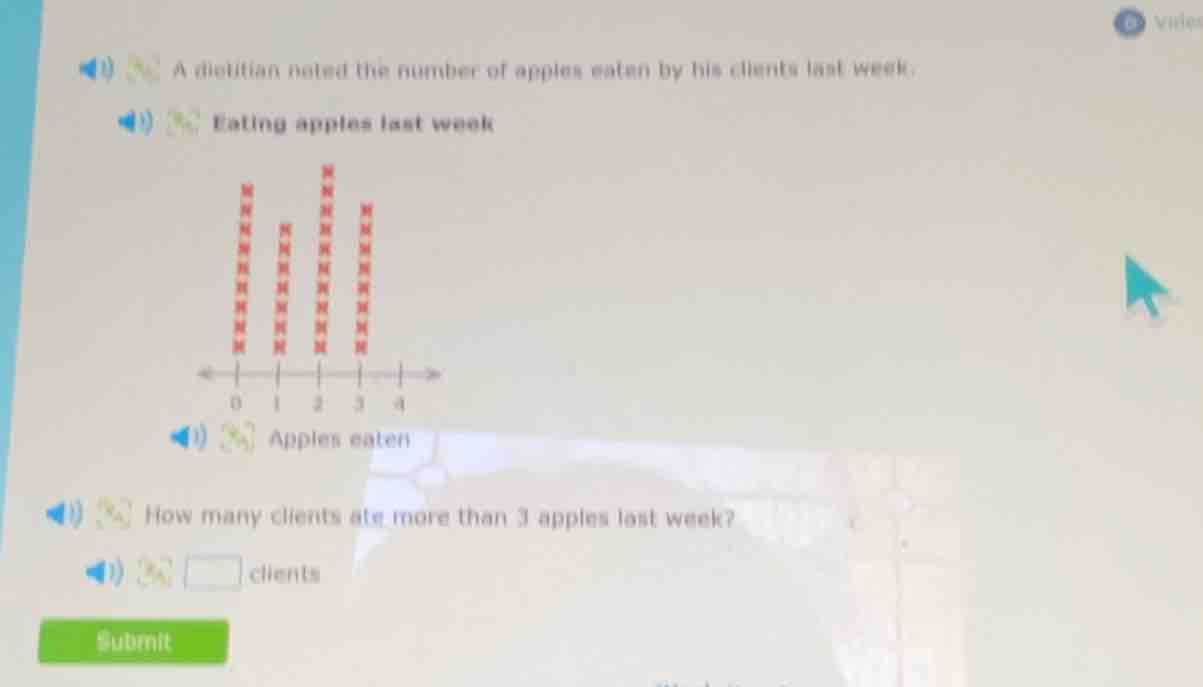
a dietitian noted the number of apples eaten by his clients last week.
eating apples last week
dot plot with xs: 0 has several xs, 1 has some, 2 has more, 3 has some, 4 has none? wait, no, the axis is 0,1,2,3,4. wait, the question is how many clients ate more than 3 apples last week?
apples eaten
how many clients ate more than 3 apples last week?
clients
Step1: Identify the category for more than 3
To find clients who ate more than 3 apples, we look at the category for 4 apples (since more than 3 means 4 or above, and from the graph, the x - axis has 0,1,2,3,4. So we check the number of X's at 4.
Step2: Count the X's at 4
Looking at the graph, the column for 4 apples has 0 X's (since there are no X's above the 4 mark). Wait, maybe I misread. Wait, let's re - examine. Wait, the x - axis labels are 0,1,2,3,4. Let's count the X's for each:
- At 0: Let's say the number of X's is, for example, let's count again. Wait, maybe the original graph (even though the image is a bit unclear) - wait, the question is "more than 3", so we need to look at the number of clients who ate 4 apples (since 4 is more than 3). If we look at the graph, the column for 4 has 0 X's? Wait, no, maybe I made a mistake. Wait, maybe the X's: let's assume that the graph has for 0: let's say 9 X's, 1: 6 X's, 2: 10 X's, 3: 7 X's, and 4: 0? No, that can't be. Wait, maybe the user's graph: let's re - interpret. Wait, the key is "more than 3", so we need to find the frequency (number of X's) for the value 4 (since 4>3). If we look at the graph, the column for 4 has 0 X's? Wait, no, maybe I misread. Wait, maybe the correct count: let's see, the x - axis is apples eaten (0,1,2,3,4). To find clients who ate more than 3, we look at 4. If the graph for 4 has 0 X's, then the number is 0. But maybe I made a mistake. Wait, maybe the original graph (from similar problems) - wait, maybe the user's graph has for 4: 0? Wait, no, maybe I messed up. Wait, let's think again. The question is "how many clients ate more than 3 apples last week?" So we need to sum the frequencies for values greater than 3, i.e., 4. So we look at the number of X's above 4. If there are no X's above 4, then the number is 0.

Snap & solve any problem in the app
Get step-by-step solutions on Sovi AI
Photo-based solutions with guided steps
Explore more problems and detailed explanations
0