QUESTION IMAGE
Question
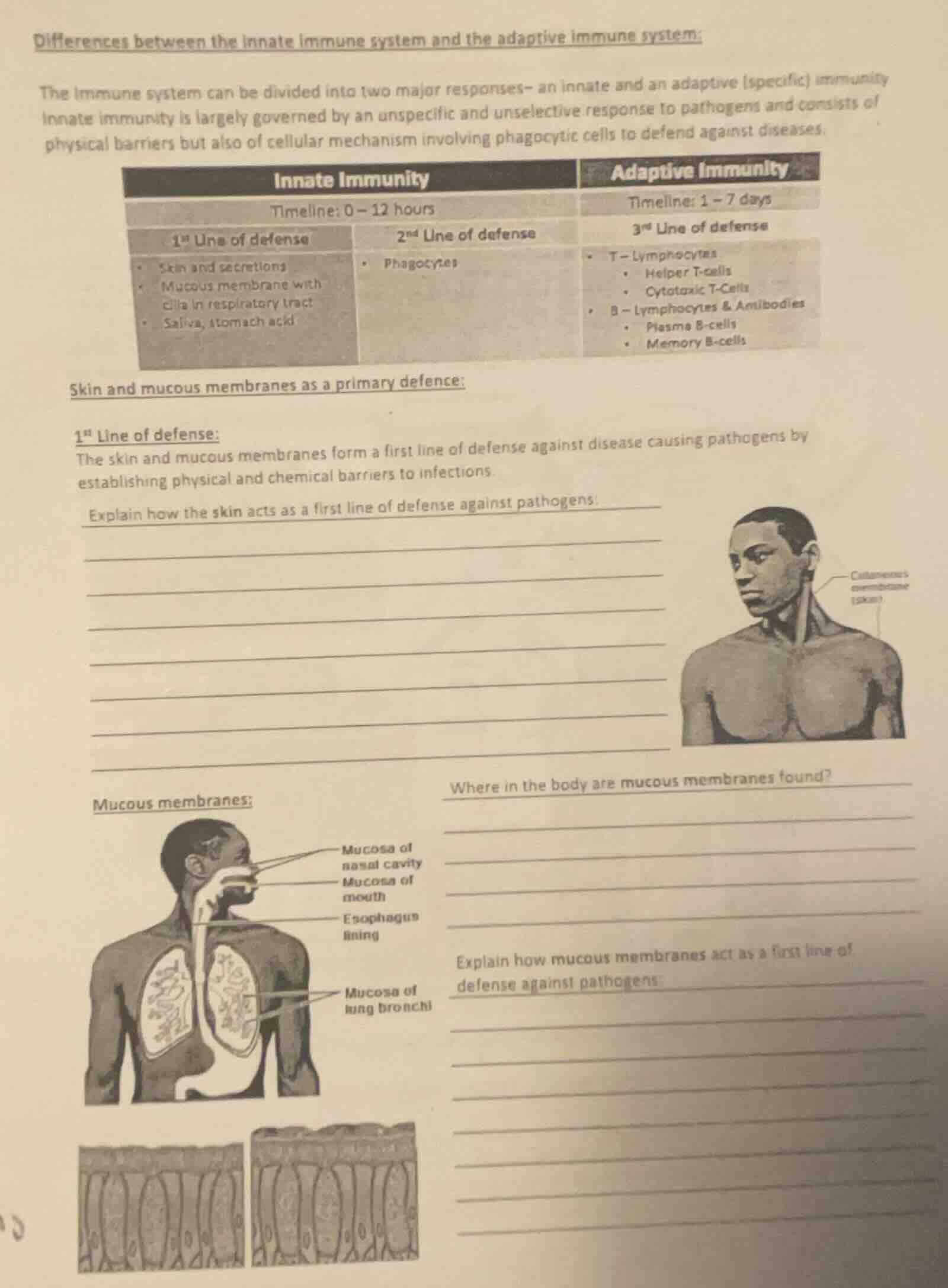
differences between the innate immune system and the adaptive immune system:the immune system can be divided into two major responses- an innate and an adaptive (specific) immunity.innate immunity is largely governed by an unspecific and unselective response to pathogens and consists of physical barriers but also of cellular mechanism involving phagocytic cells to defend against diseases.|innate immunity|adaptive immunity|| ---- | ---- ||timeline: 0-12 hours|timeline: 1-7 days||1st line of defense<br>• skin and secretions<br>• mucous membrane with cilia in respiratory tract<br>• saliva, stomach acid|3rd line of defense<br>• t-lymphocytes<br> • helper t-cells<br> • cytotoxic t-cells<br>• b-lymphocytes & antibodies<br> • plasma b-cells<br> • memory b-cells||2nd line of defense<br>• phagocytes| |skin and mucous membranes as a primary defence:1st line of defense:the skin and mucous membranes form a first line of defense against disease causing pathogens by establishing physical and chemical barriers to infections.explain how the skin acts as a first line of defense against pathogens:mucous membranes:where in the body are mucous membranes found?explain how mucous membranes act as a first line of defense against pathogens:
- For skin as first line of defense: The skin provides a tough, continuous physical barrier that blocks pathogens from entering the body. Additionally, its secretions (like sweat and sebum) have chemical properties that inhibit the growth of many pathogens.
- For locations of mucous membranes: They line the internal cavities and tracts that open to the outside of the body.
- For mucous membranes as first line of defense: They secrete sticky mucus that traps pathogens, and some have hair-like cilia that move trapped pathogens out of the body; their secretions also contain antimicrobial substances that kill or inhibit pathogens.

Snap & solve any problem in the app
Get step-by-step solutions on Sovi AI
Photo-based solutions with guided steps
Explore more problems and detailed explanations
- How the skin acts as a first line of defense:
The skin forms a thick, continuous physical barrier that prevents pathogens from accessing underlying tissues. It also produces acidic secretions (sweat, sebum) that create an environment hostile to many bacteria and fungi, inhibiting their growth and colonization.
- Where mucous membranes are found:
Mucous membranes are found lining the nasal cavity, mouth, esophagus, lung bronchi, as well as other openings/tracts like the digestive tract, urinary tract, and reproductive tract.
- How mucous membranes act as a first line of defense:
Mucous membranes secrete a viscous mucus that traps incoming pathogens. In areas like the respiratory tract, hair-like cilia on the membrane surface move the mucus-trapped pathogens upward out of the body (e.g., to the throat to be coughed or swallowed). The mucus also contains antimicrobial enzymes (like lysozyme) that break down and kill many pathogens, stopping them from invading body tissues.