QUESTION IMAGE
Question
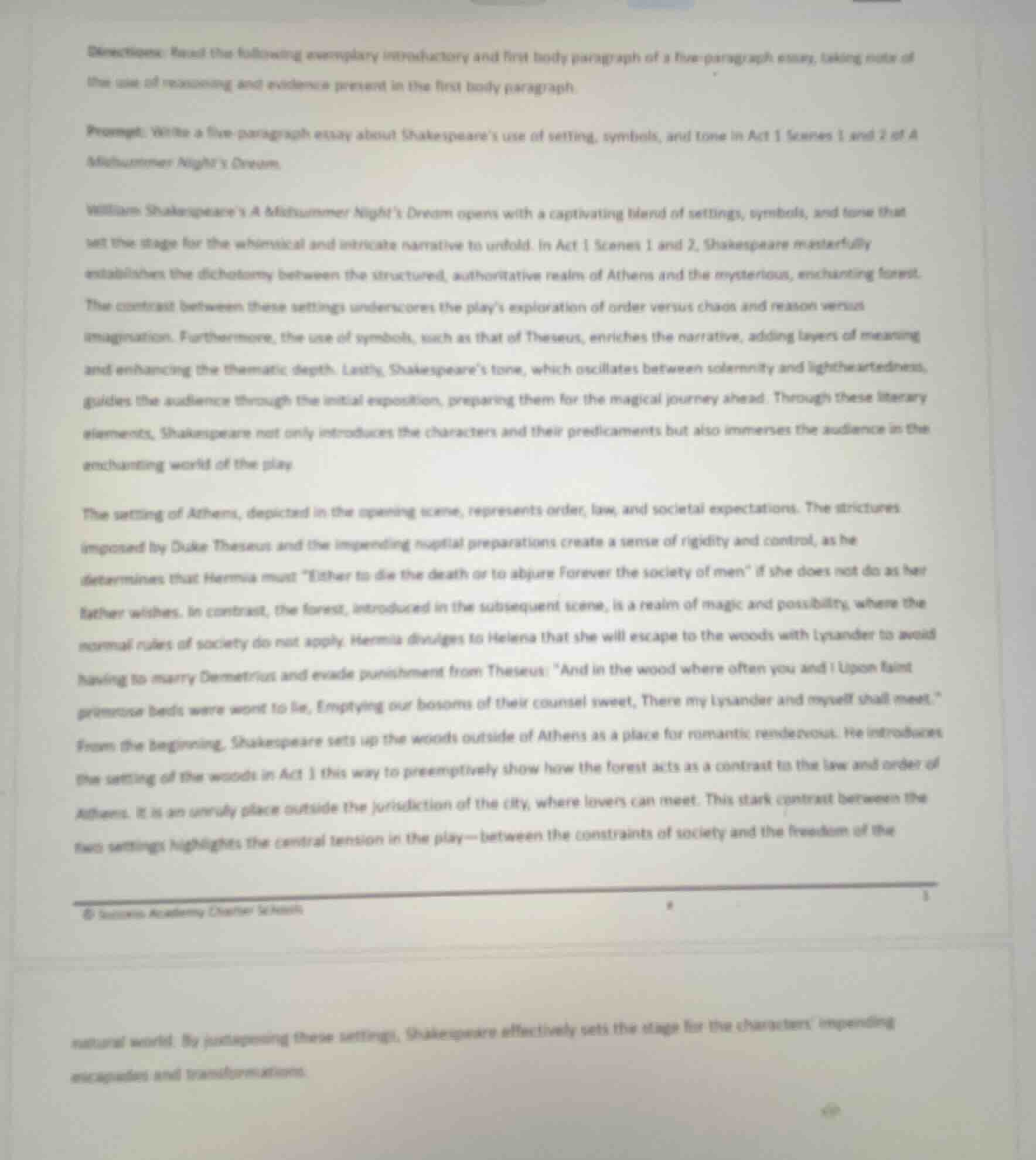
directions: read the following exemplary introductory and first body paragraph of a five - paragraph essay, taking note of the use of reasoning and evidence present in the first body paragraph.
prompt: write a five - paragraph essay about shakespeare’s use of setting, symbols, and tone in act 1 scenes 1 and 2 of a midsummer night’s dream.
william shakespeare’s a midsummer night’s dream opens with a captivating blend of settings, symbols, and tone that set the stage for the whimsical and intricate narrative to unfold. in act 1 scenes 1 and 2, shakespeare masterfully establishes the dichotomy between the structured, authoritative realm of athens and the mysterious, enchanting forest. the contrast between these settings underscores the play’s exploration of order versus chaos and reason versus imagination. furthermore, the use of symbols, such as that of theseus, enriches the narrative, adding layers of meaning and enhancing the thematic depth. lastly, shakespeare’s tone, which oscillates between solemnity and lightheartedness, guides the audience through the initial exposition, preparing them for the magical journey ahead. through these literary elements, shakespeare not only introduces the characters and their predicaments but also immerses the audience in the enchanting world of the play.
the setting of athens, depicted in the opening scene, represents order, law, and societal expectations. the strictures imposed by duke theseus and the impending nuptial preparations create a sense of rigidity and control, as he determines that hermia must “either to die the death or to abjure forever the society of men” if she does not do as her father wishes. in contrast, the forest, introduced in the subsequent scene, is a realm of magic and possibility, where the normal rules of society do not apply. hermia divulges to helena that she will escape to the woods with lysander to avoid having to marry demetrius and evade punishment from theseus: “and in the wood where often you and i upon faint primrose beds were wont to lie, emptying our bosoms of their counsel sweet, there my lysander and myself shall meet.” from the beginning, shakespeare sets up the woods outside of athens as a place for romantic rendezvous. he introduces the setting of the woods in act 1 this way to preemptively show how the forest acts as a contrast to the law and order of athens. it is an unruly place outside the jurisdiction of the city, where lovers can meet. this stark contrast between the two settings highlights the central tension in the play—between the constraints of society and the freedom of the natural world. by juxtaposing these settings, shakespeare effectively sets the stage for the characters’ impending escapades and transformations.
To complete the five - paragraph essay about Shakespeare’s use of setting, symbols, and tone in Act 1 Scenes 1 and 2 of A Midsummer Night’s Dream, we can follow these steps:
Step 1: Write the Second Body Paragraph (Symbols)
Identify and analyze symbols in the scenes
In Act 1, the figure of Theseus serves as a significant symbol. He represents the authority and order of the Athenian society. His edict regarding Hermia's marriage (she must either marry Demetrius, die, or become a nun) symbolizes the rigid social and legal structures that govern the characters' lives in Athens. Another symbol is the forest. It can be seen as a symbol of the unknown, of magic, and of the liberation from social norms. The contrast between Theseus (symbol of order) and the forest (symbol of chaos and freedom) enriches the thematic layer of the play, showing the conflict between societal expectations and individual desires.
Step 2: Write the Third Body Paragraph (Tone)
Analyze the tone in the two scenes
In Scene 1, the tone is somewhat formal and authoritative due to the presence of Theseus and the discussion of legal and social obligations. The dialogue between Theseus, Egeus, Hermia, and Lysander is filled with tension as Hermia defies her father's wishes, and the tone reflects the seriousness of the situation within the structured Athenian society. In Scene 2, as we are introduced to the mechanicals (the group of craftsmen), the tone becomes more light - hearted and comical. Their bumbling attempts to prepare a play for the wedding and their exaggerated personalities create a humorous tone, which also foreshadows the more whimsical events that will take place in the forest. The shift in tone between the two scenes mirrors the shift from the ordered world of Athens to the more chaotic and magical world of the forest.
Step 3: Write the Conclusion Paragraph
Summarize the main points and restate the thesis
In conclusion, Shakespeare’s use of setting, symbols, and tone in Act 1 Scenes 1 and 2 of A Midsummer Night’s Dream is masterful. The contrasting settings of Athens and the forest set up the central conflict between order and chaos. Symbols like Theseus and the forest add depth to the exploration of social norms and individual freedom. The shifting tone, from formal to comical, mirrors the transition between the two worlds and prepares the audience for the events to come. Through these literary devices, Shakespeare not only introduces the characters and their conflicts but also immerses the audience in the enchanting world of the play, setting the stage for the magical and complex narrative that unfolds.
Here is the full five - paragraph essay:
Introduction
William Shakespeare’s A Midsummer Night’s Dream opens with a captivating blend of settings, symbols, and tone that set the stage for the whimsical and intricate narrative to unfold. In Act 1 Scenes 1 and 2, Shakespeare masterfully establishes the dichotomy between the structured, authoritative realm of Athens and the mysterious, enchanting forest. The contrast between these settings underscores the play’s exploration of order versus chaos and reason versus imagination. Furthermore, the use of symbols, such as that of Theseus, enriches the narrative, adding layers of meaning and enhancing the thematic depth. Lastly, Shakespeare’s tone, which oscillates between solemnity and light - heartedness, guides the audience through the initial exposition, preparing them for the magical journey ahead. Through these literary elements, Shakespeare not only introduces the characters and their predicaments but also immerses the audience in the enchanting world of the play.
Body Paragraph 1 (Setting)
The setting of Athens, depicted in the opening scene, represents order, law, and societal expectations. The strictures imposed by Duke Theseus and the impending nuptial preparations create a sense of rigidity and control, as he determines that Hermia must “Either to die the death or to abjure Forever the society of men” if she does not do as her father wishes. In contrast, the forest, introduced in the subsequent scene, is a realm of magic and possibility, where the normal rules of society do not apply. Hermia divulges to Helena that she will escape to the woods with Lysander to avoid having to marry Demetrius and evade punishment from Theseus: “And in the wood where often you and I Upon faint primrose beds were wont to lie, Emptying our bosoms of their counsel sweet, There my Lysander and myself shall meet.” From the beginning, Shakespeare sets up the woods outside of Athens as a place for romantic rendezvous. He introduces the setting of the woods in Act 1 this way to preemptively show how the forest acts as a contrast to the law and order of Athens. It is an unruly place outside the jurisdiction of the city, where lovers can meet. This stark contrast between the two settings highlights the central tension in the play—between the constraints of society and the freedom of the natural world. By juxtaposing these settings, Shakespeare effectively sets the stage for the characters’ impending escapades and transformations.
Body Paragraph 2 (Symbols)
In Act 1, the figure of Theseus serves as a significant symbol. He represents the authority and order of the Athenian society. His edict regarding Hermia's marriage (she must either marry Demetrius, die, or become a nun) symbolizes the rigid social and legal structures that govern the cha…

Snap & solve any problem in the app
Get step-by-step solutions on Sovi AI
Photo-based solutions with guided steps
Explore more problems and detailed explanations
Summarize the main points and restate the thesis
In conclusion, Shakespeare’s use of setting, symbols, and tone in Act 1 Scenes 1 and 2 of A Midsummer Night’s Dream is masterful. The contrasting settings of Athens and the forest set up the central conflict between order and chaos. Symbols like Theseus and the forest add depth to the exploration of social norms and individual freedom. The shifting tone, from formal to comical, mirrors the transition between the two worlds and prepares the audience for the events to come. Through these literary devices, Shakespeare not only introduces the characters and their conflicts but also immerses the audience in the enchanting world of the play, setting the stage for the magical and complex narrative that unfolds.
Here is the full five - paragraph essay:
Introduction
William Shakespeare’s A Midsummer Night’s Dream opens with a captivating blend of settings, symbols, and tone that set the stage for the whimsical and intricate narrative to unfold. In Act 1 Scenes 1 and 2, Shakespeare masterfully establishes the dichotomy between the structured, authoritative realm of Athens and the mysterious, enchanting forest. The contrast between these settings underscores the play’s exploration of order versus chaos and reason versus imagination. Furthermore, the use of symbols, such as that of Theseus, enriches the narrative, adding layers of meaning and enhancing the thematic depth. Lastly, Shakespeare’s tone, which oscillates between solemnity and light - heartedness, guides the audience through the initial exposition, preparing them for the magical journey ahead. Through these literary elements, Shakespeare not only introduces the characters and their predicaments but also immerses the audience in the enchanting world of the play.
Body Paragraph 1 (Setting)
The setting of Athens, depicted in the opening scene, represents order, law, and societal expectations. The strictures imposed by Duke Theseus and the impending nuptial preparations create a sense of rigidity and control, as he determines that Hermia must “Either to die the death or to abjure Forever the society of men” if she does not do as her father wishes. In contrast, the forest, introduced in the subsequent scene, is a realm of magic and possibility, where the normal rules of society do not apply. Hermia divulges to Helena that she will escape to the woods with Lysander to avoid having to marry Demetrius and evade punishment from Theseus: “And in the wood where often you and I Upon faint primrose beds were wont to lie, Emptying our bosoms of their counsel sweet, There my Lysander and myself shall meet.” From the beginning, Shakespeare sets up the woods outside of Athens as a place for romantic rendezvous. He introduces the setting of the woods in Act 1 this way to preemptively show how the forest acts as a contrast to the law and order of Athens. It is an unruly place outside the jurisdiction of the city, where lovers can meet. This stark contrast between the two settings highlights the central tension in the play—between the constraints of society and the freedom of the natural world. By juxtaposing these settings, Shakespeare effectively sets the stage for the characters’ impending escapades and transformations.
Body Paragraph 2 (Symbols)
In Act 1, the figure of Theseus serves as a significant symbol. He represents the authority and order of the Athenian society. His edict regarding Hermia's marriage (she must either marry Demetrius, die, or become a nun) symbolizes the rigid social and legal structures that govern the characters' lives in Athens. Another symbol is the forest. It can be seen as a symbol of the unknown, of magic, and of the liberation from social norms. The contrast between Theseus (symbol of order) and the forest (symbol of chaos and freedom) enriches the thematic layer of the play, showing the conflict between societal expectations and individual desires. The mechanicals’ plans to meet in the forest also add to the forest’s symbolic meaning as a place of creativity and escape from the mundane, as they aim to prepare a play away from the watchful eyes of Athenian society.
Body Paragraph 3 (Tone)
In Scene 1, the tone is somewhat formal and authoritative due to the presence of Theseus and the discussion of legal and social obligations. The dialogue between Theseus, Egeus, Hermia, and Lysander is filled with tension as Hermia defies her father's wishes, and the tone reflects the seriousness of the situation within the structured Athenian society. In Scene 2, as we are introduced to the mechanicals (the group of craftsmen), the tone becomes more light - hearted and comical. Their bumbling attempts to prepare a play for the wedding and their exaggerated personalities create a humorous tone, which also foreshadows the more whimsical events that will take place in the forest. The shift in tone between the two scenes mirrors the shift from the ordered world of Athens to the more chaotic and magical world of the forest, and it also engages the audience by providing a range of emotional experiences.
Conclusion
In conclusion, Shakespeare’s use of setting, symbols, and tone in Act 1 Scenes 1 and 2 of A Midsummer Night’s Dream is masterful. The contrasting settings of Athens and the forest set up the central conflict between order and chaos. Symbols like Theseus and the forest add depth to the exploration of social norms and individual freedom. The shifting tone, from formal to comical, mirrors the transition between the two worlds and prepares the audience for the events to come. Through these literary devices, Shakespeare not only introduces the characters and their conflicts but also immerses the audience in the enchanting world of the play, setting the stage for the magical and complex narrative that unfolds.