QUESTION IMAGE
Question
directions: read the text below. then answer the questions that follow.
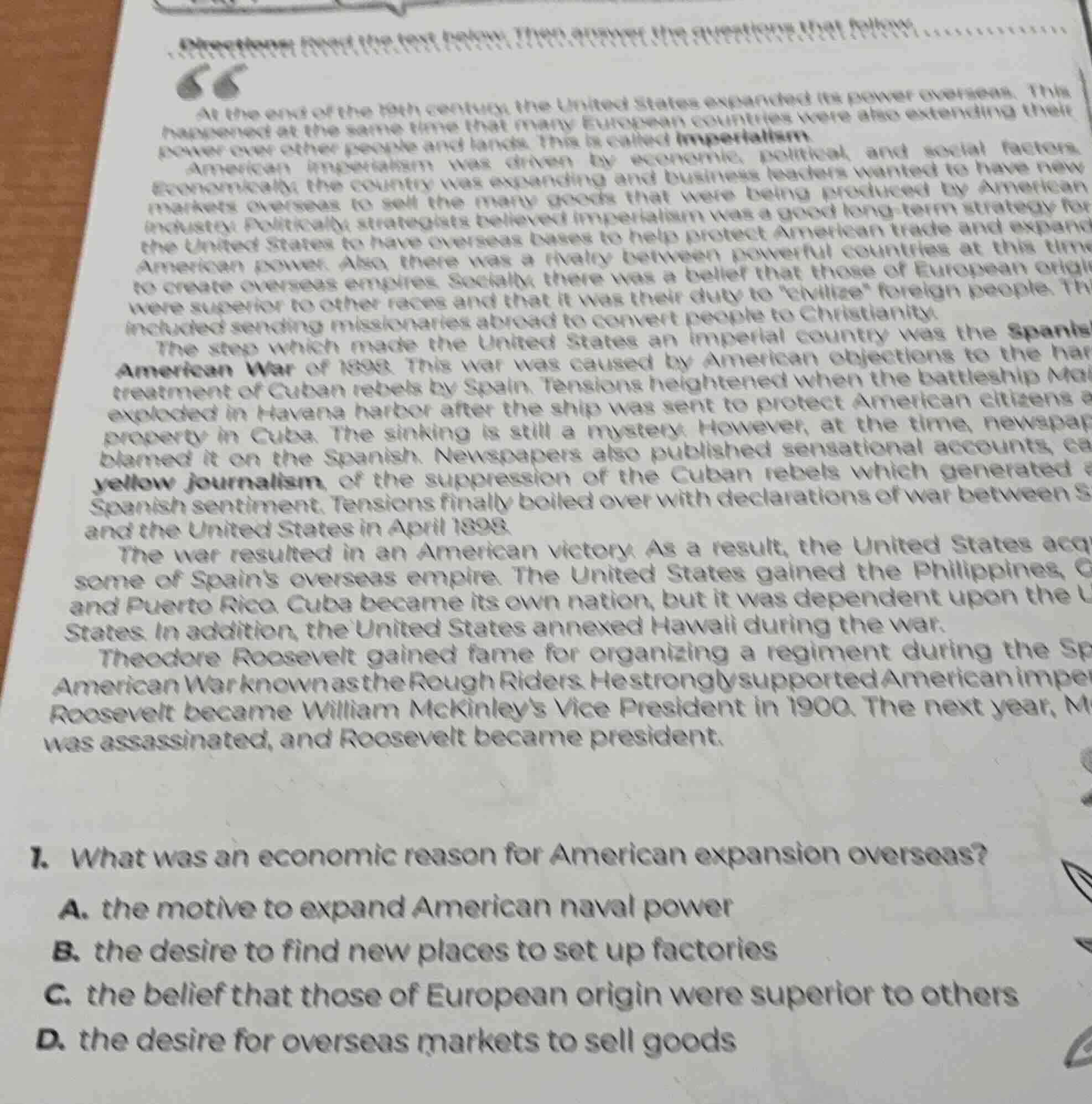
at the end of the 19th century, the united states expanded its power overseas. this happened at the same time that many european countries were also extending their power over other people and lands. this is called imperialism.
american imperialism was driven by economic, political, and social factors. economically, the country was expanding and business leaders wanted to have new markets overseas to sell the many goods that were being produced by american industry. politically, strategists believed imperialism was a good long - term strategy for the united states to have overseas bases to help protect american trade and expand american power. also, there was a rivalry between powerful countries at this time to create overseas empires. socially, there was a belief that those of european origin were superior to other races and that it was their duty to \civilize\ foreign people. this included sending missionaries abroad to convert people to christianity.
the step which made the united states an imperial country was the spanish - american war of 1898. this war was caused by american objections to the harsh treatment of cuban rebels by spain. tensions heightened when the battleship maine exploded in havana harbor after the ship was sent to protect american citizens and property in cuba. the sinking is still a mystery. however, at the time, newspapers blamed it on the spanish. newspapers also published sensational accounts, called yellow journalism, of the suppression of the cuban rebels which generated anti - spanish sentiment. tensions finally boiled over with declarations of war between spain and the united states in april 1898.
the war resulted in an american victory. as a result, the united states acquired some of spains overseas empire. the united states gained the philippines, guam, and puerto rico. cuba became its own nation, but it was dependent upon the united states. in addition, the united states annexed hawaii during the war.
theodore roosevelt gained fame for organizing a regiment during the spanish - american war known as the rough riders. he strongly supported american imperialism. roosevelt became william mckinleys vice president in 1900. the next year, mckinley was assassinated, and roosevelt became president.
- what was an economic reason for american expansion overseas?
a. the motive to expand american naval power
b. the desire to find new places to set up factories
c. the belief that those of european origin were superior to others
d. the desire for overseas markets to sell goods
Para encontrar la razón económica para la expansión estadounidense al extranjero, revisamos el texto: "Económicamente, el país estaba expandiéndose y los líderes empresariales querían tener nuevos mercados en el extranjero para vender la gran cantidad de bienes que producía la industria estadounidense". Analicemos las opciones:
- Opción A: Expansión naval es política/estratégica, no económica.
- Opción B: El texto no menciona establecer fábricas en el extranjero, sino vender bienes en mercados extranjeros.
- Opción C: Esta es una creencia social (sobre superioridad racial), no económica.
- Opción D: Coincide con el motivo económico de vender bienes en mercados extranjeros.

Snap & solve any problem in the app
Get step-by-step solutions on Sovi AI
Photo-based solutions with guided steps
Explore more problems and detailed explanations
D. the desire for overseas markets to sell goods