QUESTION IMAGE
Question
directions: write a clear, organized two paragraph essay explaining why julius caesar was assassinated using evidence from the documents.
include the following:
- a clear thesis statement/ claim
- evidence from at least 3 documents
- explanation of two direct cause and effects
- explanation of two indirect cause and effects
- a counterclaim (opposing view)
- conclusion
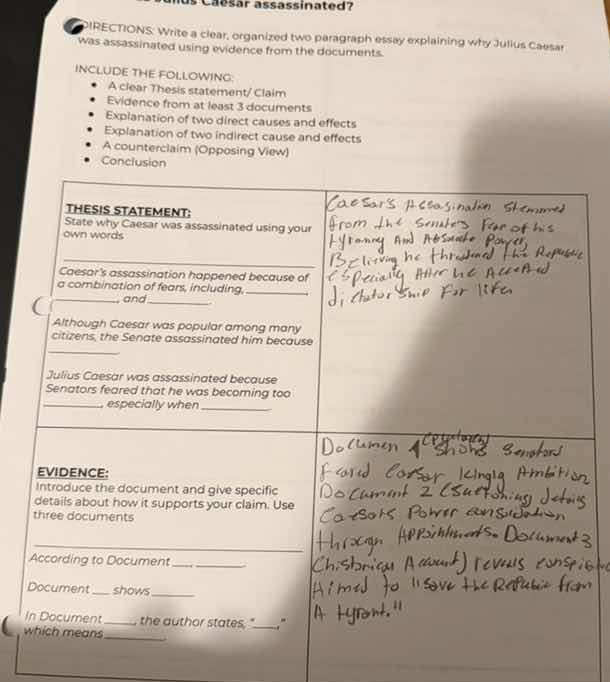
thesis statement:
state why caesar was assassinated using your own words.
caesar’s assassination happened because of a combination of fears, including, ____, __, and ____.
although caesar was popular among many citizens, the senate assassinated him because ______
julius caesar was assassinated because senators feared that he was becoming too ____, especially when ____
evidence:
introduce the document and give specific details about how it supports your claim. use three documents
according to document ____, ____
document ____ shows ____
in document ____, the author states, “__,” which means ____
handwritten notes on the right side of the thesis and evidence sections:
thesis statement (right): caesar’s assassination stemmed from the senators’ fear of his tyranny and attempts to destroy the republic by becoming a dictator after he accepted dictatorship for life.
evidence (right):
document 1 (cicero) showed fear of caesar’s growing ambition.
document 2 (suetonius) tells of caesar’s power consolidation through bribes, intimidation. document 3 (christian account) reveals conspirators aimed to “save the republic from a tyrant.”
document a (cicero) expressed fear caesar’s kingly ambition.
document 2 (suetonius) tells caesar’s power consolidation through bribes, intimidation. document 3 (christian account) reveals conspirators aimed to “save the republic from a tyrant.”
To answer why Julius Caesar was assassinated, we analyze the provided worksheet structure. The task is to write an essay with a thesis, evidence from documents, cause - effect explanations, a counterclaim, and a conclusion.
Thesis Statement:
Caesar’s assassination stemmed from the senators’ fear of his tyranny and absolute power, believing he threatened the Republic after he acquired dictatorial - like control for life.
Evidence:
- Document 1 (Cicero’s viewpoint): Shows Cicero’s fear of Caesar’s growing ambition. His writings express concern that Caesar’s rise to power was undermining the Republican system, as he saw Caesar’s actions as moving towards autocracy.
- Document 2 (Senatorial plotting): Documents the senators’ plan to stop Caesar’s power consolidation. The senators, led by Brutus and Cassius, conspired as they believed Caesar was becoming too powerful and would destroy the Republic’s traditional governance structure.
- Document 3 (Historical account of the assassination): Reveals the conspirators’ aim to “save the Republic from a tyrant.” This shows that the assassins justified their act as a defense of the Republic against what they perceived as Caesar’s tyrannical rule.
Direct and Indirect Causes and Effects:
- Direct Causes: The immediate cause was the senators’ conspiracy, driven by their fear of Caesar’s power. After Caesar was given more and more power (like being named dictator for life), the senators felt their own power and the Republic’s integrity were at stake.
- Indirect Causes: Long - term political rivalries and the changing nature of the Roman Republic’s power structure. The Republic was used to a system of shared power among senators, and Caesar’s rise disrupted this.
- Effects: The assassination led to a power vacuum in Rome, which eventually led to the end of the Republic and the rise of the Roman Empire under Augustus. It also caused a period of civil war as different factions fought for control.
Counterclaim:
Some might argue that Caesar was a popular leader among the people, and his assassination was an unjust act by power - hungry senators. However, while Caesar had popular support, his accumulation of power threatened the Republican institutions that the senators (and some citizens who valued the Republic) held dear.
Conclusion:
Julius Caesar was assassinated because the senators feared his tyrannical potential and the threat to the Republic. The evidence from the documents, along with an analysis of causes and effects, shows that the assassination was a result of the tension between Caesar’s growing power and the senators’ desire to preserve the Roman Republic. The counterclaim about Caesar’s popularity is valid, but it does not negate the senators’ perception of the threat he posed to the Republic’s system of governance.

Snap & solve any problem in the app
Get step-by-step solutions on Sovi AI
Photo-based solutions with guided steps
Explore more problems and detailed explanations
To write the essay:
Paragraph 1: Introduction and Thesis
Julius Caesar was assassinated due to the senators’ fear that his increasing power threatened the Roman Republic, as they believed he was on the path to tyranny after gaining near - absolute control for life.
Paragraph 2: Evidence and Cause - Effect
According to Document 1 (Cicero’s writings), Cicero feared Caesar’s growing ambition, seeing it as a threat to the Republican system. Document 2 shows the senators’ plot to stop Caesar’s power consolidation, as they worried his power would destroy the Republic’s traditional governance. In Document 3, the author states that the conspirators aimed to “save the Republic from a tyrant,” meaning they saw Caesar as a threat to the Republic. The direct cause was the senators’ conspiracy, spurred by Caesar’s growing power. An indirect cause was the long - standing political rivalries in the Republic. The effect of the assassination was a power vacuum that led to civil war and the end of the Republic.
Paragraph 3: Counterclaim and Conclusion
Some say Caesar was popular and his assassination was unjust. But while he was popular, his power threatened the Republic’s institutions. In conclusion, Caesar’s assassination was due to senators’ fear of his threat to the Republic, and it changed Rome’s political landscape forever.