QUESTION IMAGE
Question
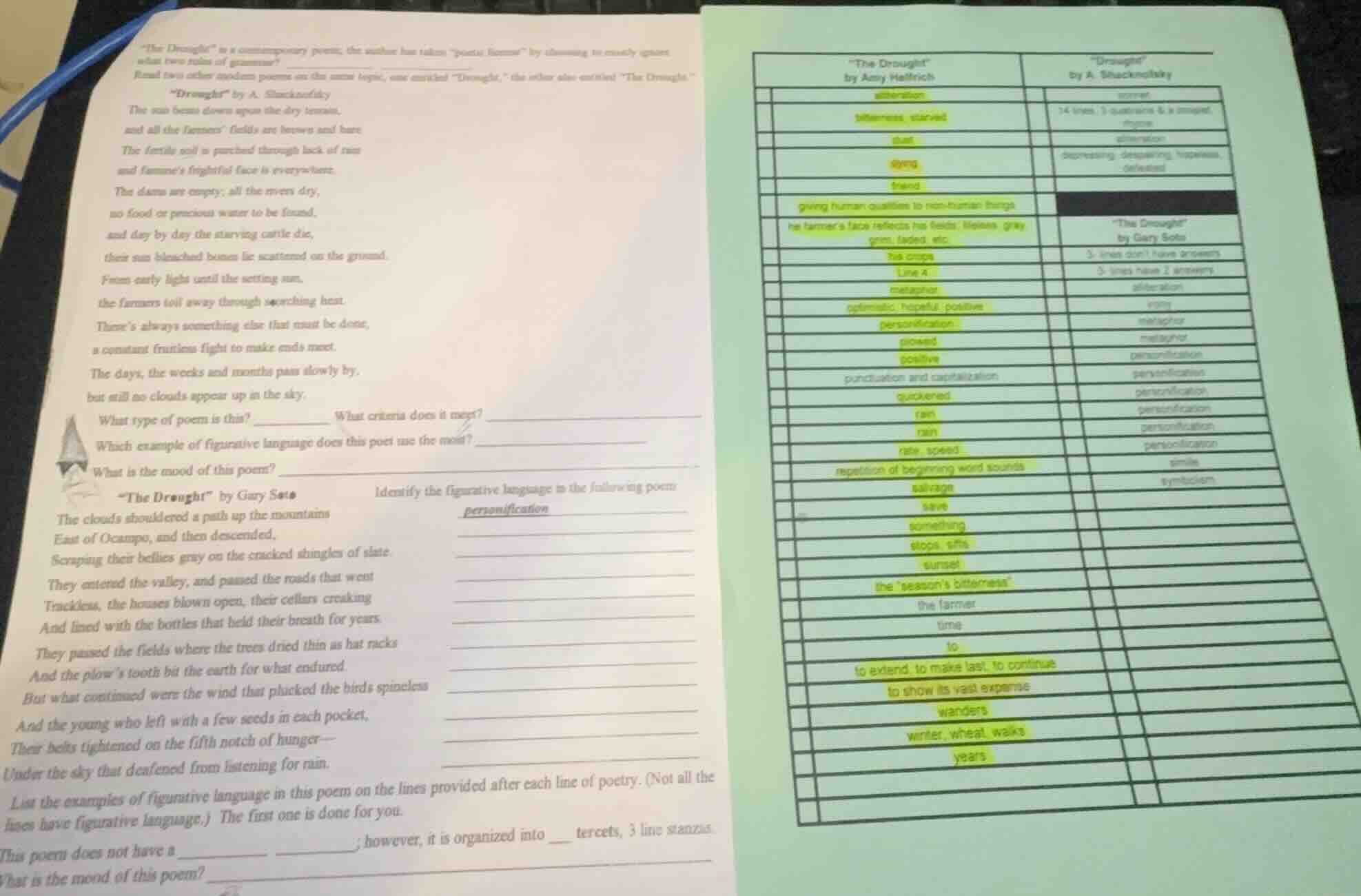
“the drought” is a contemporary poem; the author has taken “poetic license” by choosing to creatly ignore what two rules of grammar?
read two other modern poems on the same topic, one entitled “drought,” the other also entitled “the drought.”
“drought” by a. stackensfdy
the sun beats down upon the dry terrain,
and all the farmers’ fields are brown and bare
the fertile soil is parched through lack of rain
and famine’s frightful face is everywhere.
the dams are empty; all the rivers dry;
no food or precious water to be found,
and day by day the starving cattle die,
their sun bleached bones lie scattered on the ground.
from early light until the setting sun,
the farmers toil away through scorching heat.
there’s always something else that must be done,
a constant fruitless fight to make ends meet.
the days, the weeks and months pass slowly by,
but still no clouds appear up in the sky.
what type of poem is this? ______ what criteria does it meet? __________________
which example of figurative language does this poet use the most? ____________________
what is the mood of this poem? ________________________________________________
“the drought” by gary soto identify the figurative language in the following poem:
the clouds shouldered a path up the mountains personification
east of ocampo, and then descended,
scraping their bellies gray on the cracked shingles of slate.
they entered the valley, and passed the roads that went
trackless, the houses blown open, their cellars creaking
and lined with the bottles that held their breath for years
they passed the fields where the trees dried thin as hat racks
and the plow’s teeth bit the earth for what endured.
but what continued were the wind that plucked the birds spineless
and the young who left with a few seeds in each pocket,
their belts tightened on the fifth notch of hunger—
under the sky that deafened from listening for rain.
list the examples of figurative language in this poem on the lines provided after each line of poetry. (not all the lines have figurative language.) the first one is done for you.
this poem does not have a ______ ___; however, it is organized into _ tercets, 3 line stanzas.
what is the mood of this poem? ________________________________________________
| “the drought” by amy hallrich | “drought” by a. stackensfdy | “the drought” by gary soto |
|---|---|---|
| barren, starved | 14 lines, 3 quatrains & a couplet | 5 lines have 2 answers |
| dull | rhyme | alliteration |
| dying | extension | rain |
| fixed | decreasing, despairing, hopeless, defeated | metaphor |
| giving human qualities to non - human things | metaphor | |
| the farmer’s face reflects his fields: brown, gray, grim, faded, etc. | personification | |
| the crops | personification | |
| line 4 | personification | |
| metaphor | personification | |
| optimistic, hopeful, positive | personification | |
| personification | personification | |
| slowed | personification | |
| positive | personification | |
| punctuation and capitalization | simile | |
| quickened | symbolism | |
| rain | ||
| rain | ||
| rate, speed | ||
| repetition of beginning word sounds | ||
| all rage | ||
| save | ||
| something | ||
| stoops, lifts | ||
| sunset | ||
| the “season’s bitterness” | ||
| the farmer | ||
| time | ||
| to | ||
| to extend, to make last, to continue | ||
| to show its vast expanse | ||
| wanders | ||
| winter, wheat, waits | ||
| years |
For "Drought" by A. Shucknohsky:
- Type of poem & criteria: It is a narrative lyric poem. It tells a story of drought's impact, has a consistent somber tone, follows a loose rhythmic structure, and uses descriptive language to convey emotion.
- Most used figurative language: Personification (e.g., "Famine's frightful face is everywhere," giving famine human features).
- Mood: Despairing, hopeless, and desperate, reflecting the suffering of the land and farmers.
For "The Drought" by Gary Soto:
- Figurative language breakdown (line-by-line):
- Line 2: Scraping their bellies gray on the cracked shingles of slate: Personification (clouds have "bellies" and perform the human action of scraping)
- Line 5: their cellars creaking: Personification (cellars are given the human action of creaking)
- Line 6: And lined with the bottles that held their breath for years: Personification (bottles "hold their breath")
- Line 7: the trees dried thin as hat racks: Simile (comparing dry trees to hat racks using "as")
- Line 8: And the plow's tooth bit the earth: Personification (the plow's "tooth" performs the human action of biting)
- Line 9: the wind that plucked the birds spineless: Personification (wind performs the human action of "plucking")
- Line 11: Under the sky that deafened from listening for rain: Personification (the sky "listens" and is "deafened")
- Missing structure: This poem does not have a rhyme scheme; however, it is organized into tercets (3-line stanzas).
- Mood: Somber, anxious, and weary, capturing the slow, draining despair of the drought.

Snap & solve any problem in the app
Get step-by-step solutions on Sovi AI
Photo-based solutions with guided steps
Explore more problems and detailed explanations
"Drought" by A. Shucknohsky
- Type of poem: Narrative Lyric Poem; Criteria: Tells a story of drought's impact, uses emotional descriptive language, loose rhythmic structure
- Most used figurative language: Personification
- Mood: Despairing, hopeless
"The Drought" by Gary Soto
- Figurative language:
- Line 2: Personification
- Line 5: Personification
- Line 6: Personification
- Line 7: Simile
- Line 8: Personification
- Line 9: Personification
- Line 11: Personification
- Missing structure: Rhyme scheme
- Mood: Somber, weary, anxious